International Cybercrime Prevention Act This bill makes changes to the federal statutory framework commonly known as the Computer Fraud and Abuse Act, which criminalizes various categories of computer-related conduct by individuals who act without authority or in excess of authorization. The bill broadens the scope of prohibited conduct and expands federal enforcement authorities with respect to existing computer fraud and abuse offenses. The bill also creates a new, related criminal offenses for aggravated damage to a critical infrastructure computer and trafficking in botnets.
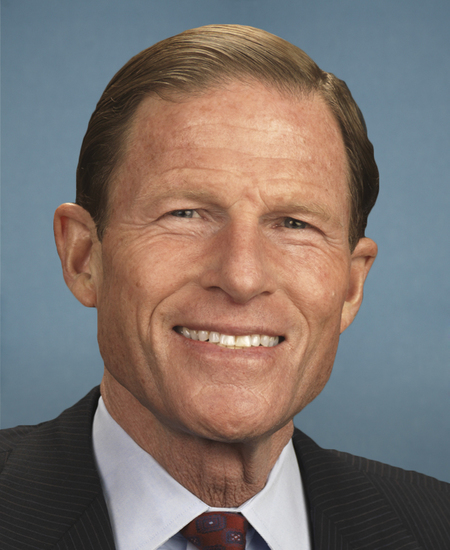
Sen. Richard Blumenthal
Sponsored bills
This joint resolution proposes an amendment to the U.S. Constitution that prohibits slavery and involuntary servitude as a criminal punishment.
This resolution acknowledges and condemns the discrimination against, wrongful termination of, and exclusion from the federal civil service, the Foreign Service, and the Armed Forces of the thousands of lesbian, gay, bisexual, and transgender (LGBT) individuals who were affected by the anti-LGBT policies of the federal government. The resolution expresses that the Senate, on behalf of the United States, apologizes to the affected LGBT military service members, Foreign Service members, veterans, and federal civil service employees and their families. Finally, the resolution reaffirms the commitment of the federal government to treat all military service members, Foreign Service members, veterans, and federal civil service employees and retirees, including LGBT individuals, with equal respect and fairness.
This bill establishes the Alzheimer's Research and Caregiving Trust Fund to pay for research regarding the treatment or cure of Alzheimer's disease and for education, counseling, respite, and other supportive services for individuals with Alzheimer's disease and their families, caregivers, and health care professionals. The bill allows taxpayers an election to contribute a whole dollar amount to the trust fund when they file their tax returns.
Stop Shackling and Detaining Pregnant Women Act This bill prohibits the Department of Homeland Security (DHS) from detaining an individual during pregnancy or postpartum recovery and addresses related issues. DHS must immediately release any detainee found to be pregnant, unless the detainee presents an immediate and serious threat of hurting themselves or others. A DHS detention facility may not use a restraint on a detainee who is known to be pregnant, including during labor, transport to a medical facility or birthing center, and delivery, or during postpartum recovery, except for medical or safety purposes. The bill requires DHS to use the least restrictive restraint necessary and prohibits certain specified restraint types, including four-point restraints and binding hands behind the detainee's back. The bill prohibits DHS detention officers from being present during a detainee's pelvic exam, labor, delivery, or treatment relating to a pregnancy, unless specifically requested by medical personnel. If a detention officer is requested by medical personnel, such officer shall be female, if practicable, and remain at a reasonable distance from the detainee. A pregnant detainee must have access to health care services, including comprehensive services relating to reproductive health care and pregnancy. DHS must provide annual training about this bill's requirements to each employee who has a role in the detention or care of a pregnant detainee or a postpartum parent of a newborn. DHS must also provide each detainee notice of their rights under this bill in the detainee's native language.
Personal Care Products Safety Act This bill requires cosmetics brands and manufacturers to register with the Food and Drug Administration (FDA), provides the FDA with various regulatory authorities, and addresses related issues. Cosmetics brand owners and contract manufacturers must annually register their manufacturing facilities with the FDA. Certain entities and facilities, such as manufacturers with gross sales below certain thresholds, are exempted. Registrants with gross annual sales above certain thresholds must pay a registration fee. Each registration must contain certain information, including an ingredient list for all cosmetic products from a registered facility, with different requirements for registrants that qualify as small businesses. The FDA may suspend a registration for various reasons, including if the registrant's product has a reasonable probability of causing serious adverse health consequences and the problem cannot be isolated to a single product. The FDA must annually conduct a safety review of at least five cosmetics ingredients or nonfunctional constituents and, if appropriate, issue a final finding on the safety of that ingredient or constituent. The FDA must also implement regulations for good cosmetics manufacturing practices. The bill also requires cosmetics brand owners and manufacturers to report to the FDA any serious adverse event associated with their products. The FDA shall have various authorities to regulate cosmetics, including to (1) order a mandatory recall of a product, (2) inspect the records of manufacturers and processors, and (3) require warning labels for certain products. The FDA must issue a proposed rule to ban using intentionally added perfluoroalkyl or polyfluoroalkyl substances in cosmetics.

Juneteenth National Independence Day Act This bill establishes Juneteenth National Independence Day, June 19, as a legal public holiday.
Voices for Veterans Act 2021 This bill expands the membership of the Advisory Committee on Minority Veterans to include veterans who are lesbian, gay, bisexual, transgender, gender diverse, gender non-conforming, intersex, or queer. Among other responsibilities, the committee advises the Department of Veterans Affairs on the administration of benefits and provision of health care, benefits, and services to minority veterans.
Pell Grant Preservation and Expansion Act of 2021 This bill makes various changes to the Federal Pell Grant program, including by expanding student eligibility for Pell Grants. The bill also revises student eligibility for federal student-aid programs. Specifically, the bill provides funding to increase the maximum Pell Grant award for each eligible student. Further, the bill requires the award amount to be adjusted for inflation. Next, the bill allows students who receive means-tested federal benefits (e.g., Medicaid) to automatically qualify for the maximum Pell Grant award plus an additional award amount. In addition, the bill moves the Iraq and Afghanistan Service Grant program into the Pell Grant program. Next, the bill raises from 12 to 18 the total number of semesters during which a student may receive a Pell Grant. The bill makes Dreamer students (i.e., students who have been granted Deferred Action for Childhood Arrivals status) who entered the United States before the age of 18 and who meet certain educational criteria eligible for federal financial aid. The bill also revises satisfactory academic progress requirements for federal student-aid programs, including by allowing a student who has not been enrolled in an institution of higher education for two years to regain eligibility for federal student aid.
Restaurant Revitalization Fund Replenishment Act of 2021 This bill provides an additional $60 billion in FY2021 for the Restaurant Revitalization Fund, which was established to support restaurants and other food and beverage purveyors in response to COVID-19.