

American Innovation and Choice Online Act This bill prohibits certain large online platforms from engaging in specified acts, including giving preference to their own products on the platform, unfairly limiting the availability on the platform of competing products from another business, or discriminating in the application or enforcement of the platform's terms of service among similarly situated users. Further, a platform may not materially restrict or impede the capacity of a competing business user to access or interoperate with the same platform, operating system, or hardware or software features. The bill also restricts the platform's use of nonpublic data obtained from or generated on the platform and prohibits the platform from restricting access to platform data generated by the activity of a competing business user. The bill also provides additional restrictions related to installing or uninstalling software, search or ranking functionality, and retaliation for contact with law enforcement regarding actual or potential violations of law. The bill establishes affirmative defenses for the prohibited conduct. The Federal Trade Commission and the Department of Justice must designate whether an entity is a platform covered by the bill, and both must carry out enforcement activities. The bill also provides for civil penalties, injunctions, and the forfeit of profits for repeat offenders.
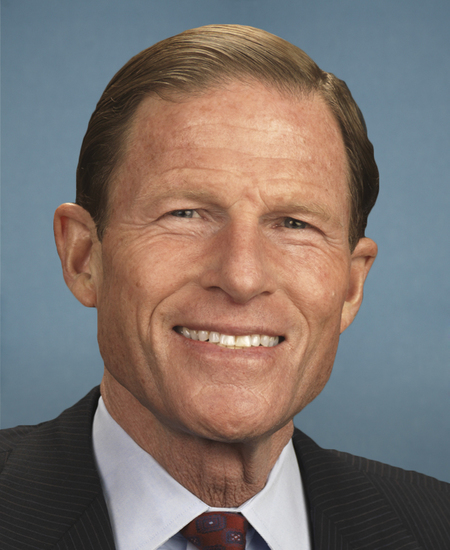
Sen. Richard Blumenthal
Sponsored bills
Highlands Conservation Reauthorization Act of 2021 This bill extends through FY2028 the Highlands Conservation Act, which provides for land conservation in Highlands states (i.e., Connecticut, New Jersey, New York, and Pennsylvania). The bill authorizes the Fish and Wildlife Service to add a municipality to the Highlands region upon the request of a Highlands state. The bill revises the way in which land is identified for conservation to require using the best available science and geographic information systems. The bill allows political subdivisions of states to enter into agreements with the Department of the Interior for land conservation projects. A Highland state that receives funds for a land conservation partnership project may not use more than 5% of the funds to administer that project. The bill extends through FY2028 Forest Service and other Department of Agriculture programs to conserve land and natural resources in the Highlands region.
H-1B and L-1 Visa Reform Act of 2022 This bill modifies requirements related to H-1B (specialty occupation) and L-1 (intracompany transfers) nonimmigrant visas and contains related provisions. Provisions relating to H-1B visas include requiring the Department of Labor to review petitions for indicators of fraud or misrepresentation of material fact; requiring the Department of Homeland Security (DHS) to prioritize certain petitions, with top priority for workers with advanced degrees in science, technology, or engineering; requiring an H-1B worker to possess at minimum a bachelor's degree to meet specialty occupation requirements (currently, relevant experience may be used instead); and prohibiting an alien classifiable in certain H-1B categories from obtaining a B-1 (temporary business visitor) visa. Provisions relating to L-1 visas include requiring a waiver from Labor for an L-1 worker to be primarily stationed with an employer other than the petitioning employer; prohibiting an alien from receiving an L-1 visa to open or be employed in a new office if the alien has received two or more such visas in the last two years; and increasing the L-1 worker minimum wage to the highest of certain amounts, such as the median wage for the worker's occupational classification in the area of employment (currently, an L-1 worker must be paid at least the higher of the federal or state minimum wage). In regards to both visas, the bill (1) expands the authority of DHS and Labor to take various enforcement actions, and (2) directs DHS to conduct annual audits of a certain percentage of employers.
Health Care for Burn Pit Veterans Act This bill updates policies and procedures related to Department of Veterans Affairs (VA) health care and benefits for veterans who have been exposed to toxic substances. Specifically, the bill extends the eligibility period for VA hospital care, medical services, and nursing home care for combat veterans who served after September 11, 2001, and were exposed to toxic substances, radiation, or other conditions, including those who did not enroll to receive VA care during the eligibility period. The VA must incorporate into its existing health care screening a screening to help determine potential exposures to toxic substances during military service. Among other requirements, the VA must also provide annual training to health care and benefits personnel with respect to veterans who were exposed to toxic substances; analyze total and respiratory disease mortality in veterans who served in specified locations on specified dates; conduct an epidemiological study on the health trends of veterans who served in the Armed Forces after September 11, 2001; conduct a study to determine trends in the rates of the incidence of cancer in veterans; publish a list of VA resources for veterans who were exposed to toxic substances, families and caregivers of such veterans, and survivors of such veterans who are receiving death benefits; and report on the data quality of the Individual Longitudinal Exposure Record and its usefulness in supporting veterans in receiving VA health care and benefits.
Harriet Tubman Bicentennial Commemorative Coin Act This bill directs the Department of the Treasury to mint and issue 50,000 $5 gold coins, 400,000 $1 silver coins, and 750,000 half-dollar clad coins emblematic of the legacy of Harriet Tubman as an abolitionist. The Secretary may issue coins under this bill only during the period of January 1, 2024, through December 31, 2024. All surcharges received by Treasury from the sale of such coins must be paid equally to the National Underground Railroad Freedom Center in Cincinnati, Ohio, and The Harriet Tubman Home, Inc. in Auburn, New York, for the purpose of accomplishing and advancing their missions.
This concurrent resolution recognizes that people with disabilities experience barriers to access every day and pledges to make universal and inclusive design a guiding principle for all infrastructure bills and projects.
Maddy summaryThis Senate resolution (SRES 526) formally condemns the antisemitic terrorist attack at Congregation Beth Israel Synagogue in Colleyville, Texas, on January 15, 2022, where hostages were held at gunpoint. It expresses gratitude that no lives were lost, applauds law enforcement and emergency responders for their actions, and condemns antisemitism in the United States. The resolution does not create new policies or allocate funds; it is a symbolic expression of support for the Jewish community and law enforcement. It directly affects the congregation and local community by affirming their safety and the importance of religious freedom.
Maddy summaryThis resolution designates February 28, 2022, as "Rare Disease Day" in the U.S. Senate. It symbolically recognizes the importance of raising awareness about rare diseases (affecting fewer than 200,000 people in the U.S.), improving early diagnosis, and supporting global efforts to develop treatments for these conditions. The resolution does not create new policies or funding but aligns with the annual global observance of Rare Disease Day, first recognized in the U.S. in 2009 and observed in over 100 countries. It acknowledges the challenges faced by the estimated 7,000+ rare diseases affecting roughly 1 in 10 Americans.
This resolution recognizes Black History Month as an opportunity to reflect on U.S. history and to commemorate the contributions of African Americans. It calls for the United States to (1) honor the contribution of pioneers who helped to ensure its legacy; and (2) move forward as a nation "indivisible, with liberty and justice for all."
Maddy summarySRES 520 is a ceremonial Senate resolution designating the week of February 21-25, 2022, as "Public Schools Week." It does not create new laws, allocate funding, or directly affect any individuals or institutions. The resolution uses symbolic language to highlight the importance of public education in the U.S. but contains no policy changes or actionable provisions. As a procedural resolution, it serves only to recognize public schools during that specific week.