Territories Medicare Prescription Drug Assistance Equity Act of 2022 This bill makes certain subsidies under the Medicare prescription drug benefit available to beneficiaries who reside in Puerto Rico or another U.S. territory. Current law makes such beneficiaries ineligible for premium and cost-sharing subsidies, but establishes a process for U.S. territories to apply for financial assistance with respect to the provision of Medicare prescription drugs. The bill eliminates this process and makes the subsidies available to beneficiaries who reside in a U.S. territory and are otherwise eligible.
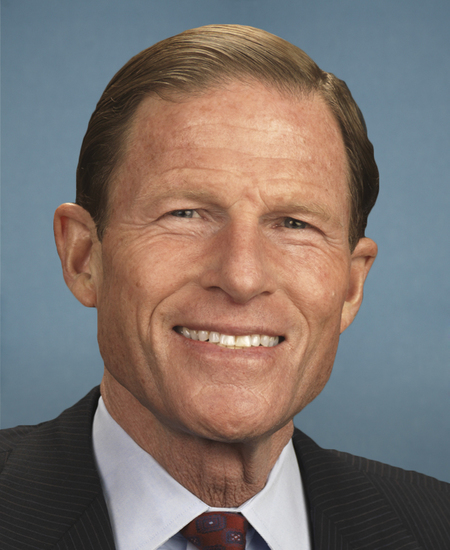
Sen. Richard Blumenthal
Sponsored bills
Women and Climate Change Act of 2022 This bill addresses climate change and its effects on women and girls. Specifically, the bill establishes the Federal Interagency Working Group on Women and Climate Change within the Department of State. The bill outlines the functions of the working group, including the coordination of agencies' policies and activities relating to combating the effects of climate change on women and improving the government's response to and strategy for climate change. In addition, the Office of Global Women's Issues of the State Department must submit a strategy to prevent and respond to the effects of climate change on women.
This resolution designates March 2022 as National Women's History Month. The resolution also recognizes the celebration of such month as a time to reflect on the contributions that women have made to the United States.
Ban Russian Energy Imports Act This bill declares that a national emergency exists with respect to the aggression of Russia against Ukraine. During this emergency, the President must prohibit the importation of crude oil, petroleum, petroleum products, liquefied natural gas, and coal in which Russia or a Russian national has any interest. The bill exempts products that are already loaded or in transit at the time of this bill's enactment.
This resolution condemns violence and threats of violence against historically Black colleges and universities (HBCUs) and reaffirms the federal government's commitment to combating violence against HBCU students, faculty, and staff.
Striking Workers Healthcare Protection Act This bill prohibits an employer from terminating or significantly altering the employer-provided health insurance coverage of an employee engaged in a lawful strike. An employer that violates this prohibition is subject to a maximum civil penalty of $50,000 for each violation.
Arbitration Fairness for Consumers Act This bill deems as invalid or unenforceable a predispute arbitration agreement or joint-action waiver related to a consumer financial product or service.
Continued Waiver of Interest on State Unemployment Loans during the Pandemic Act This bill extends the waiver on interest on State Unemployment Loans from September 6, 2021, to September 30, 2022.
Making Pipelines Accountable to Consumers and Taxpayers Act or the MPACT Act This bill revises the authority of the Federal Energy Regulatory Commission (FERC) regarding rates and charges in connection with the transportation or sale of natural gas. Specifically, the bill provides FERC the authority to set refund effective dates by which natural gas companies must pay refunds for changes in rates or charges that are unjust, unreasonable, unduly discriminatory, or preferential.
Comprehensive Access to Resources and Education for Long COVID Act or the CARE for Long COVID Act This bill requires multiple agencies to carry out research and other activities concerning individuals experiencing post-acute sequelae of COVID-19, or PASC, including health disparities related to this condition. PASC refers to persistent, long-term symptoms following recovery from acute COVID-19. First, the bill requires the Patient-Centered Outcomes Research Trust Fund to support a patient registry to collect information on the symptoms, treatments, demographics, and other relevant data of individuals with confirmed or suspected PASC. Second, the Department of Health and Human Services must, along with relevant agencies (1) conduct or support research on the U.S. health care system's response to long-term symptoms of COVID-19; and (2) develop resources about PASC or other post-viral illnesses, including about their potential impact on rights associated with employment, disability status, and education. Third, the Centers for Disease Control and Prevention must disseminate information about the common symptoms, treatment options, and other topics that pertain to PASC and related post-infectious illnesses. Fourth, the Centers for Medicare & Medicaid Services must expand its Chronic Conditions Data Warehouse to collect data on items and services furnished through Medicaid or the Children's Health Insurance Program to individuals who experience PASC. Last, the Administration for Community Living must award grants or contracts to states, health care providers, legal services providers, and other eligible entities for expanding access to legal assistance for individuals with PASC.