

Trillion Trees Act This bills establishes a variety of requirements and incentives to plant trees and conduct other land management practices for the purposes of capturing and storing carbon in domestic and international trees and forests. Additionally, the bill provides incentives to research or develop other carbon sequestration tools. Specifically, the bill directs the Department of Agriculture (USDA) to set targets to increase forest carbon stock through January 1, 2100, for the purposes of sequestering and storing carbon in U.S. forests. It also establishes and provides funding for the Trillion Trees Challenge Fund to provide grants to nonfederal entities for activities related to reforestation efforts on public or private lands. In addition, it raises the cap on the Reforestation Trust Fund to enhance forest health in the National Forest System and requires the USDA to establish a Tree City USA Grant Program. The bill also allows the U.S. Agency for International Development to enter into an agreement with a nonprofit organization to establish an International Forest Foundation to promote reforestation and prevent deforestation. Additionally, it establishes requirements and incentives to address seedling shortages and support nurseries. Finally, the bill provides market incentives to research or develop other carbon sequestration tools relating to biochar, sustainable building practices, biochemical and bioplastic products, and biomass energy.
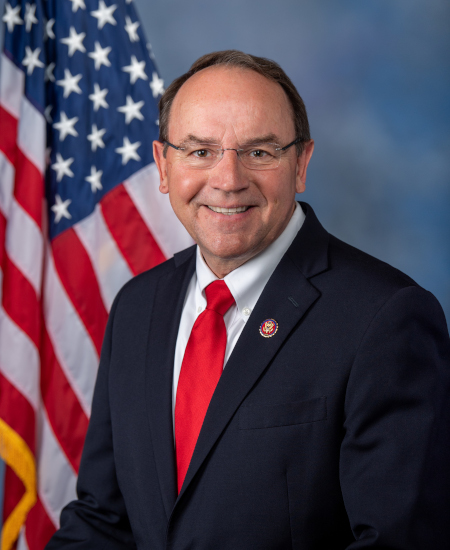
Rep. Thomas P. Tiffany
Sponsored bills
Flexible Financing for Rural America Act This bill allows rural utility service providers to submit to the Department of Agriculture (USDA) a request to adjust the interest rate or modify the terms of certain loans. The request shall include a report summarizing how the adjustment or modification will assist the borrower in providing critical utility services to a rural community. Specifically, on receipt of a request, USDA or the Department of the Treasury (in the case of a loan owned by the Federal Financing Bank) must adjust the interest rate on the loan to match certain interest rates for obligations of comparable maturity to the term remaining on the loan (or a higher rate requested by the borrower), and make modifications to the loan terms as necessary to address changes in the financial position of the borrower due to the COVID-19 public health emergency and to promote the financial sustainability of the borrower. In carrying out the adjustments or modifications, USDA or Treasury shall not impose or collect any fee from, or impose any penalty on, a borrower. The bill also provides funding to implement the adjustments and modifications and for the liquidation of residual intragovernmental amounts owed by the Federal Financing Bank in connection with certain loans.
Codifying Useful Regulatory Definitions Act or the CURD Act This bill provides statutory authority for a definition of natural cheese . Under the bill, natural cheese is defined as cheese that is produced from animal milk or certain dairy ingredients and is produced in accordance with established cheese-making standards.
Protect Speech Act This bill modifies the immunity from liability of a provider or user of an interactive computer service (e.g., a social media company) for screening and blocking offensive content on its platform. Specifically, the bill provides that this immunity shall not apply to any action taken to restrict access to or availability of material provided by another information content provider unless the action is taken in good faith based on an objectively reasonable belief that the material is (1) obscene, lewd, lascivious, filthy, excessively violent, promoting terrorism or violent extremism, harassing, promoting self-harm, or unlawful; or (2) violates the applicable terms of service or use. In order to avoid liability for taking action based on either belief, certain good faith requirements must be met, such as (1) making publicly available terms of service or use that plainly state the criteria for content moderation practices, and (2) not restricting access to or availability of material on deceptive grounds. Further, the bill specifies that being responsible in whole or in part for the creation or development of information includes instances in which a person or entity solicits, comments upon, funds, or affirmatively and substantively contributes to, modifies, or alters information provided by another person or entity.
Saving American History Act of 2021 This bill prohibits the use of federal funds by an elementary or secondary school to teach the 1619 Project or by a local educational agency (LEA) to support its teaching in public schools. (The 1619 Project is an initiative that addresses the beginning of slavery in the United States.) Specified federal agencies must reduce federal funds in a prorated amount to an elementary or secondary school that teaches this project or an LEA that supports its teaching in public schools. However, federal funding shall not be reduced for programs for low-income students (e.g., free or reduced-price lunch) or students with disabilities.
Accessing America's Critical Minerals Act of 2021 This bill establishes deadlines to complete the environmental review of critical mineral projects on federal land and sets forth related requirements to expedite the review of such projects under the National Environmental Policy Act of 1969 (NEPA). If an environmental assessment or environmental impact statement is required for such project, then all necessary federal review and permit considerations must be completed within 18 or 24 months, respectively. However, the review may exceed the time limit if the project sponsor agrees. The lead agency of the environmental review of such project must allow a state or local government, an Indian tribe, a project sponsor, or another appropriate entity to assume certain federal responsibilities regarding the environmental review of the project upon the request of such entity. Further, the bill authorizes a lead agency to determine that the requirements of NEPA have been satisfied if a state or federal agency acting under state or federal law has addressed specified factors, such as the environmental impact of the action to be conducted under the permit. If the lead agency does not make such a determination, then the agency must enter into an agreement with the project sponsor to set time limits for each part of the permitting process.
This bill prohibits the Department of the Interior, during 2021, from using the COVID-19 pandemic or any issue related to the pandemic as a basis for restricting or limiting outdoor recreational use of land or water administered by the National Park Service.
This resolution condemns the rocket attacks by Hamas against Israel beginning the week of May 9, 2021. It also states that the United States must continue to invest in and support Israel's security and sovereignty.
United States Army Rangers Veterans of World War II Congressional Gold Medal Act This bill provides for the award of a single Congressional Gold Medal to the U.S. Army Rangers Veterans of World War II in recognition of their dedicated service during World War II.
Defenders of Bataan and Corregidor Congressional Gold Medal Act This bill provides for the award of a Congressional Gold Medal to the troops from the United States and the Philippines who defended Bataan and Corregidor, in recognition of their personal sacrifice and service during World War II.