

Maddy summaryHR 8766 allows flags to be displayed upright and secured directly beside the graves of deceased military members (per Title 10) or veterans (per Title 38) at national cemeteries. This amendment to Title 4 of the U.S. Code modifies existing flag display rules by explicitly permitting this adjacent placement. The bill specifically affects how flags are displayed at veterans' gravesites in national cemeteries nationwide. It changes the current regulation that restricted flag placement to the grave itself.
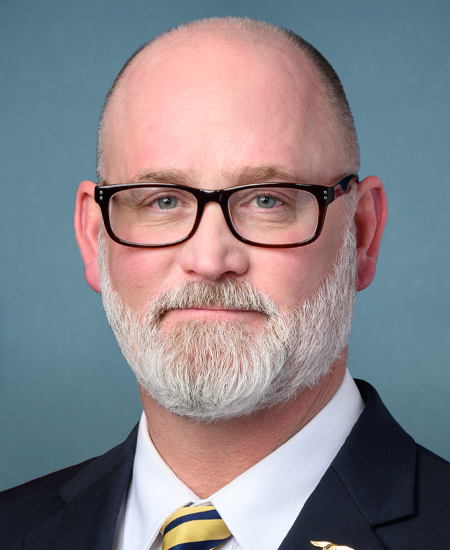
Rep. Derrick Van Orden
Sponsored bills
Maddy summaryHR 5012 (SHINE for Autumn Act of 2023) authorizes federal funding to improve stillbirth research and data collection. It provides $5 million annually for states to collect standardized stillbirth data (including risk factors) while protecting privacy, $1 million annually for developing public educational materials and data collection guidelines, and $3 million annually for medical fellowships training pathologists in perinatal autopsy and stillbirth research. The bill directly affects state health departments, medical professionals (like obstetricians and pathologists), and families who experience stillbirth by improving data quality for future research. It requires federal reports on guidelines and program effectiveness within five years but does not provide direct medical care or financial assistance to families.
Maddy summaryHR 537 authorizes a Congressional Gold Medal to honor 60 diplomats who saved Jewish lives during the Holocaust by issuing visas and passports against their governments' orders, risking expulsion and personal danger. The medal will be presented to the next of kin of these diplomats, alongside representatives from their home countries, and permanently displayed at the United States Holocaust Memorial Museum. The bill also permits the sale of bronze duplicates to cover production costs, with proceeds going to the U.S. Mint. This legislation recognizes the diplomats' humanitarian actions without creating new government programs or altering existing laws.
Maddy summaryThis resolution (HRES 1281) commemorates the 100th anniversary of the Upper Mississippi River National Wildlife and Fish Refuge, established by Congress in 1924. It recognizes the refuge's role in protecting over 250,000 acres of habitat for wildlife - including birds, fish, and mammals - and supporting annual recreational visits (4 million visitors) and regional economic activity ($125 million). The resolution honors the refuge's contributions to conservation, scientific research, and the Mississippi Flyway migratory corridor. As a ceremonial resolution, it does not create new laws or funding requirements but formally celebrates the refuge's century-long conservation mission.
Maddy summaryThis resolution (HRES 1272) calls on the Biden Administration to seek symbolic censure of Iran at the International Atomic Energy Agency (IAEA) for violating nuclear nonproliferation agreements and to refer Iran's case to the United Nations Security Council. It urges diplomatic action to prevent Iran from acquiring nuclear weapons, citing Iran's enrichment of uranium to 60% purity, obstruction of IAEA inspections, and development of advanced centrifuges. The resolution does not create new law but formally requests specific international diplomatic steps from the U.S. government.
Maddy summaryHR 5403, the CBDC Anti-Surveillance State Act, prohibits the Federal Reserve from issuing or facilitating central bank digital currency (CBDC) directly or indirectly to individuals through financial institutions. It specifically bans Federal Reserve banks from offering digital products to individuals, maintaining individual accounts, or using CBDC for monetary policy implementation. The bill also clarifies that its restrictions do not apply to existing physical cash or private, permissionless digital payment systems. This bill directly affects the Federal Reserve's ability to develop or deploy a government-run digital dollar. The law aims to prevent the Federal Reserve from creating a digital currency that could enable transaction tracking or government oversight of personal financial activity.
Maddy summaryHJRES 152 is a congressional resolution seeking to block an Environmental Protection Agency (EPA) rule on managing coal ash waste from power plants, specifically for older disposal ponds (legacy CCR surface impoundments). The rule, published on May 8, 2024, established requirements for electric utilities to handle coal ash, including safety standards for existing disposal sites. If passed, this resolution would prevent the EPA rule from taking effect, removing the compliance requirements for utilities. This directly affects electric utilities that manage coal ash and the EPA's regulatory authority over waste disposal practices.
Maddy summaryHR 8466 extends the Affordable Connectivity Program (ACP) through 2024 with $6 billion in funding, directly affecting low-income households receiving subsidized broadband internet. It strengthens eligibility verification by requiring use of the National Verifier, limiting eligibility to households with school meal program participation (not just provider programs), and mandating collection of partial Social Security numbers for verification. The bill adds new antifraud controls and performance measures for the FCC, requiring a report on program effectiveness within a year. It also allows households switching providers to maintain benefits only if they've used the current service for at least 180 days.
Maddy summaryThis bill amends the 2022 Camp Lejeune Justice Act to clarify and correct technical details. It updates eligibility requirements for claimants (requiring 30 days at Camp Lejeune and defining "latent harm" instead of "latent disease"), clarifies court jurisdiction for cases, and specifies attorney fee structures (20% pre-litigation, 25% post-litigation). The changes directly affect individuals who developed health issues due to contaminated water at Camp Lejeune, streamlining their legal process under the existing 2022 law.
Maddy summaryThe EV Fair Trade Act of 2024 requires electric vehicle (EV) companies receiving federal assistance (like grants or loans) to certify they do not use forced labor or child labor in their supply chains - from mineral extraction to final assembly. Companies must submit certifications to the Labor Department’s Bureau of International Labor Affairs, which will maintain a public database tracking valid certifications. Failure to certify or providing false certification results in denial of federal aid and potential $250,000 fines for false allegations; additionally, non-compliant companies lose tax credits for manufacturing during the period of non-compliance. The law expires after 7 years, with annual audits of 10% of certifications and public reporting on compliance.