Maddy summaryThis bill (HR 7199) renames a U.S. Postal Service facility in Muskego, Wisconsin (located at S74w16860 Janesville Road) as the "Colonel Hans Christian Heg Post Office." It updates all official federal references to this specific location to use the new name. The bill has no policy impact beyond administrative naming and affects only the postal facility and related government documents. It was signed into law on November 25, 2024.
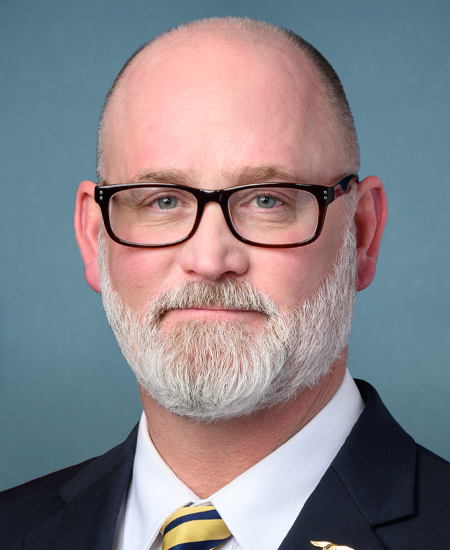
Rep. Derrick Van Orden
Sponsored bills
Maddy summaryHR 6651 designates the U.S. Postal Service facility at 603 West 3rd Street in Necedah, Wisconsin, as the "Sergeant Kenneth E. Murphy Post Office Building." The bill updates all official government references (including laws, maps, and documents) to use this new name for the building. This is a commemorative act with no policy changes or direct impact beyond renaming the facility. The bill was signed into law on November 25, 2024.
Maddy summaryThis bill renames a U.S. Postal Service facility at 220 Fremont Street in Kiel, Wisconsin, as the "Trooper Trevor J. Casper Post Office Building." It directly affects the postal service location and all federal documents referencing it. The bill’s key provision updates all official references (laws, maps, records) to use the new name. No policy changes or funding are involved - this is a purely ceremonial naming resolution.
Maddy summaryThe Working Dog Commemorative Coin Act (HR 807) directs the U.S. Treasury to mint three types of commemorative coins honoring working dogs' service: $5 gold coins, $1 silver coins, and half-dollar coins with specific weight and composition requirements. Each coin will carry a surcharge ($35 for $5 coins, $10 for $1 coins, $5 for half-dollars) that will be paid directly to America's VetDogs to support their programs providing service dogs for veterans, the disabled, and others. The coins will be issued in 2027 with designs reflecting working dogs' roles in military, detection, therapy, and assistance work. The legislation specifies that all surcharge revenue must fund America's VetDogs' operations without creating new government programs. This is a commemorative measure focused on honoring working dogs' contributions through coin sales, with all surcharge funds going to a specific nonprofit organization.
Maddy summaryHRES 1594 is a symbolic House resolution supporting the designation of "National Rural Health Day," observed annually on the third Thursday of November. It recognizes rural health care providers and the communities they serve, highlighting challenges like hospital closures, workforce shortages, and access barriers in rural areas. The resolution expresses the House's commitment to improving rural health care accessibility and affordability but does not create new laws or allocate funding. It is a non-binding gesture aligning with an existing observance since 2011, organized by the National Rural Health Association.
Maddy summary# Summary of Veterans' Affairs Bill This comprehensive legislation (likely the 2024 version of the "Senator Elizabeth Dole 21st Century Veterans Healthcare and Benefits Improvement Act") addresses multiple aspects of veterans' benefits and services across several key areas: ## Key Provisions 1. **Healthcare Modernization** - Requires machine-readable format for disability benefit questionnaires - Mandates modernization of electronic health record systems - Improves telehealth access for homeless veterans - Establishes new standards for health information technology 2. **Disability Benefits** - Modernizes disability benefit questionnaires - Implements automatic processing for certain temporary disability ratings - Prohibits non-licensed health care professionals from performing medical disability examinations - Requires provision of agent/attorney contact information to health care professionals 3. **Homelessness Support** - Increases per diem payments for homeless veterans' services - Authorizes use of funds for food, shelter, transportation, and communication technology - Creates a strategic plan for homeless veteran services - Expands access to telehealth services for homeless veterans 4. **Native American Veteran Housing** - Expands direct housing loans for Native American veterans - Creates a Native community development financial institution relending program - Requires adequate personnel dedicated to Native American veteran housing - Expands outreach programs for Native American veterans 5. **Burial and Memorial Affairs** - Expands burial allowances for veterans who die at home while receiving hospice care - Updates definitions of surviving spouse 6. **Employment and Training** - Improves reemployment rights for veterans - Creates Warrior Training Advancement Course - Establishes pilot program for veterans in conservation and resource management positions 7. **Transparency and Accountability** - Requires 90-day notice before implementing policy changes - Improves transparency of educational institutions serving veterans - Establishes new reporting requirements for various programs The bill contains numerous technical corrections, updates to existing statutes, and new provisions designed to improve veterans' access to benefits, healthcare, housing, and employment opportunities, with particular attention to underserved veteran populations including Native American veterans, homeless veterans, and veterans with disabilities.
Maddy summary# Summary of Proposed Higher Education Act Amendments This document outlines significant proposed amendments to the Higher Education Act of 1965, primarily as part of the "College Cost Reduction Act." The key elements include: ## Accreditation Reform - Major overhaul of accreditation standards, requiring accrediting agencies to demonstrate independence from trade associations - New requirements for accrediting agencies to assess student achievement outcomes, including median value-added earnings relative to median total price charged - Introduction of an "Alternative Quality Assurance Experimental Site Initiative" to test non-accredited institutions - Protections for religious institutions, including a new process for appealing accreditation decisions related to religious mission - Removal of "litmus tests" that would require institutions to support specific political viewpoints ## Student Success Initiatives - Establishment of "Postsecondary Student Success Grants" to increase participation, retention, and completion rates for high-need students - Focus on evidence-based practices, with tiered requirements (tier 1, 2, and 3 reforms) - Mandatory inclusion of high-need student populations (low-income, first-generation, military-connected, etc.) - Requirements for institutions to report on completion rates, retention rates, and student demographics ## Regulatory Changes - Repeal of numerous existing regulations including: * Closed school discharges * Borrower defense to repayment * Pre-dispute arbitration * False certification requirements * Ability-to-benefit rules * Financial responsibility regulations - New restrictions on incentive compensation for recruiters - Changes to third-party servicer definitions and regulations ## Transfer and Credit Policies - New requirement that institutions cannot deny transfer credit based solely on the source of accreditation - Requirements for transparent transfer policies - Changes to reverse transfer policies ## Other Key Provisions - Modifications to the National Advisory Committee on Institutional Quality and Integrity (NACIQI) - New definitions for "total price" and "value-added earnings" - Changes to the process for institutions to change accrediting agencies - New requirements for institutions to report on student outcomes The overall focus of these proposed amendments is to reduce regulatory burden on institutions, promote transparency, improve student outcomes (particularly for high-need students), modernize accreditation processes, and protect religious institutions' rights in accreditation decisions.

Maddy summaryThis bill provides one-time financial assistance to U.S. farmers growing specific crops (like corn, soybeans, wheat, cotton, and rice) during the 2024 crop year if their expected costs exceed expected returns. Payments equal 60% of the difference between the expected cost of production per acre (based on USDA cost forecasts) and the expected gross return per acre (based on projected farm prices and yields). Payments are calculated using actual planted acreage plus 50% of acreage prevented from planting due to natural disasters, with annual caps of $175,000 or $350,000 depending on the farm’s primary income source. The program uses existing USDA data sources and applies standard farm payment limits.
Maddy summaryThis bill modifies how disability benefits are treated for homeless disabled veterans seeking housing assistance. It excludes certain disability payments (under Chapter 11 or 15 of Title 38, U.S. Code) from income calculations when determining eligibility for HUD-assisted housing programs, including the supported housing program under Section 8(o)(19) and housing on Department property. Specifically, it ensures these benefits are not counted toward income for housing eligibility, though they still count for "adjusted income" definitions. The bill directly affects disabled veterans applying for HUD housing assistance who receive these specific disability benefits. It makes a concrete change to income calculation rules without altering benefit amounts or creating new funding.
Maddy summaryThis bill requires the Department of Veterans Affairs (VA) to establish standard practices for all suicide prevention and mental health grant or pilot programs run through the Veterans Health Administration. It mandates these programs must set clear, measurable goals, create detailed evaluation plans for data collection and analysis, and regularly share progress with relevant stakeholders. The VA must also conduct thorough post-program evaluations to assess effectiveness and share successful strategies. These rules apply to all such programs, regardless of when they began, ensuring consistent, evidence-based approaches to preventing veteran suicide.