

Saving the Civil Service Act This bill generally prohibits changes to the classification of positions in the competitive service and excepted service unless certain conditions are met. (Competitive service positions are subject to competitive examination while excepted service positions are appointed under one of five schedules. Competitive service positions have notice and appeal requirements for adverse actions that are not applicable to most excepted positions, including those of a confidential, policy-determining, policy-making, or policy-advocating character under Schedule C.) On October 21, 2020, President Donald Trump issued an executive order that placed executive agency positions that are of a confidential, policy-determining, policy-making, or policy-advocating character, and that are not normally subject to change as a result of a presidential transition, under a new Schedule F in the excepted service. The order was subsequently revoked by President Joe Biden. The bill prohibits executive agency positions in the competitive service from being placed in the excepted service, unless such positions are placed in a schedule in the excepted service as in effect on September 30, 2020. The bill also prohibits positions in the excepted service from being placed in any schedule other than the aforementioned schedules. Additionally, agencies may not (1) transfer occupied positions from the competitive or excepted service into Schedule C without the consent of the Office of Personnel Management, or (2) transfer employees in the excepted service to another schedule or transfer employees in the competitive service to the excepted service without employee consent.
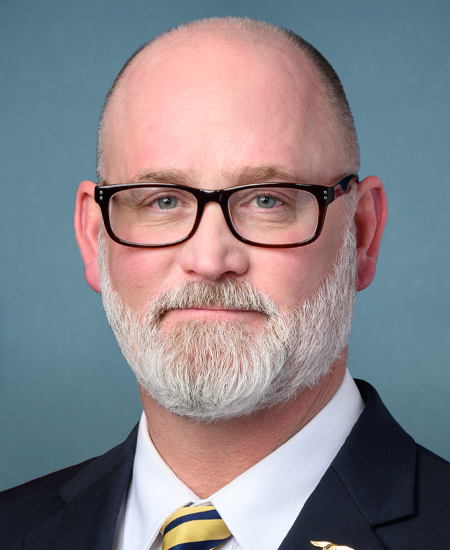
Rep. Derrick Van Orden
Sponsored bills
Maddy summaryHRES 706 is a procedural resolution that, if passed, would remove Ms. Omar from the House Committees on the Budget and Education and Workforce. It directly affects her committee assignments for the current congressional term, changing her role in those committees. The resolution was introduced by Rep. Carter and others and referred to the Committee on Ethics for review. This is a purely administrative change to committee membership, not a policy or law.
Maddy summaryHR 5352 prohibits federal funding for any entity employing individuals who condone or celebrate political violence and domestic terrorism, as defined under 18 U.S.C. §2331. This applies to all federal funds - grants, contracts, or other disbursements - to organizations that hire such individuals. The bill directly affects federal grant recipients and contractors, requiring them to ensure their employees do not engage in these activities to maintain funding eligibility. The policy change is a direct funding restriction based on employee conduct, with no additional mechanisms or exceptions specified in the text.
Maddy summaryHRES 702 is a symbolic resolution condemning the September 10, 2025, assassination of Charlie Kirk, founder of Turning Point USA and a conservative political activist. It expresses condolences to his family, praises first responders, and reaffirms the right to peaceful assembly. As a non-binding resolution, it does not create new laws or policies but serves as a formal statement of condemnation. The resolution directly addresses the House of Representatives' stance on this event, with no direct impact on constituents or legislation.
Maddy summaryHR 5268, the FAIR Trucking Act, changes federal court jurisdiction for certain trucking accident lawsuits. It gives federal courts original jurisdiction over civil cases involving bodily harm or death from commercial motor vehicles (like large trucks) in interstate commerce, provided the damages exceed $5 million and involve parties from different states or a foreign entity. This primarily affects accident victims seeking compensation and interstate trucking companies, shifting these high-value cases from state to federal courts. The bill does not alter liability rules but changes where such cases must be filed.
Maddy summaryThis bill ensures U.S. Border Patrol Agents and Customs and Border Protection officers who continue working during a government shutdown receive their salaries. It authorizes funding from the Treasury for fiscal year 2026 to cover their salaries and expenses during any lapse in discretionary appropriations. The measure specifically applies to employees "excepted from furlough," meaning those required to work during shutdowns. It does not change eligibility for pay but guarantees funding for these personnel during funding gaps.
Maddy summaryThe FIREARM Act (HR 3770) changes how federal firearm licensees (like dealers) handle violations of firearms laws. It requires the Attorney General to give licensees 30 business days to correct minor, self-reported violations - such as clerical errors - with assistance and training, instead of automatically revoking licenses. The bill also adds a 15-day window for licensees to challenge revocations in federal court, where courts must review the case anew and only uphold revocations if the licensee willfully violated the law. Additionally, it applies retroactively to licensees whose licenses were revoked under a 2021 enforcement policy, allowing them to reapply if they meet compliance requirements.
Maddy summaryHR 3593, the Title VIII Nursing Workforce Reauthorization Act of 2025, reauthorizes and expands federal funding for nursing education programs to address workforce shortages. It directly affects nursing schools, nurse practitioner, nurse-midwifery, nurse anesthesia, and clinical nurse specialist programs by expanding grant eligibility to include these specific training pathways. Key provisions include increasing annual funding from $137 million to $184 million (2026-2030), requiring schools to use funds for simulation/technology resources and faculty/student expansion, and adding clinical partnerships with healthcare facilities. The bill also updates terminology and adds protections for survivors of domestic violence and sexual assault in nursing education settings.
Maddy summaryHR 5133, the Patients’ Right to Know Their Medication Act of 2025, requires drug manufacturers to provide standardized printed patient medication information (PMI) with each prescription dispensed in non-hospital settings. This PMI must include clear, plain-language details on drug name, usage instructions, warnings, side effects, storage, disposal, and interactions - formatted consistently with readable text and graphics. The bill directly affects patients receiving prescriptions, ensuring they get accessible, non-promotional printed information to improve safety and reduce errors. The FDA would establish regulations within one year of enactment, mandating that manufacturers include this standardized PMI on prescription drug packaging.
Maddy summaryThis bill prohibits Members of Congress, their spouses, and dependent children from owning or trading certain investments, including stocks, commodities, and derivatives (referred to as "covered investments"). It requires affected individuals to divest these investments within 90-180 days, with specific exemptions for Treasury bonds, diversified mutual funds, small business interests, and family trusts meeting strict conditions. Violations incur penalties of 10% of the investment's value plus disgorgement of profits, paid directly to the U.S. Treasury. The law applies to all covered individuals during federal service, with exceptions for investments acquired through inheritance or occupational trading (e.g., a spouse’s finance job).