

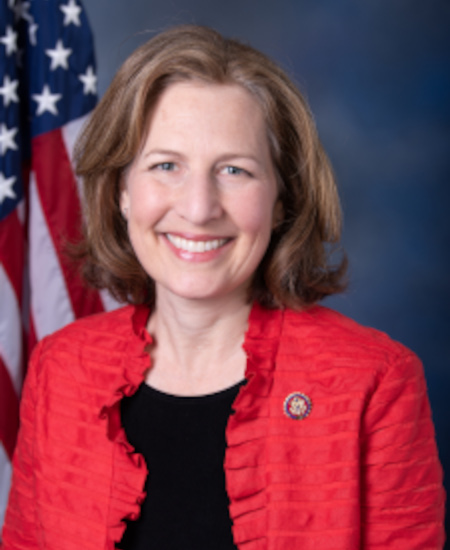
Photo of Kim Schrier
D United States House · District 8 · Washington On the 2026 ballot

Rep. Kim Schrier

Compare
Total votes
2,837
all sessions
Attendance
99%
24 missed
Near the chamber average
With party
94%
of cast votes
Lower than 83% of chamber peers
Bipartisan score
3%
crosses aisle rarely
Higher than 82% of chamber peers
Sponsored
1,071
bills & resolutions
Near the chamber average
Committees
4
assignments
1,071 bills and resolutions

Sponsored bills

Total
1,071
Primary
73
Co-sponsor
998
This page
1,071
matching current filters
Co-sponsor HR 6834
In committee · Indiana House · Co-sponsor
STORE Act of 2025

Maddy summaryHR 6834 (STORE Act of 2025) increases annual funding for the Emergency Food Assistance Program (EFAP) from $15 million to $25 million (2026-2030) and expands grant eligibility to include state agencies and tribal, low-income, and remote community organizations. It allows grants to support mobile/home food delivery, refrigerated truck purchases, and cold storage infrastructure for food banks and pantries. The bill also requires the USDA to produce a national report within two years assessing refrigeration storage shortages and costs for emergency food organizations. These changes directly affect state agencies administering EFAP and food distribution networks serving communities with food insecurity.

In committee May 20, 2026 1 co-sponsor
Co-sponsor HR 6780
In committee · Indiana House · Co-sponsor
Producing Real Opportunities for Technology and Entrepreneurs Investing in Nutrition Act

Maddy summaryThis bill creates federal programs to advance alternative protein production through biomanufacturing and bioprocessing. It authorizes $15 million annually for research centers focused on protein diversification, $50 million for grants to companies building food biomanufacturing facilities, and $25 million for workforce development programs. The bill also requires a national strategy on protein security coordinated across multiple federal agencies. These provisions aim to strengthen food supply chains, create jobs in the growing protein sector, and reduce reliance on foreign commodities. The bill explicitly excludes insect-based food production from its scope.

In committee May 20, 2026 1 co-sponsor
Co-sponsor HR 210
In committee · Indiana House · Co-sponsor
Dental Care for Veterans Act

Dental Care for Veterans Act This bill expands eligibility for veterans for dental care provided by the Department of Veterans Affairs (VA). Specifically, the bill makes all veterans who are enrolled in the VA health care system eligible for VA-provided dental services. Currently, only veterans who have a service-connected dental issue or meet other narrow criteria are eligible for certain dental services. The bill phases in eligibility over four years based upon existing eligibility, degree of service-connected disability or other disability, prisoner of war status, award of a Purple Heart, financial need, or VA health care eligibility.

In committee May 20, 2026 1 co-sponsor
Co-sponsor HRES 1301
In committee · Indiana House · Co-sponsor
Supporting the designation of May 29, 2026, as "Mental Health Awareness in Agriculture Day" to raise awareness around mental health in the agricultural industry and workforce and to continue to reduce stigma associated with mental illness.

Maddy summaryThis resolution designates May 29, 2026, as "Mental Health Awareness in Agriculture Day" to highlight mental health issues within the farming and agricultural workforce. It aims to reduce the stigma surrounding mental illness by acknowledging the unique stressors faced by producers and workers, such as unpredictable weather, labor shortages, and market fluctuations. The bill also draws attention to available support resources, specifically the Farm and Ranch Stress Assistance Network, and encourages the public to observe the day as a way to promote well-being in the industry.

In committee May 19, 2026 1 co-sponsor
Co-sponsor HR 8891
In committee · Indiana House · Co-sponsor
Rural MOMS Act of 2026

Maddy summaryThe Rural MOMS Act of 2026 modifies how Medicare counts hospital beds, specifically excluding labor and delivery rooms from the total number of acute care inpatient beds used to determine if a facility qualifies as a Critical Access Hospital. This change directly affects rural hospitals that provide maternity services by altering the financial thresholds required to maintain their special status under the Medicare program. By removing delivery rooms from the bed count calculation, the bill aims to prevent these facilities from losing their designation solely because they offer childbirth care. The legislation does not change how these hospitals are funded or operated, but rather adjusts the metric used to evaluate their eligibility for critical access benefits.

In committee May 19, 2026 1 co-sponsor
Co-sponsor HR 8811
In committee · Indiana House · Co-sponsor
Moms Matter Act

Maddy summaryThe Moms Matter Act directs the Department of Health and Human Services to create two main grant programs aimed at improving maternal mental health and reducing health disparities among pregnant and postpartum individuals. The first program provides funding to community organizations and healthcare providers to expand services that integrate mental health care into prenatal and postpartum settings, with a specific focus on groups facing higher risks of mortality and morbidity. The second program offers grants to educational institutions to train and recruit a diverse workforce of mental health professionals who specialize in caring for pregnant and postpartum patients. Both initiatives require recipients to submit annual reports on their activities and outcomes, while the legislation authorizes $25 million and $15 million respectively for each program from fiscal years 2027 through 2031.

In committee May 14, 2026 1 co-sponsor
Co-sponsor HR 8807
In committee · Indiana House · Co-sponsor
Maternal Health Pandemic Response Act

Maddy summaryThe Maternal Health Pandemic Response Act allocates $200 million to the Centers for Disease Control and Prevention to improve data collection, surveillance, and research on how public health emergencies affect pregnant and postpartum individuals. This funding supports efforts to gather detailed demographic information on maternal health outcomes, establish regional centers of excellence, and expand surveys to better reach underrepresented communities. The legislation also requires the CDC to make this data publicly available in a disaggregated format while protecting patient privacy, and mandates public education campaigns to ensure accurate information reaches families and healthcare providers. Additionally, the bill creates a diverse task force to develop federal recommendations for respectful maternity care during emergencies, addressing issues such as telehealth access, doula coverage, and the treatment of mental health and substance use disorders. These measures aim to reduce health disparities and improve care quality for pregnant people from racial and ethnic minority groups during public health crises.

In committee May 14, 2026 1 co-sponsor
Co-sponsor HR 3159
In committee · Indiana House · Co-sponsor
Improving SCRA Benefit Utilization Act

Improving SCRA Benefit Utilization Act This bill expands interest rate protections under the Servicemembers Civil Relief Act (SCRA) and requires expanded training for and outreach to servicemembers regarding financial literacy and SCRA protections. The SCRA caps the maximum interest charged on any debt incurred by a servicemember prior to entering active duty at 6% annually if the servicemember's ability to pay is materially affected by active-duty status; servicemembers must provide notice and other documentation to creditors to receive this cap. The bill requires creditors to apply this cap to all of a servicemember’s obligations or liabilities with that creditor, regardless of whether a certain obligation or liability was specifically mentioned in the required notice provided by the member to invoke SCRA rights. Further, the bill requires creditors to provide all necessary mechanisms to ensure a servicemember is able to submit any required documentation. The bill also requires that the financial literacy training program provided to servicemembers include information about consumer financial protections afforded to such members and their dependents, including protections regarding interest rate limits under the SCRA. Additionally, the bill requires the military department concerned to provide written notice of benefits under the SCRA to servicemembers at the time they first enter military service and, for members of the reserve components, at the time they first enter service in the reserves and at any time when they are mobilized or ordered to active duty for more than 30 days.

In committee May 14, 2026 1 co-sponsor
Co-sponsor HR 2853
Passed · Indiana House · Co-sponsor
Combating Organized Retail Crime Act of 2025

Maddy summaryThis bill would amend federal law to strengthen penalties for organized retail crime by expanding definitions of theft to include digital goods, gift cards, and setting a $5,000 aggregate value threshold for charges over a 12-month period. It would establish a new "Organized Retail and Supply Chain Crime Coordination Center" under Homeland Security to coordinate Federal, State, local, and Tribal law enforcement efforts against cross-jurisdictional theft groups. The Center would share information with retailers, transportation companies, and law enforcement agencies, track crime trends, and produce annual reports on organized retail crime. This legislation directly affects retailers, supply chain businesses, and law enforcement agencies, while targeting organized crime groups responsible for a 93% increase in larceny incidents and rising safety concerns for retail employees. The bill aims to address significant financial losses and supply chain disruptions noted in the National Retail Federation's 2023 data.

Passed May 13, 2026 1 co-sponsor
Co-sponsor HR 8698
In committee · Indiana House · Co-sponsor
Lower Prices at the Pump Act

Maddy summaryThe Lower Prices at the Pump Act prohibits businesses from selling gasoline or petroleum distillates at prices deemed unconscionably excessive during a specific period tied to potential military operations against Iran. This ban applies to both wholesale and retail transactions and remains in effect until the President certifies that military operations have ceased and the Strait of Hormuz is fully open. To enforce these rules, the Federal Trade Commission will investigate violations using its existing powers, while state attorneys general can also file civil lawsuits to stop unfair pricing or seek compensation for affected residents. Penalties for breaking the law include fines of up to $500 million, and any money collected from these penalties will be placed in a fund to assist low-income households with home energy costs.

In committee May 7, 2026 1 co-sponsor
Showing 51 to 60 of 1,071 bills
Previous 1 … 5 6 7 … 108 Next