

This bill requires the Department of Defense (DOD) to conduct outreach to build awareness among former members of the Armed Forces of the process established for the review of discharge characterizations related to sexual orientation (i.e., on the basis of Don't Ask, Don't Tell or a similar policy). DOD must also provide for specified relief for former members of the Armed Forces who were impacted by the discharge characterizations and ensure that DOD oral historians review related facts and receive testimony from affected individuals.
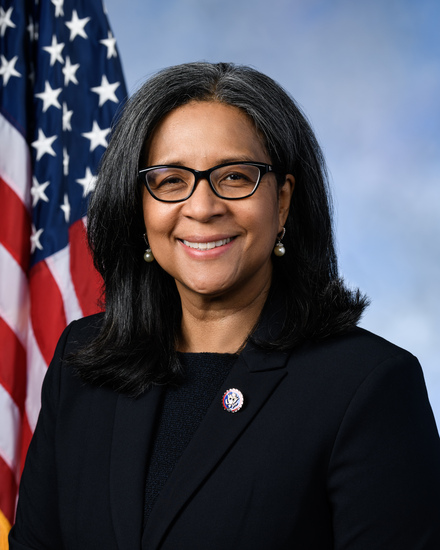
Rep. Marilyn Strickland
Sponsored bills
Israel Relations Normalization Act of 2021 This bill requires the Department of State to take certain actions promoting the normalization of relations between Israel, Arab states, and other relevant countries and regions. Specifically, the State Department must develop a strategy on expanding and strengthening the Abraham Accords (the term used to refer collectively to agreements between Israel and the United Arab Emirates and between Israel and Bahrain marking the public normalization of relations between the two Arab countries and Israel). The strategy must include a description of how the U.S. government will encourage further normalization of relations with Israel. In addition, the State Department must report on options for U.S. international efforts to promote the strengthening of ties between Israel, Arab states, and other relevant countries and regions. The State Department must also report on the status of the normalization of relations with Israel, including information on (1) laws that punish individuals for people-to-people relations with Israelis (i.e., anti-normalization laws), and (2) evidence of steps taken by Arab governments toward permitting or encouraging normalized relations between their citizens or residents and Israeli citizens.
Veteran Families Health Services Act of 2021 This bill addresses fertility treatments, counseling, and other health-related programs for veterans and members of the Armed Forces. Specifically, the bill requires the Department of Defense (DOD) and the Department of Veterans Affairs (VA) to provide fertility treatments and counseling to covered veterans and active duty service members or a spouse, partner, or gestational surrogate of such veteran or service member. A covered veteran or service member is a former or current member of the Armed Forces who has an infertility condition, unless it is demonstrable that the individual was completely infertile prior to serving in the Armed Forces. In the case of in vitro fertilization treatment, DOD and the VA may not furnish more than three completed cycles or six attempted cycles, whichever occurs first. DOD must establish procedures related to gamete retrieval and storage. Additionally, DOD must provide service members with the opportunity to cryopreserve and store their gametes prior to deployment to a combat zone or a hazardous duty assignment. DOD and the VA must share best practices and facilitate referrals for the furnishing of fertility treatment and counseling to eligible individuals. Fertility counseling and treatment are included within authorized VA medical services. The VA may pay the adoption expenses (for up to three adoptions) for a covered member who is enrolled in the VA health care system. The VA must facilitate specified reproduction and infertility research conducted collaboratively by DOD and the Department of Health and Human Services.
Debt Ceiling Reform Act This bill authorizes the Secretary of the Treasury to increase the public debt limit. Under current law, the debt limit restricts the amount of funds that the Department of the Treasury may borrow to fund the federal government.
Eliminating a Quantifiably Unjust Application of the Law Act of 2021 or the EQUAL Act of 2021 This bill eliminates the federal sentencing disparity between drug offenses involving crack cocaine and powder cocaine. Currently, different threshold quantities of crack cocaine and powder cocaine (e.g., 28 grams of crack cocaine and 500 grams of powder cocaine) trigger the same statutory criminal penalties. This bill eliminates the lower quantity thresholds for crack cocaine offenses. Under the bill, the same threshold quantities of crack cocaine and powder cocaine trigger the same statutory criminal penalties. The change applies to future cases and cases pending on the date of enactment. With respect to past cases, the bill authorizes a sentencing court to impose a reduced sentence on a defendant who was convicted or sentenced for a specified crack cocaine offense before this bill's enactment. A defendant does not have to be present at the sentence reduction hearing. Finally, the bill prohibits the reduction of a sentence that was previously reduced.
This bill requires the Department of the Interior to establish a grant program for plant genetics and genomics research related to (1) making riparian forests (e.g., forests on river banks) become more resilient to climate change and invasive species; and (2) providing critical habitat for animals and plants that are suffering from lost, degraded, or threatened habitat.
2020 WHIP+ Reauthorization Act This bill expands disaster indemnity programs through which the Department of Agriculture provides payments to agricultural producers for crop and milk losses resulting from hurricanes, wildfires, and other qualifying natural disasters. In particular, the bill extends the Wildfire and Hurricane Indemnity Program Plus (WHIP+), the On-Farm Storage Loss Program, and the Milk Loss Program to make losses that occurred in the 2021 and 2022 calendar years eligible for payments. Under current law, these programs provide disaster payments to agricultural producers with crop and milk losses resulting from qualifying natural disasters that occurred in the 2018 and 2019 calendar years.
Reducing Obesity in Youth Act of 2021 This bill requires the Centers for Disease Control and Prevention, in coordination with the Administration for Children and Families, to award grants to nonprofits, institutions of higher education, or consortia of these entities to promote healthy eating and physical activity and address food insecurity among children in early care and education settings.
This bill reauthorizes through FY2026 certain activities under the Impact Aid Program. The program provides funding to local educational agencies that have lost property tax revenue due to the presence of tax-exempt federal property or to those that have experienced increased expenditures due to enrollment of federally connected children (e.g., children living on Indian lands or military bases).
Streamlining Nutrition Assistance Paperwork Act of 2021 or the SNAP Act of 2021 This bill provides statutory authority for a Department of Agriculture (USDA) waiver that allows states to use a written record to document telephonic signatures for Supplemental Nutrition Assistance Program (SNAP) applications. Under current law, states may allow individuals to sign their SNAP applications over the telephone, but states must preserve audio recordings of those telephonic signatures. During the COVID-19 emergency, USDA waived the requirement to preserve the audio recording and allowed states to document the telephonic signatures through written records.