

Maddy summaryHRES 1074 is a symbolic House resolution reaffirming congressional support for a two-state solution to the Israel-Palestine conflict. It explicitly states the House supports Israel's right to exist as a Jewish, democratic state and recognizes Palestinians' right to sovereignty through a separate state. The resolution identifies a two-state solution as the best path to lasting peace and condemns efforts opposing this approach. As a non-binding resolution, it does not create new law or policy but formally expresses the House's position on this issue. It was introduced by multiple House members on March 12, 2024.
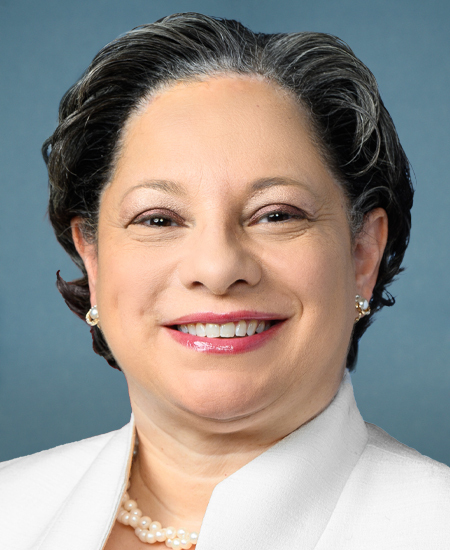
Rep. Jennifer L. McClellan
Sponsored bills
Maddy summaryThe American High-Speed Rail Act authorizes $35 billion annually for high-speed rail corridor development (with $3 billion for corridor planning), requiring at least 20% of project costs to come from non-Federal sources. It defines "high-speed rail" as services reaching 186+ mph and "higher-speed rail" as 110-186 mph, with no more than 20% of funds allocated to higher-speed rail projects. Key provisions include allowing advance acquisition of rail corridors before environmental reviews, creating tax exclusions for rail carriers selling property to high-speed rail projects, and requiring consideration of equity, sustainability, and economic development impacts in planning. The bill affects federal agencies, state and local governments, rail carriers, and communities along proposed rail corridors.
Maddy summaryThis bill extends the funding deadline for the Chesapeake WILD program from 2025 to 2030 under the America's Conservation Enhancement Act. It directly affects conservation projects in the Chesapeake Bay watershed by ensuring continued federal support for habitat restoration and wildlife management efforts. The key change is simply updating the program's expiration year in the law, without altering its scope or funding levels. This procedural update maintains existing conservation work without introducing new requirements.
Maddy summaryThis bill reauthorizes annual federal funding for the Chesapeake Bay Program, directly affecting the multi-state partnership managing the bay's restoration. It mandates $100 million in annual funding for fiscal years 2026 through 2030 to support ongoing cleanup efforts. The provision modifies existing law to ensure stable financial support for water quality improvement projects across the Chesapeake Bay watershed. This change continues current program operations without altering existing environmental goals or responsibilities.
Maddy summaryHRES 1053 is a non-binding House resolution reaffirming the U.S.-Canada partnership, not a legislative bill with new policy provisions. It states that the U.S. House of Representatives recognizes the strategic importance of the relationship, citing existing economic ties (e.g., $1.3 trillion in bilateral trade in 2022 supporting 7.5 million U.S. jobs) and security cooperation (including NORAD, border security programs, and shared climate efforts). The resolution emphasizes mutual dependence in areas like energy security, supply chains, and defense, but does not create new obligations or funding. It serves as a symbolic statement of support for the existing partnership, referencing established frameworks like USMCA and joint climate initiatives. As a resolution, it has no legal effect on policy or operations.
Chesapeake Bay Gateways and Watertrails Network Reauthorization Act of 2024 This bill reauthorizes for FY2025-FY2030 the Chesapeake Bay Gateways and Watertrails Network and the Chesapeake Bay Gateways Grants Assistance Program.
Maddy summaryThis resolution (HRES 1050) designates March 2024 as National Colorectal Cancer Awareness Month. It symbolically supports existing public awareness efforts around colorectal cancer prevention, screening, and early detection, without creating new requirements or funding. The resolution encourages the public to observe the month with educational activities, aligning with ongoing annual campaigns. It directly affects public awareness efforts but has no binding policy impact.
Maddy summaryThis bill establishes a federal interagency committee led by the Office of Science and Technology Policy to coordinate soil carbon research and monitoring across 11 agencies, including Agriculture, Energy, EPA, and NOAA. The committee must develop a strategic plan, create standardized measurement protocols, submit regular reports to Congress, and engage agricultural communities - especially historically underserved groups - in research design. It also creates working groups focused on monitoring standards, data management, research gaps, and community outreach. The bill authorizes $10 million in funding to implement these coordination efforts.
Maddy summaryHR 6203 extends funding for the Emergency Food Assistance Program (EFAP) through fiscal year 2028, increasing annual commodity funding to $500 million per year for 2024-2028. It raises storage and distribution funding from $100 million to $200 million annually and creates new delivery options for geographically isolated states (Hawaii, Alaska, Puerto Rico, Northern Mariana Islands, U.S. Virgin Islands, and Guam), including allowing them to order through the Department of Defense Fresh Fruit and Vegetable Program. The bill also permits these states to use up to 20% of allocated funds to directly purchase locally grown food. Finally, it allows the Secretary to consider factors like product variety and transportation distance when awarding contracts for fresh produce packages, while maintaining nutritional goals.
Maddy summaryThe Increasing Access to Mental Health in Schools Act creates a federal grant program to increase mental health staff in low-income schools. It provides funding for partnerships between low-income schools (where at least 20% of students are from families below the poverty line) and graduate programs in school counseling, psychology, and social work. Grant funds can cover training costs, salary support for new mental health providers, recruitment of underrepresented students, and student loan repayment for mental health staff working in qualifying schools. The bill sets target ratios for staff-to-student ratios (like 1 counselor per 250 students) and requires annual reporting on program outcomes. The program is authorized for $200 million annually to address mental health staffing shortages in schools serving high-poverty communities.