

Maddy summaryThis bill redesignates the existing National Parks and Public Land Legacy Restoration Fund as the America's Legacy Restoration Fund to address deferred maintenance on federal lands. It directs revenue from recreation fees and a portion of energy development income into the fund, which must be used primarily for repairing critical infrastructure like roads, trails, and buildings managed by agencies such as the National Park Service and the Forest Service. The legislation establishes strict rules requiring that most funds go toward non-transportation projects, mandates transparency through public dashboards tracking project status, and sets aside a small percentage for matching private donations. Additionally, the bill increases entrance fees for foreign visitors to ensure they contribute to the fund, while prohibiting the use of these specific funds for land acquisition or employee bonuses.
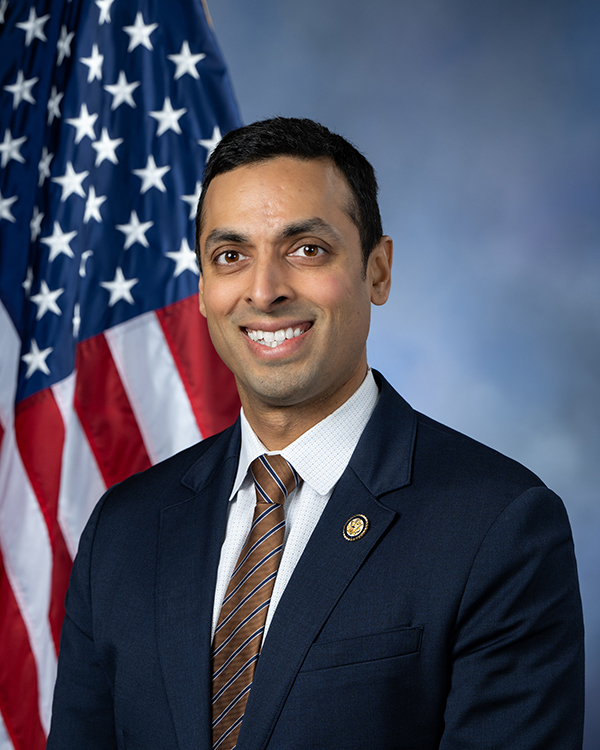
Rep. Suhas Subramanyam
Sponsored bills
Maddy summaryThe SPIRIT Act creates a new tax credit for small distilleries that use at least 90% of their ingredients from domestic sources. To qualify for a $2.35 reduction per proof gallon in their taxes, a distiller must produce no more than 100,000 proof gallons annually and ensure their production is primarily based on U.S.-harvested materials. The law also includes a recapture provision that requires distilleries to pay back the credit if they are found to be ineligible after receiving it. These financial incentives are designed to support smaller producers who rely on American agricultural ingredients, and the changes will take effect for spirits produced after December 31, 2025.
Maddy summaryThe SLASH Prices Act requires businesses that sell goods or services to clearly inform customers when prices are set by an algorithm using their personal data. Companies must display this notice prominently next to the price and provide an easy way for consumers to opt out of personalized pricing without facing discrimination or higher rates. The law exempts certain sectors like insurance and credit, as well as dynamic pricing based on real-time market conditions or delivery distance, and gives the Federal Trade Commission authority to enforce these rules.
Maddy summaryThe Protect Every Preschooler Act of 2026 expands the federal Gun Free School Zones Act to include early childhood education programs and preschools. This change directly affects firearm regulations by prohibiting the possession of guns in these specific educational settings, which were previously not explicitly covered under the law. The bill achieves this by amending the United States Code to add definitions for early childhood education programs and preschools to the list of protected areas. Consequently, individuals attempting to carry firearms into these locations would be subject to federal penalties under the existing gun-free zone provisions.
Maddy summaryThe Gun Safety Innovation Opportunity Act of 2026 creates a new grant program to fund research and development of advanced safe firearm storage devices by institutions of higher education and firearms manufacturers. These grants, totaling up to $10 million annually from 2027 to 2030, are intended to support technologies that use biometric data or other security measures to prevent unauthorized access to guns and to study how consumers might adopt such devices. To receive funding, applicants must submit detailed plans explaining how their technology will enhance community safety and increase affordability for users. Additionally, the bill requires the Attorney General to submit a report to Congress within a year of enactment, outlining potential ways to support this technology development and its use by law enforcement to prevent suicide.
Maddy summaryThis concurrent resolution directs the President to withdraw all U.S. military forces from active hostilities with Iran. The measure requires the President to remove troops unless they are needed to defend the United States or its allies from an immediate attack, and even then, such defensive actions must follow specific reporting rules. The directive applies unless Congress has explicitly authorized the use of force against Iran through a formal declaration of war or a specific legislative act.
Maddy summaryThe TRUE Accountability Act requires federal agencies to create and maintain internal control plans specifically designed for emergency spending situations like disasters, pandemics, or economic relief efforts. These plans must identify senior officials responsible for implementation, assess risks of improper payments and fraud, and include data-driven monitoring techniques to detect issues before funds are spent. Agencies must submit their plans to the Office of Management and Budget within a year of enactment and report them to Congress annually, with the guidance and plans being reviewed and updated every three years. The bill does not authorize any new funding but instead establishes reporting and accountability procedures for existing emergency appropriations processes.
Maddy summaryHR 3429 establishes a formal US-Japan-ROK Inter-Parliamentary Dialogue to deepen trilateral cooperation. It creates a US delegation of up to 8 Congress members (2 each from House/Senate leadership, with committee requirements) to meet annually with Japanese and South Korean legislators. The bill mandates annual reports to the Foreign Affairs and Foreign Relations committees and requires the delegation to rotate leadership between House and Senate every two years. This legislation directly affects US congressional members appointed to the delegation and provides a structured mechanism for ongoing policy coordination among the three nations.
Maddy summaryThe Artificial Intelligence Environmental Impacts Act of 2026 directs the Environmental Protection Agency to study and report on the environmental effects of artificial intelligence, including energy and water use, pollution, and electronic waste. This bill requires large data centers to annually submit detailed public reports on their resource consumption and environmental footprint, with penalties for non-compliance. Additionally, it establishes a stakeholder consortium to develop standardized methods for measuring these impacts and to identify ways to promote beneficial uses of AI while reducing negative effects. The legislation aims to increase transparency and accountability regarding the growing environmental costs associated with AI infrastructure and operations.
Maddy summaryThis resolution expresses support for designating June 5, 2026, as National Gun Violence Awareness Day and June 2026 as National Gun Violence Awareness Month. The bill calls on the public to wear orange on the designated day to honor victims and promote awareness of gun safety. It highlights statistics on gun-related deaths and injuries to underscore the need for community discussions on making neighborhoods safer.