

Maddy summaryHR 6056, the International Human Rights Defense Act of 2025, establishes a permanent Special Envoy at the State Department to lead U.S. foreign policy efforts addressing discrimination and violence against LGBTQI+ people globally. The bill requires the U.S. government to develop and update a biannual global strategy to prevent criminalization and violence against LGBTQI+ individuals, mandate detailed reporting on such abuses in annual country reports, and ensure all U.S. foreign assistance programs include inclusive nondiscrimination policies. This legislation directly affects U.S. foreign policy implementation, federal agencies receiving funding, and LGBTQI+ communities facing persecution worldwide. The bill aims to coordinate U.S. government efforts across departments and with international partners to advance LGBTQI+ rights globally through concrete policy mechanisms.
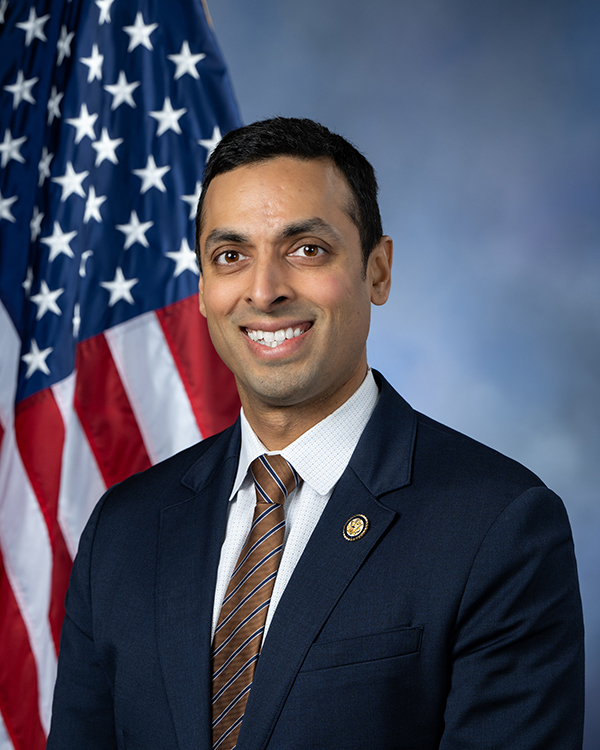
Rep. Suhas Subramanyam
Sponsored bills
Maddy summaryThis bill expands outreach to service members transitioning out of the military through the Solid Start program. It requires the Department of Veterans Affairs to coordinate with the Department of Defense to reach out to service members 120-210 days before separation, with priority for women veterans. Key provisions include calling each service member during this window to explain transitional health care options and provide contact information for disability claims assistance, plus collecting suicide prevention resources for crisis support. The law directly affects service members separating from the military by mandating structured pre-separation support.
Maddy summaryHR 5941, the Restoring Access for Detainees Act, requires U.S. Immigration and Customs Enforcement (ICE) to provide immigration detainees in DHS custody with specific communication access. It mandates 200 free monthly minutes for general outgoing calls, unlimited free minutes for contacting legal counsel, courts, consulates, or oversight offices, and special initial contact provisions during arrival or transfer. Detention facilities must allow uninterrupted legal communication time, cannot restrict minutes for legal calls, and must provide private spaces for confidential legal discussions. The bill also requires facilities to establish clear, publicly available communication policies that comply with these requirements.
Maddy summaryThis bill, HR 5973, requires federal immigration enforcement personnel to follow strict limits on force use, including proportional application, mandatory de-escalation efforts, and prohibitions on equipment like flash bangs or rubber bullets except for specific public safety threats. It mandates body-worn and vehicle cameras for all operations, with footage retained for one year (three years for force incidents or complaints), and grants affected individuals the right to inspect recordings. The law also requires annual training on force policies, First Amendment compliance, and racial bias avoidance, while demanding detailed quarterly reports to Congress on force usage, assaults on agents, and equipment approvals. These provisions directly affect all federal immigration agents conducting enforcement actions, aiming to increase transparency and accountability during operations.
Maddy summaryHRES 854 is a non-binding House resolution commemorating the seventh anniversary of Jamal Khashoggi's murder in 2018 and calling for accountability. It acknowledges U.S. sanctions against 17 Saudi officials involved in his killing and urges Saudi Arabia to: (1) ensure accountability for those responsible, (2) release wrongfully detained individuals like Nourah al-Qahtani and Abdulrahman Alsadhan, and (3) respect freedoms of press and assembly. The resolution directly addresses the Saudi government and indirectly supports Saudi dissidents in the U.S. facing transnational repression. As a commemorative measure, it does not create new laws but formally expresses congressional concern over ongoing human rights abuses.
Maddy summaryHRES 846 is a symbolic resolution designating October 2025 as National Domestic Violence Awareness Month. It expresses the House's support for raising awareness about domestic violence and its impacts, and calls for continued congressional attention to ending domestic violence through existing programs. The resolution does not create new laws, allocate funding, or directly affect any specific groups - it is purely a statement of support. It references statistics on domestic violence prevalence but focuses on awareness rather than policy changes.
Maddy summaryHR 5892, the "Keep Main Street Open Act," creates a Small Business Administration (SBA) program to provide loans to eligible small businesses during government shutdowns. These loans would cover estimated revenue losses from the shutdown, carry a maximum 1% interest rate, and require repayment within one year after the shutdown ends. The bill defines "eligible applicant" as small businesses qualifying under existing SBA Section 7(a) criteria and "shutdown" as the period starting when government funding lapses and ending 30 days after appropriations are restored. This program directly affects small businesses facing financial disruption due to federal funding gaps.
Maddy summaryHR 5867, the Plant-Powered School Meals Pilot Act, creates a federal grant program to help schools serve 100% plant-based meal options. It authorizes $10 million for grants to school food authorities (specifically those serving 50%+ students eligible for free/reduced-price meals) over three years to cover staff training, meal preparation, community partnerships, and procurement from underserved farmers. The bill also establishes a separate $2 million pilot to reimburse schools for nondairy beverage substitutions for students with dietary needs, prioritizing schools with high lactose intolerance rates. Both pilots require annual reporting on participation, meal counts, and fund usage, with final reports submitted to Congress.
Maddy summaryHRES 824 is a ceremonial House resolution recognizing the religious and historical significance of Diwali, the festival of lights. It acknowledges Diwali’s meaning across Hindu, Sikh, and Jain traditions - symbolizing light over darkness, good over evil, and marking spiritual milestones like Guru Hargobind’s release and Lord Mahavira’s Nirvana. The resolution expresses respect for Indian-Americans and the global Indian diaspora, highlighting Diwali’s role in U.S. religious diversity. As a non-binding recognition, it does not create new laws, policies, or funding, but formally honors the cultural observance.
Maddy summaryHRES 825 is a procedural resolution requesting the President to provide specific unredacted documents to the House of Representatives within 14 days. It seeks all communications related to government agencies' public messaging during the October 2025 funding lapse, including OMB directives to agencies, HUD's website statement about the shutdown, modified email messages from the Department of Education for furloughed staff, and internal reviews of whether such communications violated federal laws. This resolution focuses solely on transparency regarding government communications during the funding lapse, not on policy changes. As a procedural request for information, it does not alter laws or affect any specific group.