

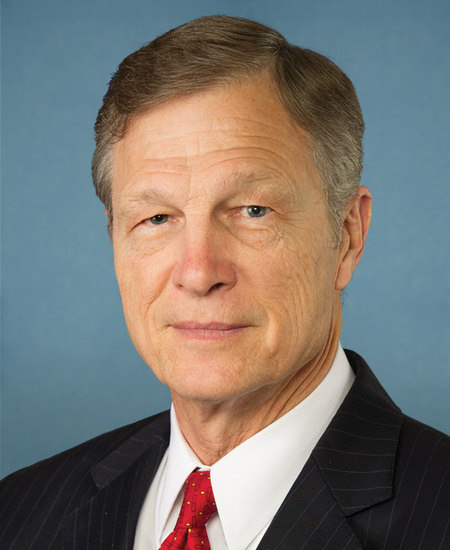
Photo of Brian Babin
R United States House · District 36 · Texas On the 2026 ballot

Rep. Brian Babin

Compare
Total votes
2,837
all sessions
Attendance
98%
63 missed
Near the chamber average
With party
94%
of cast votes
Near the chamber average
Bipartisan score
3%
crosses aisle rarely
Near the chamber average
Sponsored
1,288
bills & resolutions
Near the chamber average
Committees
4
assignments
1,288 bills and resolutions

Sponsored bills

Total
1,288
Primary
44
Co-sponsor
1,244
This page
1,288
matching current filters
Co-sponsor HR 5694
In committee · Indiana House · Co-sponsor
Fentanyl Penalties Parity Act

Fentanyl Penalties Parity Act This bill modifies the drug quantity thresholds that trigger a mandatory minimum prison term for a defendant who manufactures, distributes, imports, exports, or possesses with intent to distribute fentanyl. Specifically, the bill reduces from 400 to 20 grams the fentanyl quantity and from 100 to 5 grams the fentanyl analogue quantity that trigger a mandatory minimum prison term for high-level first-time or repeat offenders. It also reduces from 40 to 2 grams the fentanyl quantity and from 10 to 0.5 grams the fentanyl analogue quantity that trigger a mandatory minimum prison term for low-level first-time or repeat offenders.

In committee Nov 1, 2022 1 co-sponsor
Co-sponsor HR 5639
In committee · Indiana House · Co-sponsor
Foreign Merger Subsidy Disclosure Act of 2021

Foreign Merger Subsidy Disclosure Act of 2021 This bill requires entities to disclose in their premerger notification filings to federal antitrust regulators a detailed accounting of any economic support they received from a foreign state.

In committee Nov 1, 2022 1 co-sponsor
Co-sponsor HR 5572
In committee · Indiana House · Co-sponsor
SECURE America Act

Safeguards Ensuring Criminal and Unvetted Refugees don't Enter America Act or the SECURE America Act This bill imposes restrictions on the admission of aliens, including refugees, and addresses related issues. Specifically, no refugees may be admitted until Congress enacts a joint resolution setting the maximum number of refugees allowed to be admitted in a particular fiscal year. Currently, that number is set each fiscal year by the President. The Department of Homeland Security (DHS) must notify Congress at least 30 days before determining that an alien or class of aliens is eligible for refugee status. Congress may nullify the determination by enacting a joint resolution of disapproval. Further, an alien shall be inadmissible for holding certain beliefs, such as (1) believing that a system of religious law should be implemented in the United States, (2) believing that the alien does not need to learn English if the alien is not already fluent, or (3) any belief that the Department of State determines is incompatible with the principles of the United States. DHS may not parole into the United States an alien who does not have status under immigration law. Currently, DHS may provide parole in certain instances, including for urgent humanitarian reasons. Federal agencies must notify a state at least 30 days before resettling a refugee in that state. The refugee may not be resettled in that state if the state expresses disapproval. An alien who has committed a crime of violence (generally one involving the use or threat of physical violence against person or property) may not be eligible for refugee status and must be removed.

In committee Nov 1, 2022 1 co-sponsor
Co-sponsor HR 5557
In committee · Indiana House · Co-sponsor
DEMOCRACIA Act

Denying Earnings to the Military Oligarchy in Cuba and Restricting Activities of the Cuban Intelligence Apparatus Act or the DEMOCRACIA Act This bill provides for asset- and visa-blocking sanctions for conduct relating to Cuba. It also establishes an interagency task force to facilitate access to uncensored internet in Cuba. The President must sanction foreign persons that provide financial support to Cuban government sectors involved in human rights abuses or terrorism (e.g., the defense sector). This includes foreign persons that (1) are military contractors or mercenaries operating on behalf of the Cuban government, or (2) violate laws restricting trade with Cuba. Specified transactions, including remittances to immediate family members (subject to some limitations) and payments related to U.S. military and diplomatic sites, are not subject to these sanctions. The President must also sanction (1) foreign persons complicit or engaged in human rights abuses or corruption, (2) foreign persons supporting such conduct, and (3) specified Cuban government officials and their affiliates. The bill provides humanitarian exceptions to these sanctions, for example, donating food or agricultural commodities to organizations or individuals unaffiliated with the Cuban government. The President may not license sanctionable conduct, and U.S. persons seeking to engage in a permitted transaction must submit a written request to the Office of Foreign Asset Control of the Department of the Treasury. The President may waive the sanctions in the interest of U.S. national security. To terminate the sanctions, the President must certify that the Cuban government has legalized all political activities and taken other steps to promote political rights and freedoms. Congress must then enact a joint resolution approving the termination.

In committee Nov 1, 2022 1 co-sponsor
Co-sponsor HR 5398
In committee · Indiana House · Co-sponsor
Defending Students’ Civil Rights Act of 2021

Defending Students' Civil Rights Act of 2021 This bill prohibits the use of critical race theory or critical race pedagogy in any federally funded program or activity. Specifically, the bill includes the use of critical race theory or critical race pedagogy as a violation of Title VI of the Civil Rights Act of 1964, which prohibits discrimination based on race, color, or national origin in federally funded programs or activities. The bill defines critical race pedagogy as the separation of students or teachers, or the assignment of characteristics or assumptions, based on race, color, or national origin. The bill defines critical race theory as a curriculum that establishes specified principles relating to race or sex, including that (1) one race or sex is inherently superior to another, (2) the United States is fundamentally racist or sexist, and (3) an individual bears responsibility for the past actions of others of the same race or sex.

In committee Nov 1, 2022 1 co-sponsor
Co-sponsor HR 5294
In committee · Indiana House · Co-sponsor
Make the Migrant Protection Protocols Mandatory Act of 2021

Make the Migrant Protection Protocols Mandatory Act of 2021 This bill requires the Department of Justice (DOJ) to remove certain aliens from the United States while such an alien's application for admission is pending. Specifically, if an alien arrived by land from a foreign country bordering the United States and the alien is not clearly and beyond a doubt entitled to admission into the United States, DOJ must return that alien to that bordering foreign country while the alien's application for admission is pending. (Currently, DOJ may choose to detain such an alien or return the alien to the bordering foreign country while the application for admission is pending.)

In committee Nov 1, 2022 1 co-sponsor
Co-sponsor HR 5171
In committee · Indiana House · Co-sponsor
Freedom From Union Violence Act of 2021

Freedom From Union Violence Act of 2021 This bill revises the federal criminal statute commonly known as the Hobbs Act, which prohibits the obstruction of interstate commerce by robbery or extortion (or by attempting or conspiring to commit robbery or extortion). Currently, an extortion offense includes obtaining property of another with consent through the wrongful use of force, violence, or fear. Typically, violations are investigated by the Federal Bureau of Investigation and prosecuted by the U.S. Attorney's Office. First, this bill broadens the scope of prohibited conduct by (1) eliminating the requirement that the means used to obtain property (i.e., the use of force, violence, or fear) must be wrongful, and (2) expanding extortion to include obtaining property of another by wrongful use of fear not involving force or violence. Second, the bill explicitly states that the maximum fine is $100,000. Third, the bill exempts from the federal prohibition conduct that (1) is incidental to peaceful picketing during a labor dispute, (2) consists solely of minor bodily injury or damage to property, and (3) is not part of a pattern of violent conduct or of a coordinated violent activity. A violation involving exempted conduct is subject to prosecution only by state and local authorities.

In committee Nov 1, 2022 1 co-sponsor
Co-sponsor HR 5136
In committee · Indiana House · Co-sponsor
Teleabortion Prevention Act of 2021

Teleabortion Prevention Act of 2021 This bill restricts the use of telehealth for chemical abortions (also known as medication abortions). Specifically, it requires a provider who dispenses or prescribes medication for a chemical abortion to physically examine the patient, be physically present at the location of the chemical abortion, and schedule a follow-up visit. The bill provides an exception for a chemical abortion that is necessary to save the life of a mother whose life is endangered by a physical disorder, illness, injury, or condition. The bill establishes criminal penalties—a fine, a prison term of up to two years, or both—for a provider who does not comply with the requirements. A patient who undergoes a chemical abortion may not be prosecuted.

In committee Nov 1, 2022 1 co-sponsor
Co-sponsor HR 5062
In committee · Indiana House · Co-sponsor
Americans not Aliens Act

Americans not Aliens Act This bill prohibits an alien who has been ordered removed from receiving employment authorization. Currently, an individual who has been ordered removed may receive employment authorization if the Department of Justice finds that the individual's removal is impracticable or contrary to the public interest.

In committee Nov 1, 2022 1 co-sponsor
Co-sponsor HR 4914
In committee · Indiana House · Co-sponsor
Havana Syndrome Attacks Response Act

Havana Syndrome Attacks Response Act This bill requires the President to sanction foreign persons and governments for carrying out clandestine attacks on U.S. personnel that have caused brain injury. Specifically, the President must impose visa- and asset-blocking sanctions on any foreign person that has directed or carried out such an attack. If the President determines a foreign government carried out such an attack, the President must notify Congress and sanction that country by terminating any foreign assistance (except for humanitarian aid or food or agricultural commodities or products) and arms transactions, restricting commercial exports, and denying access to U.S. credit or other financial assistance. The President must remove these sanctions after 12 months, provided that (1) the country's government gives reliable assurances that it will not conduct future attacks, and (2) the executive branch does not have persuasive information indicating an attack occurred in the preceding six months. The bill also requires a congressional briefing and report about suspected clandestine attacks on U.S. personnel that have caused brain injury, including hypotheses concerning the identity of the perpetrators and the technical methods used to carry out the attacks.

In committee Nov 1, 2022 1 co-sponsor
Showing 771 to 780 of 1,288 bills
Previous 1 … 77 78 79 … 129 Next