

This resolution recognizes the ultimate sacrifice of the unknown soldiers interred at Arlington National Cemetery and expresses gratitude and appreciation of all the members of the Armed Forces who have served during wars and peacetime. Additionally, the resolution commends all members of the 3d Infantry Regiment, specifically those who guard the Tomb of the Unknown Solider.
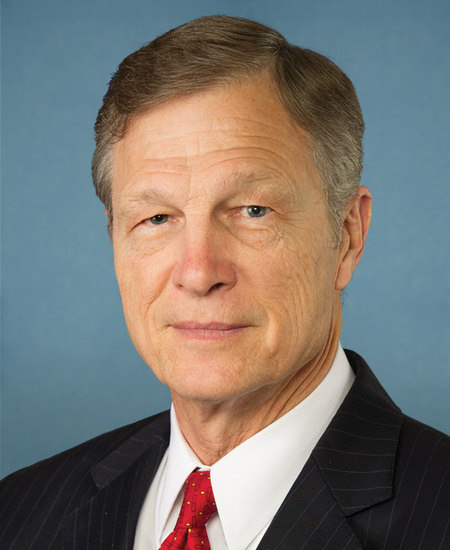
Rep. Brian Babin
Sponsored bills
Bring Entrepreneurial Advancements To Consumers Here In North America Act This bill provides tax incentives for relocating manufacturing facilities in the United States. Specifically, it allows accelerated depreciation (20-year recovery period) for nonresidential real property acquired in connection with the relocation of manufacturing facilities in the United States. It also excludes from gross income, for income tax purposes, gain on the sale or exchange of such relocated facilities. Finally, the bill allows permanent 100% expensing of manufacturing property relocated in the United States.
Safeguarding Children's Privacy in Schools Act This bill revises the standards for parental consent with respect to the online collection, use, and disclosure of the personal information of a child. First, it revises the definition of verifiable parental consent to require websites and online services to obtain consent by a parent before collecting a child's personal information. Currently, websites and online services must make a reasonable effort to ensure that a parent authorizes the collection, use, and disclosure of such personal information before collecting it. The bill also prohibits elementary and secondary school employees from acting as the agent of a child enrolled in such school for the purpose of providing verifiable parental consent.
This resolution recognizes and appreciates the dedication and devotion demonstrated by the men and women of law enforcement. It also condemns calls to defund, disband, dismantle, or abolish the police.
Maximum Pressure Act This bill expands sanctions and economic penalties on Iran. It also restricts the President from unilaterally lifting or waiving the sanctions or penalties and increases congressional oversight of them. Specifically, the bill requires the President to impose visa- and asset-blocking sanctions. Additionally, it modifies existing sanctions, including by (1) providing statutory authority for executive orders imposing sanctions; (2) applying sanctions to additional sectors of Iran's economy; and (3) broadening sanctionable conduct to cover, for example, assisting Iran with the acquisition of ballistic missiles and the complicity of Iranian officials in human rights violations in specified countries. The bill also requires reporting on licenses that authorize activities subject to sanctions. The bill prohibits U.S. representatives at the International Monetary Fund from voting to allow Iran's access to special drawing rights (a currency support tool) and places restrictions on financial transactions with Iran. The restrictions include requiring domestic financial institutions to implement special measures with respect to foreign financial institutions that conduct significant transactions connected to the Instrument in Support of Trade Exchanges (a European mechanism that bypasses U.S. sanctions when carrying out trade with Iran). The Department of State must maintain the Islamic Revolutionary Guard Corps' designation as a terrorist organization and must designate Ansharallah (or Houthis), which operates in Syria, as a foreign terrorist organization. The bill also requires reports on U.S. sanctions concerning Iran, the status of Iran's nuclear weapons program, and other matters.
District of Columbia-Maryland Reunion Act This bill cedes the District of Columbia to Maryland after Maryland's acceptance of the retrocession. Furthermore, the bill declares that the National Capital Service Area in the District shall not be ceded and relinquished to Maryland and shall continue to serve as the permanent seat of the federal government. The bill maintains the exclusive legislative authority and control of Congress over the area. Finally, excluding the District Building, the area shall include the principal federal monuments, the White House, the U.S. Capitol, the U.S. Supreme Court Building, the federal executive, legislative, and judicial office buildings located adjacent to the Mall and the U.S. Capitol, including any federal real property affronting or abutting such area, such as the Department of Housing and Urban Development and the Department of Energy buildings.
Eradicate Crossing of Illegal Tunnels Act of 2021 or the EXIT Act of 2021 This bill authorizes the Department of Homeland Security (DHS) to take various actions to facilitate the search for and remediation of unlawful border crossing tunnels on private land. Specifically, DHS may waive federal, state, or local environmental permits and reviews as necessary to search for or remediate such tunnels. U.S. Customs and Border Protection and U.S. Immigration and Customs Enforcement may enter into indefinite delivery, indefinite quantity contracts with two or more sources to facilitate such border tunnel activities. (Indefinite delivery, indefinite quantity contracts provide for an indefinite quantity of services for a fixed time.)
Drug Cartel Terrorist Designation Act This bill directs the Department of State to designate the Reynosa/Los Metros faction of the Gulf Cartel and the Cartel Del Noreste faction of Los Zetas as foreign terrorist organizations and to submit a detailed report on those drug cartels and any other cartels it may identify. Based on this report, the State Department must designate as a foreign terrorist organization any such identified cartel (or faction thereof) that meets certain criteria for designation as a foreign terrorist organization.
Competition in Professional Baseball Act This bill removes the limited exemption from the antitrust laws for professional baseball clubs. For purposes of this bill, the term antitrust laws means laws to protect against unlawful restraints and monopolies (Clayton Act) and to protect against unfair methods of competition (Federal Trade Commission Act).
Accountability Through Electronic Verification Act This bill expands the E-Verify program by requiring all employers to use it and permanently reauthorizes the program. Currently, E-Verify use is voluntary for most employers, although some states mandate its use. All employers shall use E-Verify to confirm the identity and employment eligibility of all recruited, referred, or hired individuals, including current employees who were never verified under the program. Failure to use E-Verify shall create a rebuttable presumption that the employer is violating immigration law. U.S. Citizenship and Immigration Services shall generate weekly reports about individuals who have received a final nonconfirmation of employment eligibility. The Department of Homeland Security (DHS) shall use the report to enforce immigration laws. DHS shall establish a program to help certain small businesses verify employee eligibility. DHS shall also update E-Verify's design to help prevent and detect fraud and identity theft. The bill increases civil and criminal penalties for hiring unauthorized aliens. DHS shall debar repeat offenders and those criminally convicted from holding federal contracts, grants, or cooperative agreements. The Social Security Administration, Internal Revenue Service, Department of the Treasury, and DHS shall jointly establish a program to share information to help identify unauthorized aliens. The bill establishes the Employer Compliance Inspection Center within Homeland Security Investigations of U.S. Immigration and Customs Enforcement. The center's duties include processing I-9 employment eligibility verification forms and ensuring compliance with employment eligibility laws. DHS shall report to Congress on ways to simplify procedures relating to I-9 forms and on whether the I-9 process should be eliminated.