Governing Unaccredited Representatives Defrauding VA Benefits Act or the GUARD VA Benefits Act This bill imposes criminal penalties and/or fines on individuals for directly or indirectly soliciting, contracting for, charging, or receiving any unauthorized fee or compensation with respect to the preparation, presentation, or prosecution of any claim for Department of Veterans Affairs benefits. The attempted commission of such offenses is also punishable by fine or imprisonment.
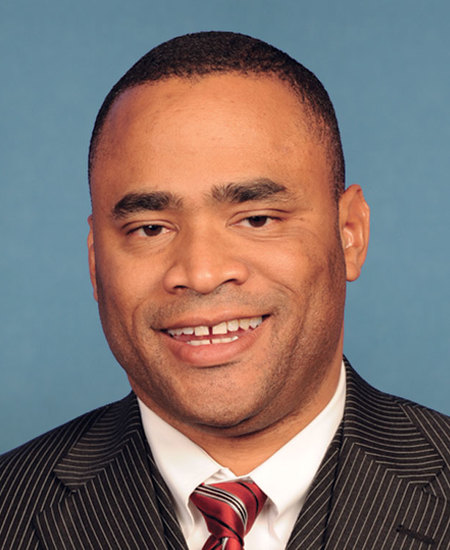
Rep. Marc A. Veasey
Sponsored bills
Protecting Families from Fertility Fraud Act of 2022 This bill establishes a new federal criminal offense for knowingly misrepresenting the nature or source of DNA used in assisted reproductive technology or assisted insemination. The term assisted reproductive technology includes any treatment or procedure that involves the handling of human oocytes or embryos, such as in vitro fertilization, gamete intrafallopian transfer, and zygote intrafallopian transfer. The term assisted insemination includes any procedure that involves the handling of sperm including intrauterine insemination. A violation is subject to a fine, a prison term of up to 10 years, or both. Additionally, the bill makes the violation a predicate offense (i.e., an underlying offense) for prosecutions under the federal racketeering statute.
This bill requires states to prioritize additional groups (i.e., victims of firearm violence or the family members of victims of homicide) for state victim assistance formula grants.
Strengthen and Tackle Opportunities to Prevent Violence Act of 2022 or the STOP Violence Act of 2022 This bill allows funds under the Antiterrorism and Emergency Assistance Program to be used for efforts to prepare against mass violence and protect public assembly facilities.
Digital Civil and Human Rights Act of 2022 This bill establishes prohibitions on the use of automated systems in a discriminatory manner. Specifically, the bill prohibits (1) a federal agency, U.S. court, or state, local, or tribal government from using any automated decision system that has a disparate impact on the basis of race, national origin, color, religion, disability, or sex; or (2) the use of automated systems with bias by the Department of Defense. Each federal agency must maintain on its public website a bias data sheet for each automated decision system used by such agency with the potential for a disparate impact on such bases. The bill prohibits a respondent, in connection with the selection or referral of applicants or candidates for employment or promotion, from using any automated decision system that has a disparate impact on the basis of race, color, religion, sex, or national origin. The bill prohibits places of public accommodation from using in their operations that affect commerce any decision system that has a disparate impact on the basis of race, color, religion, sex, or national origin. The bill requires (1) the Office of the Director of National Intelligence to submit to Congress a report on the use within the intelligence community of automated decision systems with an adverse distinction based on race, religion, sex, health, age, or any other similar criteria; and (2) the National Institute of Standards and Technology to develop, publish, and maintain standards for reporting bias in an automated decision system.

Latonya Reeves Freedom Act of 2022 This bill prohibits government entities and insurance providers from denying community-based services to individuals with disabilities that require long-term service or support that would enable such individuals to live in the community and lead an independent life. Specifically, these entities may not discriminate against such individuals in the provision of community-based services by such actions as imposing prohibited eligibility criteria, cost caps, or waiting lists or failing to provide a specific community-based service. Additionally, community-based services must be offered to individuals with such disabilities prior to institutionalization. Institutionalized individuals must be notified regularly of community-based alternatives. The bill requires the Department of Justice to issue regulations requiring government entities and insurance providers to offer community-based long-term services to individuals with such disabilities who would otherwise qualify for institutional placement. Government entities must ensure sufficient availability of affordable, accessible, and integrated housing that is not a disability-specific residential setting or a setting where services are tied to tenancy. Regulations shall also (1) require government entities and insurance providers to perform self-evaluation on current services, policies, and practices and concerning compliance with requirements of this bill; and (2) require government entities to submit a transition plan. The bill provides funds for FY2022 for the Department of Health and Human Services to provide technical assistance with respect to transition plans. The bill allows civil actions by individuals subjected to, or about to be subjected to, a violation of its requirements.
Election Worker and Polling Place Protection Act This bill addresses certain protections for election workers and polling places. In particular, the bill prohibits, with enhanced penalties for certain types of threats and harms (1) intimidation of poll watchers, election officials, and election agents, vendors, and contractors involving violence or threats of harm; and (2) physical damage to or threats to physically damage a polling place, tabulation center, or other election infrastructure.
Porch Pirates Act of 2022 This bill extends federal criminal penalties for obstruction of correspondence and theft of stolen mail matter (which apply to U.S. Postal Service mail) to matter (e.g., packages) sent or delivered by private or commercial interstate carriers.
Lifting Immigrant Families Through Benefits Access Restoration Act of 2021 or the LIFT the BAR Act of 2021 This bill repeals certain limits on the eligibility of noncitizens who lawfully reside in the United States for federal means-tested programs, including Medicaid, the Children's Health Insurance Program (CHIP), programs funded through Temporary Assistance for Needy Families (TANF) grants, Supplemental Security Income (SSI), and certain nutrition and housing programs.
Counter-Kleptocracy Act This bill addresses prevention and elimination of corruption globally. The Department of State must (1) annually rank, using specified standards, foreign countries based on their efforts to eliminate corruption; and (2) designate an anti-corruption contact in the diplomatic mission of any country that does not meet the standards. The State Department must also evaluate whether to sanction foreign persons engaged in significant corruption (1) in countries that make de minimis or no efforts to meet the standards, or (2) connected to a designated Russian pipeline project. The President may temporarily sanction foreign persons engaging in public corruption activities (e.g. bribery). The bill makes it a federal crime for foreign officials to demand or accept bribes to influence the performance of an official act or otherwise confer an improper advantage. Officials who engage in this conduct are subject to a fine, a prison term, or both. Funds recovered by prosecuting this crime shall be deposited into a new fund in the Treasury for anti-corruption initiatives. The Department of Justice must make publicly available an accounting of property relating to foreign government corruption that is forfeited to the United States. The bill addresses issues concerning U.S. visas, including related to (1) abuse of investor visas by corrupt foreign officials or criminals, and (2) foreign individuals denied admission to the United States because of adverse foreign policy consequences. The bill also prohibits extraditions based solely on, and otherwise addresses, International Criminal Police Organization communications.