

Maddy summaryThe Federal Prison Oversight Act establishes a new inspections regime for federal prisons, requiring the Justice Department's Inspector General to conduct regular assessments of Bureau of Prisons facilities. These inspections will evaluate conditions of confinement, medical care, staffing levels, safety protocols, and policies related to visitation and programming. The bill also creates a new Ombudsman position within the Department of Justice to receive and address complaints from incarcerated people, their families, and staff about health, safety, and rights concerns. The Inspector General must submit public reports with recommendations, and the Bureau must respond with corrective action plans within 60 days. The law includes protections against retaliation for those filing complaints and requires the Bureau to provide multiple confidential channels for submitting complaints.
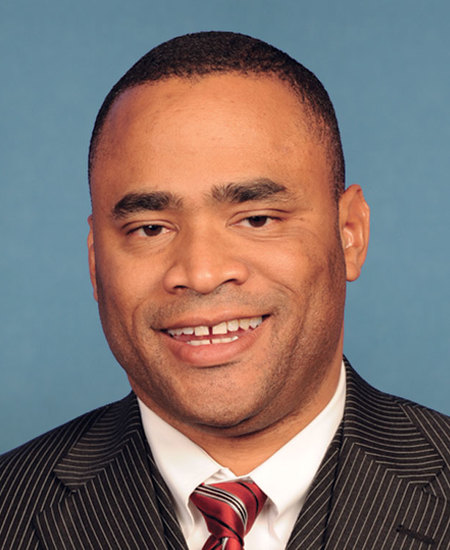
Rep. Marc A. Veasey
Sponsored bills
Maddy summaryH.J. Res. 193 proposes a constitutional amendment to eliminate legal immunity for federal officials, including the President, from criminal prosecution for actions taken while performing official duties. It also prohibits the President from granting a pardon to themselves. The amendment would apply to all federal officers (such as the President, Vice President, and members of Congress) except for Congress members acting in their legislative role as defined in the Constitution. If ratified by 38 states, this change would become part of the U.S. Constitution, requiring no further congressional action.
Maddy summaryHRES 1381 is a symbolic resolution that commemorates the United States Olympic and Paralympic Teams' historical achievements, including over 5,300 total medals across past Games. It expresses congressional support for U.S. athletes competing in the 2024 Summer Olympics and Paralympics in Paris, France, and commends the Government of France for hosting the events. The resolution also commits to ensuring a safe environment for the 2028 Los Angeles Olympic and Paralympic Games. As a non-binding expression of support, it does not create new laws or allocate funds.
Maddy summaryThis resolution designates September 2024 as "PCOS Awareness Month" to highlight polycystic ovary syndrome (PCOS), a hormonal condition affecting an estimated 5-10 million U.S. women and girls. It recognizes PCOS as a serious health issue linked to infertility, type 2 diabetes, heart disease, mental health challenges, and other related conditions. The resolution urges increased public and medical education about PCOS, improved diagnosis, and research into better treatments, without creating new laws or funding. It directly supports women and girls living with PCOS by promoting awareness of its wide-ranging health impacts.
Maddy summaryThis bill designates the U.S. Postal Service facility at 4650 East Rosedale Street in Fort Worth, Texas, as the "Dionne Phillips Bagsby Post Office Building." It updates all official references (in laws, maps, documents, etc.) to this specific location to reflect the new name. The bill has no policy provisions or direct impact on constituents beyond renaming the post office facility.
Maddy summaryHR 9104, the Access to Birth Control Act, requires pharmacies that normally stock contraception to provide birth control or related medications without delay if in stock, or immediately offer alternatives like referrals to other pharmacies or expedited orders if unavailable. It prohibits pharmacists from intimidating customers, misrepresenting availability, breaching confidentiality, or refusing to fill valid prescriptions for birth control. Pharmacies violating these rules face civil penalties up to $1,000 per day or private lawsuits. The law specifically applies to pharmacies that routinely carry contraception and excludes cases where a valid prescription is missing or payment cannot be made. It aims to address documented refusals to dispense birth control, particularly following the Dobbs decision.
Maddy summaryHR 9060 extends tax credits for biodiesel and renewable diesel producers and users through 2025, replacing the previous 2024 expiration date. It amends the Internal Revenue Code to extend the biodiesel credit (Section 40A) and biodiesel mixture credit (Section 6426) for fuels sold or used after December 31, 2024. The bill also adds a provision preventing double benefits by requiring the credit amount to be zero for fuels already claiming another credit under Section 45Z(a). This directly affects biodiesel producers, refiners, and businesses using these fuels for tax purposes.
Maddy summaryHRES 1355 is a non-binding resolution supporting the designation of July 10 as Journeyman Lineworkers Recognition Day. It honors lineworkers who maintain electrical infrastructure under hazardous conditions, including during disasters, and commemorates Henry Miller, the first president of the International Brotherhood of Electrical Workers, who died on July 10, 1896, while troubleshooting an electrical outage. The resolution encourages public recognition of these workers' contributions but does not create new laws or policies.
Maddy summaryHR 8825, the Right to Vote Act, establishes a fundamental right for all citizens of legal voting age to vote in federal elections. It directly affects voters across all states and territories by prohibiting government actions that make voting harder (like restrictive ID laws or reduced polling places) unless those actions are the least restrictive way to serve a significant government interest. The bill creates two legal standards: "retrogression" (diminishing voting access) and "substantial impairment" (making voting significantly harder), allowing voters to sue in federal court to challenge such restrictions. Courts must expedite these cases, and the law applies to all federal elections occurring on or after September 1, 2024.
Maddy summaryThis bill amends the Federal Employees' Compensation Act to include physician assistants and nurse practitioners as eligible providers for injured federal workers. It defines "other eligible provider" as a nurse practitioner or physician assistant within their state-authorized scope of practice. The law updates key sections to replace "physician" with "physician or other eligible provider" for treatment, certification, and claim processes. The Secretary must finalize implementing regulations within six months of enactment.