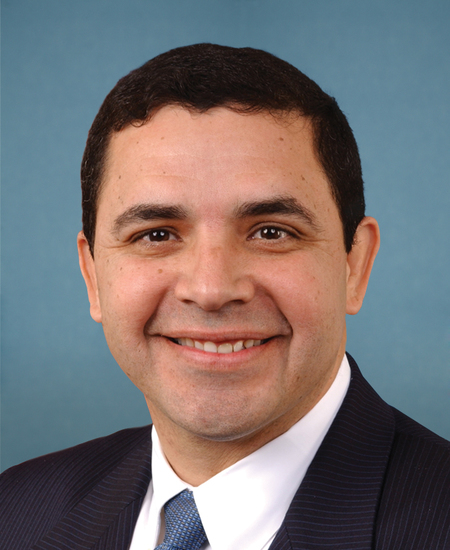
Photo of Henry Cuellar
D United States House · District 28 · Texas On the 2026 ballot

Rep. Henry Cuellar

Compare
Total votes
2,837
all sessions
Attendance
98%
43 missed
Near the chamber average
With party
86%
of cast votes
Among the lowest in the chamber
Bipartisan score
7%
crosses aisle rarely
Higher than 99% of chamber peers
Sponsored
768
bills & resolutions
Lower than 78% of chamber peers
Committees
4
assignments
768 bills and resolutions

Sponsored bills

Total
768
Primary
26
Co-sponsor
742
This page
768
matching current filters
Co-sponsor HR 707
Passed · Indiana House · Co-sponsor
Ghost Army Congressional Gold Medal Act

Ghost Army Congressional Gold Medal Act This bill directs the Speaker of the House of Representatives and the President pro tempore of the Senate to award a Congressional Gold Medal to the 23rd Headquarters Special Troops and the 3133d Signal Service Company, known as the Ghost Army , collectively, in recognition of its service during World War II.

Passed May 19, 2021 1 co-sponsor
Co-sponsor HRES 404
In committee May 18, 2021 1 co-sponsor
Co-sponsor HR 3281
In committee · Indiana House · Co-sponsor
RPM Act of 2019

Recognizing the Protection of Motorsports Act of 2019 or the RPM Act of 2019 [ sic ] This bill authorizes the modification of a vehicle's air emission controls for vehicles that are not legal for operation on a street or highway and are used solely for competition.

In committee May 18, 2021 1 co-sponsor
Co-sponsor HR 1961
In committee · Indiana House · Co-sponsor
ATF Accountability Act of 2021

ATF Accountability Act of 2021 This bill establishes a federal statutory process for licensed gun dealers, importers, and manufacturers to appeal rulings and determinations by the Bureau of Alcohol, Tobacco, Firearms and Explosives.

In committee May 18, 2021 1 co-sponsor
Co-sponsor HR 1920
In committee · Indiana House · Co-sponsor
PROVE IT Act of 2021

Providing Retrospective Observations Validating Economics and Increasing Transparency Act of 2021 or the PROVE IT Act of 2021 This bill requires agencies, when publishing a final major rule and biennially thereafter, to assess the impact of the rule on regulated entities, determine how the actual benefits and costs of the rule have varied from those anticipated, and assess the effectiveness of the rule at meeting its regulatory objectives. If an agency determines that the cost to regulated entities has exceeded the anticipated cost, then the agency must assess and report whether the rule is meeting its objectives and whether the rule is necessary. Further, in such case, the agency must reopen the public comment period for 60 days and consider modifications or alternatives to the rule. The bill defines a major rule as a rule likely to cause (1) an annual effect on the economy of $100 million or more; (2) a major increase in costs or prices; or (3) significant adverse effects on competition, employment, investment, productivity, innovation, or the ability of U.S.-based enterprises to compete with foreign-based enterprises.


In committee May 18, 2021 1 co-sponsor
Co-sponsor HR 1707
In committee · Indiana House · Co-sponsor
Border Visibility and Security Act

Border Visibility and Security Act This bill directs the Department of Homeland Security (DHS) to install surveillance technology and take other actions with respect to the U.S.-Mexico border. DHS shall deploy the most practical and effective technology available to achieve situational awareness and operational control of the border. Such technology may include radar surveillance systems, tunnel detection technology, and unmanned aerial vehicles. DHS is authorized to waive legal requirements as necessary in order to implement the necessary surveillance technology along the border. DHS shall also (1) construct a navigable road along at least 700 miles of the southwest border, (2) permanently eradicate certain foliage that grows along the Rio Grande river, and (3) report to Congress a comprehensive strategy about the barriers and technologies needed to secure operational control along the border. Drug cartel funds that have been criminally forfeited to the U.S. government shall be reserved for security measures along the U.S.-Mexico border.

In committee May 18, 2021 1 co-sponsor
Co-sponsor HR 1626
In committee · Indiana House · Co-sponsor
State Border Security Reimbursement Act of 2021

State Border Security Reimbursement Act of 2021 This bill requires the federal government to reimburse eligible states for their border security expenses. To be eligible, a state must have expended more than $2.5 billion on border security and enforcement in the 10 years before this bill's enactment. If such a state provides an accounting of all of its nonfederally funded border security expenses any time up to 180 days after this bill's enactment, the federal government shall reimburse the full amount.

In committee May 18, 2021 1 co-sponsor
Co-sponsor HR 1518
In committee · Indiana House · Co-sponsor
21st Century NICS Act

21st Century NICS Act This bill modifies procedures for conducting firearms-related background checks through the national instant criminal background check system (NICS). Specifically, it permits the NICS to query an additional database—the National Data Exchange—as part of a firearm-related background check.

In committee May 18, 2021 1 co-sponsor
Co-sponsor HR 1527
In committee · Indiana House · Co-sponsor
Homeland Security Investigations Victim Assistance Act of 2021

Homeland Security Investigations Victim Assistance Act of 2021 This bill provides statutory authority for a U.S. Immigration and Customs Enforcement program that assists victims of human trafficking, child sexual exploitation, and other crimes.

In committee May 18, 2021 1 co-sponsor
Co-sponsor HR 1065
Passed · Indiana House · Co-sponsor
Pregnant Workers Fairness Act

Pregnant Workers Fairness Act This bill prohibits employment practices that discriminate against making reasonable accommodations for qualified employees affected by pregnancy, childbirth, or related medical conditions. A qualified employee is an employee or applicant who, with or without reasonable accommodation, can perform the essential functions of the position, with specified exceptions. Specifically, the bill declares that it is an unlawful employment practice to fail to make reasonable accommodations to known limitations of such employees unless the accommodation would impose an undue hardship on an entity's business operation; require a qualified employee affected by such condition to accept an accommodation other than any reasonable accommodation arrived at through an interactive process; deny employment opportunities based on the need of the entity to make such reasonable accommodations to a qualified employee; require such employees to take paid or unpaid leave if another reasonable accommodation can be provided; or take adverse action in terms, conditions, or privileges of employment against a qualified employee requesting or using such reasonable accommodations. The bill sets forth enforcement procedures and remedies that cover different types of employees in relation to such unlawful employment practices. The Equal Employment Opportunity Commission must provide examples of reasonable accommodations that shall be provided to affected employees unless the employer can demonstrate that doing so would impose an undue hardship. The bill prohibits state immunity under the Eleventh Amendment to the Constitution from an action for a violation of this bill.

Passed May 17, 2021 1 co-sponsor
Showing 661 to 670 of 768 bills
Previous 1 … 66 67 68 … 77 Next