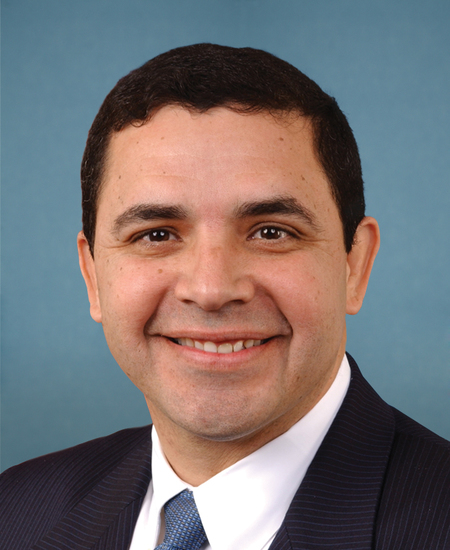
Photo of Henry Cuellar
D United States House · District 28 · Texas On the 2026 ballot

Rep. Henry Cuellar

Compare
Total votes
2,837
all sessions
Attendance
98%
43 missed
Near the chamber average
With party
86%
of cast votes
Among the lowest in the chamber
Bipartisan score
7%
crosses aisle rarely
Higher than 99% of chamber peers
Sponsored
768
bills & resolutions
Lower than 78% of chamber peers
Committees
4
assignments
768 bills and resolutions

Sponsored bills

Total
768
Primary
26
Co-sponsor
742
This page
768
matching current filters
Co-sponsor HR 8150
Passed · Indiana House · Co-sponsor
Reducing Excessive Vetting Authorities to Maintain our Ports Act

Maddy summaryHR 8150 streamlines maintenance for U.S. Customs and Border Protection (CBP) at federal ports of entry by allowing small repair projects (up to $300,000) without lengthy approval processes. It requires CBP to establish and publish clear procedures for these projects, including project types and tenant impact plans, with annual adjustments tied to inflation. The bill directly affects CBP operations at ports where they conduct field activities, enabling faster upkeep of existing infrastructure. Annual reports to Congress must detail all projects, their costs, funding sources, and any budget transfers related to these maintenance efforts.

Passed Dec 17, 2024 1 co-sponsor
Primary HR 6377
In committee · Indiana House · Lead sponsor
ARCC Act

Maddy summaryThe ARCC Act provides $100 million in federal funding to help apprentices and pre-apprentices in job training programs cover childcare costs. It authorizes competitive grants to 10 states, which must distribute monthly stipends of at least $500 per dependent child directly to eligible childcare providers on behalf of participants in these programs. The bill prioritizes individuals from historically underrepresented groups (based on race, ethnicity, or gender) and ensures stipends are tax-free while not affecting eligibility for other federal benefits. States must report on participation, program completion rates, and demographic data, with the Secretary later summarizing program impacts for Congress.

In committee Dec 17, 2024 0 co-sponsors
Co-sponsor HR 5256
In committee · Indiana House · Co-sponsor
Medicare Access to Rural Anesthesiology Act of 2023

Maddy summaryThis bill changes Medicare payment rules for anesthesiologist services in specific rural hospitals. It requires Medicare to pay for anesthesiologist services in qualifying rural hospitals using the same "reasonable cost, pass-through" reimbursement method currently used for certified registered nurse anesthetists (CRNAs), rather than the standard physician payment rate. The bill directly affects rural hospitals and anesthesiologists working in those facilities, ensuring they receive comparable reimbursement to CRNAs under existing rules. The change applies to services provided during cost reporting periods starting after the bill's enactment date. This is a technical adjustment to payment methodology, not a new coverage benefit.

In committee Dec 17, 2024 1 co-sponsor
Co-sponsor HR 4583
In committee · Indiana House · Co-sponsor
Social Security 2100 Act

Maddy summaryThe Social Security 2100 Act would significantly enhance Social Security benefits for millions of Americans by increasing monthly payments for retirees, disabled workers, widows/widowers, and children. Key provisions include raising the minimum benefit for long-term low earners, improving cost-of-living adjustments using a more accurate index, eliminating the 5-month waiting period for disability benefits, and extending child benefits to age 26. The bill also changes how Social Security taxes are calculated by applying them to income above $400,000 and establishes a unified Social Security Trust Fund to manage program finances. Most provisions would apply to benefits payable from 2025 through 2034, affecting all current and future Social Security beneficiaries.

In committee Dec 17, 2024 1 co-sponsor
Co-sponsor HR 4319
In committee · Indiana House · Co-sponsor
Farm Workforce Modernization Act of 2023

Maddy summary# Summary of the Farm Workforce Modernization Act of 2023 This comprehensive legislation introduces significant reforms to employment verification and immigration processes in the United States, with particular focus on agricultural workers. Key provisions include: ## Electronic Verification System (Section 301) - Establishes a new electronic verification system (replacing E-Verify) that must confirm identity and employment authorization within 3 business days - Includes photo matching tools, individual monitoring features, and fraud prevention measures - Requires employers to verify employment eligibility through this system ## Agricultural Industry Requirements (Section 302) - Mandates electronic verification for agricultural employers based on business size: * 500+ employees: 6 months after application period * 100-499 employees: 9 months after application period * 20-99 employees: 12 months after application period * 1-19 employees: 15 months after application period - Creates rural access points through USDA offices to assist with verification challenges ## System Modernization (Section 303) - Repeals the E-Verify Program and replaces it with the new verification system - Requires former E-Verify users to transition to the new system ## Compensation for Errors (Section 301) - Establishes an Electronic Verification Compensation Account to reimburse workers for lost wages due to government errors in verification - Includes procedures for contesting non-confirmations and appealing final nonconfirmations ## Additional Protections - Prohibits unfair immigration-related employment practices (e.g., terminating employees due to tentative nonconfirmations) - Creates a new compensation mechanism for workers wrongfully denied employment - Requires employers to provide specific notices to individuals with verification issues This legislation represents a major overhaul of employment verification processes, with special attention to agricultural workers and a focus on reducing errors that could lead to wrongful termination or denied employment. It also includes significant protections for workers against discrimination based on immigration status.


In committee Dec 17, 2024 1 co-sponsor
Co-sponsor HR 4261
In committee · Indiana House · Co-sponsor
ARC Act of 2023

Maddy summaryThe ARC Act of 2023 establishes a national program to address peripheral artery disease (PAD), which disproportionately affects minority populations and leads to avoidable amputations. The bill requires Medicare and Medicaid to cover PAD screening tests (such as ankle-brachial index testing) for at-risk beneficiaries without cost-sharing, including people 65+ or those with diabetes, smoking history, or other risk factors. It authorizes $6 million annually for a CDC-led education program to inform healthcare providers and the public about PAD prevention and treatment. The bill also creates quality measures to encourage alternative treatments to amputation and establishes a pilot program to test amputation prevention services at healthcare facilities. These provisions aim to reduce amputation rates and improve outcomes for millions of Americans with PAD.

In committee Dec 17, 2024 1 co-sponsor
Co-sponsor HR 4260
In committee · Indiana House · Co-sponsor
Public Servants Protection and Fairness Act of 2023

Maddy summaryThis bill, the Public Servants Protection and Fairness Act of 2023, amends Social Security to better protect public servants who work in jobs not covered by Social Security (such as certain government positions). It creates a new formula for calculating retirement benefits that combines both covered and noncovered earnings, ensuring public servants receive the higher of two benefit calculations. The bill also provides an additional $150 monthly payment for certain public servants whose benefits were previously reduced by the windfall elimination provision. It improves Social Security account statements to clearly show noncovered earnings and requires a study of how state retirement plans handle these benefits. These changes will apply to benefits starting in 2025.

In committee Dec 17, 2024 1 co-sponsor
Co-sponsor HR 3674
In committee · Indiana House · Co-sponsor
Providing Relief and Stability for Medicare Patients Act of 2023

Maddy summaryHR 3674 increases Medicare payments for specific physician services that rely heavily on equipment and supplies (defined as services where 65%+ of costs are for equipment/supplies). It raises payment rates by 10% in 2024 and 15% in 2025 for these services in non-hospital settings like doctor's offices. The bill funds these increases through federal appropriations to the Medicare Trust Fund. It directly affects physicians and clinics providing those defined services, aiming to stabilize reimbursement for providers of high-cost equipment-dependent care.

In committee Dec 17, 2024 1 co-sponsor
Primary HR 3135
In committee · Indiana House · Lead sponsor
LPOE Modernization Trust Fund Act

Maddy summaryThe LPOE Modernization Trust Fund Act (HR 3135) establishes a trust fund to modernize U.S. land border ports of entry. It is funded by 25% of certain immigration and border fees (like the immigrant user fee and land border inspection fees), plus up to $1.6 billion from existing customs processing fees. Funds must be used for specific infrastructure projects: building new ports, expanding existing facilities, purchasing inspection technology, repairing infrastructure, and hiring CBP staff. The bill requires annual reports on fund usage and creates an oversight board with industry and government representatives to prioritize projects.

In committee Dec 17, 2024 0 co-sponsors
Co-sponsor HR 2940
In committee · Indiana House · Co-sponsor
PASTEUR Act

Maddy summaryThe PASTEUR Act establishes a new subscription payment model to incentivize development of new antimicrobial drugs for resistant infections. It creates a Committee on Critical Need Antimicrobials and a Subscription Contract Office to manage payments based on specific drug characteristics like treating multi-drug resistant infections, novel mechanisms of action, and oral administration. Under this model, the government would pay drug developers up to $3 billion over 10 years for qualifying drugs, with payments tied to requirements like ensuring drug availability, reporting resistance data, and developing appropriate use plans. The bill aims to address the lack of new antimicrobial drugs by changing the funding model to reward drugs that meet specific clinical and public health needs.

In committee Dec 17, 2024 1 co-sponsor
Showing 211 to 220 of 768 bills
Previous 1 … 21 22 23 … 77 Next