More Homes on the Market Act This bill increases the amount of gain from the sale of a principal residence that an individual may exclude from gross income (for federal tax purposes). Under the bill, an individual may exclude from gross income gain from the sale of a principal residence of up to $500,000 (currently $250,000), and taxpayers who are married and file a joint federal income tax return may exclude up to $1 million (currently $500.000). The bill also requires these amounts to be adjusted annually for inflation.
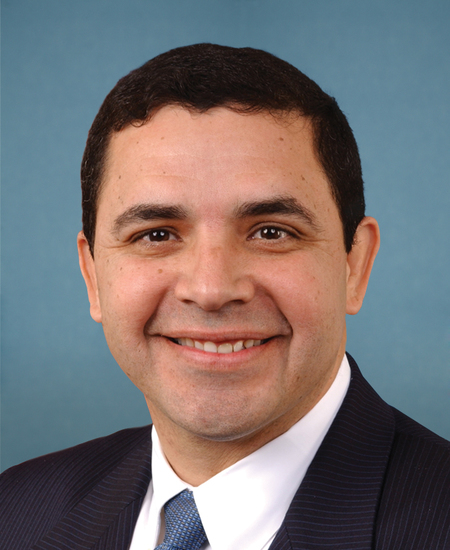
Rep. Henry Cuellar
Sponsored bills
LPOE Modernization Trust Fund Act This bill establishes the Land Port of Entry Modernization Trust Fund and addresses other issues related to U.S. ports of entry. The bill transfers specified amounts, including a portion of certain collected customs fees, to the trust fund each year. It also requires the Department of Homeland Security (DHS) and the Department of State to collect certain surcharges related to immigration and land border inspections, with a portion of the surcharges to be deposited into the trust fund. DHS may not seek to increase fees to offset the amounts transferred into the trust fund. Subject to appropriations, the amounts in the trust fund may be used to (1) construct new ports of entry, (2) expand and improve existing ports of entry, (3) procure technology for inspecting and processing traffic passing through ports of entry, and (4) hiring U.S. Customs and Border Protection staff. DHS must also establish the Land Port of Entry Modernization Oversight Board to advise DHS on how to use the trust fund and to review the trust fund's expenditures.
United States-Israel Defense Partnership Act of 2025 This bill requires or authorizes certain actions to increase defense-related cooperation between the United States and Israel. Specifically, the bill requires the Department of Defense (DOD) to establish a cooperative program, with the concurrence of Israel's Ministry of Defense (MOD), to develop and deploy advanced technologies for countering unmanned systems that threaten the United States and Israel; establish in Israel an office of the Defense Innovation Unit (an organization that focuses on rapidly fielding and scaling commercial technology across the U.S. military); and seek to engage Israel's MOD on the ascension of Israel into the national technology and industrial base (currently defined in law as the persons and organizations engaged in research, development, production, integration, services, or information technology activities conducted within the United States, the United Kingdom, Australia, New Zealand, and Canada). The bill authorizes DOD, upon request of Israel's MOD, to jointly conduct research, development, test, and evaluation (RDT&E) of emerging technologies such as artificial intelligence and robotics to meet defense challenges. Additionally, the bill extends the authority for DOD to (1) carry out RDT&E on a joint basis with Israel to establish anti-tunnel and counter unmanned aerial systems capabilities through 2028, and (2) transfer defense articles intended for use as reserve stocks for Israel through January 1, 2029.

Maddy summaryThis bill creates a 10% tax credit for businesses that modernize or replace freight railcars, directly affecting railcar owners and manufacturers. To qualify, railcars must meet an 8% improvement standard in capacity or fuel efficiency, be built or modernized after enactment, and replace two scrapped railcars. The credit is limited to 1,000 qualified railcars per business annually, with reporting requirements for the Treasury to track claimed credits, scrapped railcars, and new railcar production. The credit applies to railcars placed in service after December 2024, ending three years after enactment.
Maddy summaryHR 1189, the National Plan for Epilepsy Act, creates a coordinated federal strategy to address epilepsy through a National Plan for Epilepsy. The plan requires the Secretary of Health and Human Services to establish an annual assessment, maintain a diverse Advisory Council (including people with epilepsy, caregivers, and experts), and coordinate research and care across federal agencies. Key provisions include annual progress reports to Congress, data sharing between agencies, and recommendations to improve diagnosis, treatment access, and reduce epilepsy-related disparities. The plan expires December 31, 2035, and directly affects the estimated 3.4 million people in the U.S. living with epilepsy and their caregivers.
Maddy summaryThis bill designates the Department of Veterans Affairs community-based outpatient clinic in Lubbock, Texas, as the "General Bernie Mittemeyer VA Clinic" upon enactment. It updates all official references in federal laws, documents, and records to reflect this new name. The bill does not alter services, funding, or operations at the clinic - its sole purpose is to honor General Bernie Mittemeyer through a ceremonial naming designation. This change affects only the clinic's official identification within federal systems.
Maddy summaryHR 1153, the Rural Physician Workforce Production Act of 2025, provides additional Medicare payments to hospitals training medical residents in rural areas to address physician shortages. Hospitals can receive payments equal to the difference between rural training costs (based on 2015 GAO data adjusted for inflation) and standard graduate medical education payments, for residents spending at least 8 weeks in rural settings. It specifically supports hospitals with residency programs where over 50% of training occurs in rural locations, regardless of specialty or training site. This bill directly affects eligible hospitals, including critical access and rural emergency hospitals, by incentivizing rural physician training through updated Medicare funding mechanisms.
Maddy summaryThe Laken Riley Act expands mandatory detention for immigrants convicted of certain property crimes like burglary, theft, or shoplifting by adding these offenses to existing immigration detention criteria. It requires the federal government to issue detainers for such individuals and take custody if not detained by local authorities. The bill also grants state attorneys general standing to sue federal officials in federal court if they believe immigration enforcement actions (like releasing detained immigrants) cause the state financial harm exceeding $100. This creates new legal pathways for states to challenge federal immigration decisions through expedited lawsuits.
Maddy summaryThis bill expands 529 college savings account flexibility by allowing funds to cover costs for industry-recognized postsecondary credentials, not just traditional degrees. It defines "qualified expenses" to include tuition/fees for recognized credential programs (like certifications or apprenticeships), required testing fees, and continuing education needed to maintain credentials. To qualify, programs must meet specific criteria, such as appearing on state lists under the Workforce Innovation and Opportunity Act or being listed in VA or Defense directories. The change applies to 529 distributions made after the law's enactment, giving families more options to use these accounts for job-focused training.
Protect Our Letter Carriers Act of 2025 This bill requires or authorizes certain actions related to the U.S. Postal Service (USPS). The bill requires the Department of Justice to appoint an assistant U.S. attorney in each judicial district to coordinate and supervise the investigation and prosecution of various crimes related to postal services (for example, assault on a postal service employee, breaking into a post office, or obstruction of mails). The bill also requires the U.S. Sentencing Commission to amend sentencing guidelines to provide that the assault or robbery of a postal employee shall be treated the same as the assault of a law enforcement officer. Additionally, the bill authorizes appropriations for the USPS to install high security collection boxes and replace older versions of the universal mailbox key with electronic versions.