

Maddy summaryHRES 348 is a ceremonial House resolution commending Jason Owens for retiring after 29 years of service as U.S. Border Patrol Chief. It recognizes his career, including his leadership as Border Patrol Chief since 2023 and his efforts to strengthen border security operations. The resolution does not enact any policy changes or affect any individuals or programs; it solely expresses the House's appreciation for his service. As a procedural resolution, it has no legal effect.
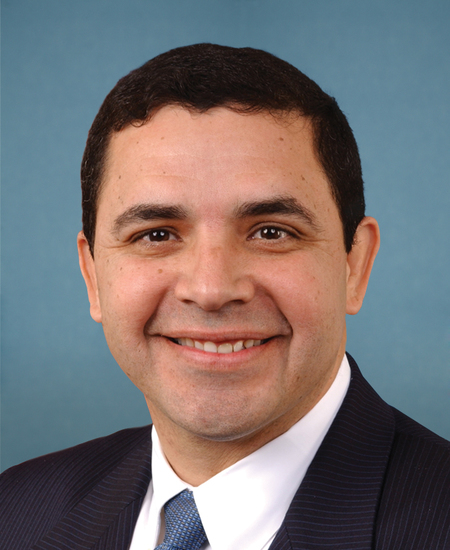
Rep. Henry Cuellar
Sponsored bills
Frederick Douglass Trafficking Victims Prevention and Protection Reauthorization Act of 2025 This bill reauthorizes certain programs and activities that promote awareness of human trafficking and support victims. The bill also establishes a new program to support victims of trafficking. Specifically, this bill reauthorizes through FY2029 programs and activities at the Department of Health and Human Services (HHS) to promote awareness of trafficking and strengthen services for victims, including the National Human Trafficking Hotline and cybersecurity and public education campaigns; Department of Justice grants to support trafficking victims inside the United States, including amounts for housing assistance grants; and International Megan’s Law, which requires sex offenders to provide certain information about their intended travel outside of the United States, among other provisions. The bill also authorizes HHS to carry out a new program—the Human Trafficking Survivors Employment and Education Program—to help victims of trafficking integrate or reintegrate into society.
Maddy summaryHRES 326 is a non-binding resolution designating April 10 as "Dolores Huerta Day" to honor the late labor and civil rights leader Dolores Huerta. It recognizes her foundational work co-founding the United Farm Workers, leading grape boycotts that secured union contracts, advocating for farm workers' safety, and championing women's rights and Latino political representation. The resolution has no policy impact or direct effect on any group, as it solely serves to commemorate Huerta's legacy. It was introduced by multiple House members in recognition of her contributions to civil rights and equality.
Maddy summaryThe Housing Supply Frameworks Act (HR 2840) directs the Department of Housing and Urban Development (HUD) to create federal guidelines and best practices for state and local governments to reform zoning rules that restrict housing supply. It focuses on practical changes like reducing parking minimums, allowing more housing types (e.g., duplexes, accessory dwellings), streamlining approval processes, and increasing density near transit - aiming to address a nationwide housing shortage affecting cost-burdened households. The guidelines, developed with public input from planners, developers, and community groups, are intended to help states and localities voluntarily adopt reforms that increase housing availability across income levels. States and localities that adopt these recommendations must report progress to Congress within five years, though the bill does not mandate specific changes or provide direct housing construction funds.
Transportation Freedom Act This bill reduces taxes on auto companies and repeals specified environmental regulations on cars and trucks. The bill establishes a new tax deduction equal to 200% of eligible wages paid or incurred by domestic producers of automobiles or automobile components, subject to limitations. It also allows an entity to reduce (and adjust) its financial statement income (for purposes of calculating liability for the alternative minimum tax) by the amount of eligible wages it elects to deduct. The bill nullifies the 2024 rules of the Environmental Protection Agency (EPA) regarding (1) the finalization of specified greenhouse gas (GHG) programs and the reduction of emissions from certain light-duty and medium-duty vehicles (e.g., cars and trucks that are under a certain weight) starting with model year 2027, and (2) phase three of GHG emission standards for heavy-duty vehicles (e.g., school buses and tractor-trailer trucks). It also repeals the 2024 rules of the National Highway Traffic Safety Administration (NHTSA) regarding corporate average fuel economy (CAFE) standards for certain cars, trucks, and vans. Additionally, the bill eliminates (1) the option given to California to set standards for car emissions that are more stringent than those set under the Clean Air Act, and (2) the option for other states to adopt California's standards. NHTSA and the EPA must establish new CAFE and GHG standards, respectively, for vehicles that are economically practicable and technologically feasible. The GHG standards may not require the production or sale of electric vehicles.
Maddy summaryThe American Family Act (HR 2763) establishes a new refundable child tax credit that provides monthly payments to eligible families with children. It would pay $300 per month for each child under age 6 and $360 per month (120% of $300) for each child age 6 or older, with income limits of $150,000 for joint filers and $112,500 for other filers. The bill creates a "period of presumptive eligibility" to determine eligibility for monthly payments, allowing families to receive advance payments based on information from previous tax returns. This would directly affect millions of families with children who meet the income requirements, providing more consistent financial support throughout the year rather than an annual tax credit.
Frederick Douglass Trafficking Victims Prevention and Protection Reauthorization Act of 2025 This bill reauthorizes certain programs and activities that promote awareness of human trafficking and support victims. The bill also establishes a new program to support victims of trafficking. Specifically, this bill reauthorizes through FY2029 programs and activities at the Department of Health and Human Services (HHS) to promote awareness of trafficking and strengthen services for victims, including the National Human Trafficking Hotline and cybersecurity and public education campaigns; Department of Justice grants to support trafficking victims inside the United States, including amounts for housing assistance grants; and International Megan’s Law, which requires sex offenders to provide certain information about their intended travel outside of the United States, among other provisions. The bill also authorizes HHS to carry out a new program—the Human Trafficking Survivors Employment and Education Program—to help victims of trafficking integrate or reintegrate into society.
Maddy summaryHR 2729, the "Carnivals are Real Entertainment Act," creates a new temporary work visa category for carnival and circus workers. It directly affects mobile entertainment providers (like traveling carnivals, circuses, and affiliated food/game concession services) and their workers who perform essential tasks such as transporting, assembling, operating, and maintaining rides and equipment at seasonal fairs and festivals. The bill amends immigration law to define "mobile entertainment workers" as those entering temporarily for functions integral to these operations, subject to labor program requirements similar to other temporary work visas. It requires the Departments of Homeland Security and Labor to issue implementing rules within one year of enactment.
Maddy summaryThis bill makes it a federal crime to intentionally cause or arrange collisions involving commercial motor vehicles (like trucks) for insurance fraud. It imposes fines and prison sentences of up to 20 years for basic staging, and at least 20 years if the collision causes serious injury or death. The law directly affects individuals who commit this type of fraud, which is often used to file false insurance claims. It also prevents federal prosecution if someone was already convicted or acquitted under state law for the same act.
Maddy summaryThe No Tax Breaks for Union Busting Act would deny tax deductions for employers who spend money to influence employees' decisions about union activities, such as union elections or collective bargaining. It defines "labor organization activities" broadly to include union elections, labor disputes, and collective actions. The bill requires employers to report such spending on tax returns and prevents them from deducting these expenses from taxable income. This would apply to employers using tactics like captive audience meetings, outside consultants, or other efforts to sway workers' union decisions. The policy aims to remove tax incentives for employers to interfere with workers' rights under labor law.