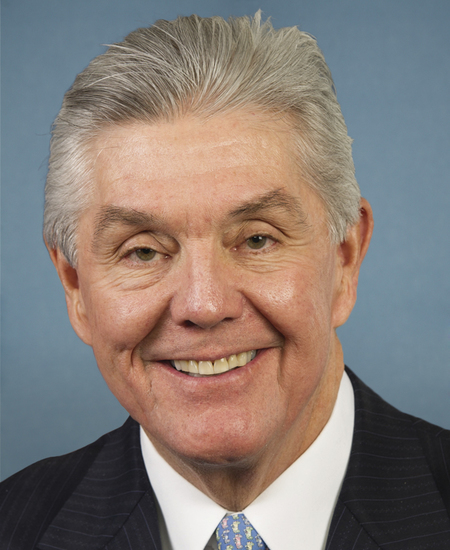
Photo of Roger Williams
R United States House · District 25 · Texas On the 2026 ballot

Rep. Roger Williams

Compare
Total votes
2,837
all sessions
Attendance
94%
182 missed
Near the chamber average
With party
95%
of cast votes
Near the chamber average
Bipartisan score
3%
crosses aisle rarely
Near the chamber average
Sponsored
801
bills & resolutions
Near the chamber average
Committees
4
assignments
801 bills and resolutions

Sponsored bills

Total
801
Primary
83
Co-sponsor
718
This page
801
matching current filters
Co-sponsor HR 7548
In committee · Indiana House · Co-sponsor
SCAM Act

Maddy summaryThe SCAM Act requires online platforms that display paid advertisements (like social media sites) to verify advertiser identities, implement scam detection systems, and remove fraudulent ads within 24 hours of confirmation. It directly affects platforms that accept payment for ads, targeting scams such as fake giveaways, romance scams, and AI impersonations that cost consumers $195 billion in 2024 (per FTC data). Key mechanisms include mandatory identity checks for advertisers, active monitoring systems, and a 72-hour investigation window for reported scams. The law aims to reduce fraud by shifting responsibility to platforms, with enforcement by the FTC and state attorneys general.

In committee Feb 12, 2026 1 co-sponsor
Co-sponsor HR 7442
In committee · Indiana House · Co-sponsor
National Bridge Funding Reform Act

Maddy summaryHR 7442 establishes a new National Bridge Program under federal highway law to allocate funding for bridge replacement, rehabilitation, and construction. It changes how funds are distributed: 75% based on the total deck area of bridges on federal-aid highways in each state, and 25% based on the deck area of bridges in poor condition. This directly affects state transportation departments managing federal-aid highway bridges, requiring them to prioritize projects using this updated formula starting after December 31, 2024. The bill eliminates prior programs (Carbon Reduction and PROTECT) and revises related funding mechanisms.

In committee Feb 10, 2026 1 co-sponsor
Co-sponsor HR 5221
In committee · Indiana House · Co-sponsor
PART Act

Maddy summaryThe PART Act requires new vehicles to have catalytic converters marked with a unique identification number that links directly to the vehicle's identification number, stored in a law enforcement-accessible database. It establishes a $7 million grant program to help repair shops, dealers, law enforcement, and fleet owners purchase equipment for marking converters with visible, durable identifiers (using die or pin stamping and high-visibility paint). The bill also mandates that businesses buying catalytic converters keep detailed seller records (including vehicle information) for two years and use traceable payments, banning cash or cryptocurrency transactions. Additionally, it creates new federal criminal penalties for stealing or trafficking in catalytic converters, with potential sentences of up to five years in prison.

In committee Feb 10, 2026 1 co-sponsor
Co-sponsor HR 3699
In committee · Indiana House · Co-sponsor
Energy Choice Act

Maddy summaryThis bill prevents state or local governments from banning or restricting energy connections (like installation, modification, or access) based on the type or source of energy, such as electricity, natural gas, or renewable fuels. It directly affects consumers choosing energy providers and energy companies seeking to offer services. The key provision prohibits local laws, regulations, or policies that limit energy services sold in interstate commerce, covering all energy types listed in the bill’s definitions. It does not create new programs but limits regulatory authority at the state or local level. The law aims to ensure open access to diverse energy sources without source-based restrictions.

In committee Feb 4, 2026 1 co-sponsor
Co-sponsor HR 7300
In committee · Indiana House · Co-sponsor
Make Elections Great Again Act

Maddy summaryThe Make Elections Great Again Act (HR 7300) would require voters to present photo identification to cast ballots in person or by mail for federal elections, with limited exceptions for religious objections or military voters. It would establish new requirements for proving U.S. citizenship during voter registration, including documentary proof of citizenship and proof of state residency. The bill would change mail-in ballot procedures by requiring voters to request mail-in ballots (rather than universal mail-in voting), implementing barcode tracking for mail-in ballots, and setting strict deadlines for ballot receipt. These provisions would apply to all states for federal elections held in 2027 or later, affecting how voters register, vote in person, and submit mail-in ballots for federal office elections.

In committee Feb 2, 2026 1 co-sponsor
Co-sponsor HR 7296
In committee · Indiana House · Co-sponsor
SAVE America Act

Safeguard American Voter Eligibility Act or the SAVE America Act This bill requires individuals to provide documentary proof of U.S. citizenship when registering to vote, and requires photo identification to vote, in federal elections. Specifically, the bill prohibits states from accepting and processing an application to register to vote in a federal election unless the applicant presents documentary proof of U.S. citizenship. The bill specifies what documents are considered acceptable proof of U.S. citizenship, such as identification that complies with the REAL ID Act of 2005 that indicates U.S. citizenship. Further, the bill (1) prohibits states from registering an individual to vote in a federal election unless, at the time the individual applies to register to vote, the individual provides documentary proof of U.S. citizenship; and (2) requires states to establish an alternative process to demonstrate U.S. citizenship. Each state must take affirmative steps on an ongoing basis to ensure that only U.S. citizens are registered to vote, which shall include establishing a program to identify individuals who are not U.S. citizens using information supplied by certain sources. Additionally, states must remove noncitizens from their official lists of eligible voters. The bill (1) provides for a private right of action for certain violations, and (2) establishes criminal penalties for certain offenses. Individuals voting in federal elections must present an eligible photo identification document. An individual who votes by absentee ballot must submit a copy of their identification document with both the request for, and the submission of, the absentee ballot.


In committee Jan 30, 2026 1 co-sponsor
Primary HR 5763
Passed · Indiana House · Lead sponsor
Main Street Parity Act

Maddy summaryThe Main Street Parity Act (HR 5763) adjusts eligibility rules for small businesses seeking SBA loans to acquire, build, convert, or expand facilities. It modifies Section 502(3)(C) of the Small Business Investment Act by removing two specific criteria and reorganizing the remaining requirements. This change directly affects small businesses applying for these particular SBA loans, simplifying the application process by eliminating outdated or redundant conditions. The bill makes technical adjustments to the loan criteria without creating new programs or altering funding levels.

Passed Jan 26, 2026 0 co-sponsors
Co-sponsor HR 7230
In committee · Indiana House · Co-sponsor
Buying American Cotton Act of 2026

Maddy summaryThis bill creates a tax credit for businesses selling products made with U.S.-grown cotton. The credit equals 24% of the cotton's market value if processed only in the U.S. or in countries with U.S. trade deals, or 18% for other processing locations. To qualify, cotton must be digitally traced from U.S. farms to finished products and certified by the USDA as meeting origin requirements. It directly affects clothing and textile manufacturers selling qualifying products in the U.S. market.

In committee Jan 22, 2026 1 co-sponsor
Co-sponsor HR 7156
In committee · Indiana House · Co-sponsor
SCAM Act

Maddy summaryHR 7156, the SCAM Act, would expand grounds for revoking U.S. citizenship (denaturalization) for naturalized citizens who commit specific offenses within 10 years of becoming citizens. It targets individuals convicted of defrauding federal, state, or local governments (e.g., $10,000+ in public benefit fraud), affiliating with foreign terrorist organizations, or committing aggravated felonies or espionage. If convicted in these categories, the government could automatically revoke citizenship retroactively (as if it never existed) based on evidence that the person lacked good moral character or loyalty to the U.S. at the time of naturalization. This bill directly affects naturalized citizens who commit these offenses within a decade of gaining citizenship, with revocation triggering immediate deportability.

In committee Jan 20, 2026 1 co-sponsor
Co-sponsor HR 7034
In committee · Indiana House · Co-sponsor
To amend the Internal Revenue Code of 1986 to eliminate the dollar limitations on the exclusion of gain from sales of principal residences, and for other purposes.

Maddy summaryHR 7034 would remove the current $250,000 (single filers) and $500,000 (married couples) tax exclusion limit for capital gains when selling a primary residence. This change would allow all homeowners to exclude their full profit from federal income tax upon selling their main home, regardless of the sale price. The bill amends Section 121 of the Internal Revenue Code to eliminate the dollar caps and adjusts related provisions to reflect this change. It directly affects homeowners who sell their primary residence, making the tax exclusion fully unlimited for qualifying sales after the bill's enactment.

In committee Jan 13, 2026 1 co-sponsor
Showing 61 to 70 of 801 bills
Previous 1 … 6 7 8 … 81 Next