

Maddy summaryThe IDEA Full Funding Act (HR 4519) mandates specific annual increases in federal funding for special education programs under the Individuals with Disabilities Education Act (IDEA). It requires Congress to appropriate increasing amounts each fiscal year - from $5.87 billion for 2024 up to $55.53 billion for 2033 - to reach 40% of the national average per-pupil expenditure for public schools by 2033. This directly affects all public school districts serving students with disabilities, as federal IDEA funding supports their special education services. The bill sets fixed dollar amounts or percentage targets (whichever is greater) for each fiscal year, aiming to gradually close the long-standing gap between promised and actual federal funding. It does not alter eligibility for services but mandates higher, phased funding levels to meet the 40% target.
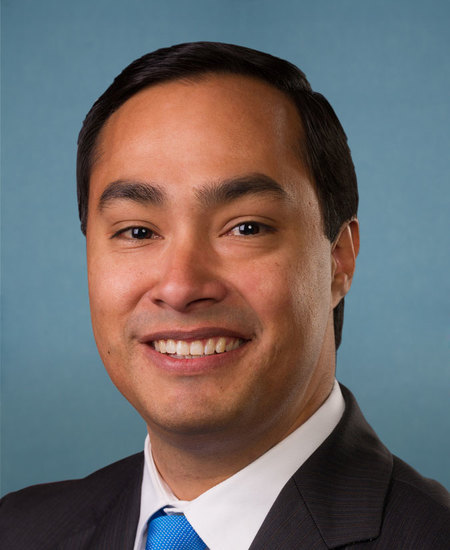
Rep. Joaquin Castro
Sponsored bills
This resolution expresses the sense of the House of Representatives that (1) lesbian, gay, bisexual, transgender, queer, intersex, and asexual (LGBTQIA+) rights are human rights and protected by the U.S. Constitution; (2) LGBTQIA+ Pride Month should be celebrated; and (3) all Americans should be treated equally regardless of sexual orientation, sex characteristics, or gender identity.
Maddy summaryThis bill prohibits defendants in federal criminal cases from using a victim's LGBTQ+ identity (sexual orientation, gender identity, or expression) as a legal excuse for violence or to reduce sentences - a practice known as the "LGBTQ+ panic defense." It specifically bans arguments that a "nonviolent sexual advance or perception" of the victim's identity justified the crime, while allowing evidence of the defendant's past trauma under standard evidence rules. The law directly affects federal criminal trials where defendants attempt to justify violence against LGBTQ+ victims using prejudice-based excuses. It also requires the Attorney General to report annually on federal prosecutions involving bias-motivated crimes against LGBTQ+ individuals.
Maddy summaryHR 4422 (Global Respect Act) requires the President to publicly identify foreign officials responsible for violence, torture, or arbitrary detention against LGBTQI individuals and block their entry to the U.S., including revoking visas for them and their immediate families. It mandates annual reporting to Congress on the list of sanctioned individuals, the reasons for additions/removals, and efforts to coordinate with other countries on similar sanctions. The bill also updates U.S. human rights reporting requirements to explicitly include data on violence and discrimination against LGBTQI people worldwide. These measures aim to increase accountability for human rights violations against LGBTQI individuals without advocating for specific policy outcomes.
Maddy summaryHR 4340, the Therapeutic Fraud Prevention Act of 2023, prohibits paid providers from offering conversion therapy - defined as any commercial service attempting to change a person's sexual orientation or gender identity - and bans advertising that claims such therapy is effective or harmless. It directly affects therapists, counselors, or organizations offering paid conversion therapy services, including those advertising such services. Key provisions make it unlawful to provide, advertise, or facilitate paid conversion therapy, with enforcement led by the Federal Trade Commission (FTC) under consumer protection laws and allowing states to pursue civil actions. The bill explicitly excludes supportive care for gender transition or identity exploration from its definition of prohibited therapy.
Maddy summaryHRES 557 is a non-binding resolution honoring the historical contributions and struggles of Texas' LGBTQ+ community. It recognizes key milestones like Dallas' first pride parade (1972), the legalization of same-sex marriage in Texas (2015), and local advocacy efforts. The resolution does not create new laws or policies - it solely serves as a ceremonial acknowledgment of the community's fight for equality. It cites specific Texas events (e.g., the 1975 Houston LGBT Political Caucus founding) but has no legal effect on discrimination protections or state codes.
Maddy summaryHR 4352, the Nicaragua Political Prisoner Support Act, provides specific benefits to Nicaraguans who arrived in the U.S. on February 9, 2023, as part of a political prisoner release, and their immediate family members. It grants these individuals access to refugee-equivalent resettlement assistance, child welfare services, and driver's licenses - matching benefits available to refugees under existing law. The bill does not confer lawful permanent residency or alter their current parole status. Eligibility requires passing background checks and maintaining valid parole, with specific protections against termination if renewal was pending.
Healthcare Equality and Rights for Our Heroes Act or the HERO Act This bill allows claims to be brought against the United States for damages relating to the personal injury or death of a member of the Armed Forces arising out of a negligent or wrongful act or omission in providing medical, dental, or related health care functions at a military medical treatment facility. However, the bill does not apply to care provided at a medical treatment location deployed in an area of armed combat.
Maddy summaryHR 4325, the Historically Underserved Veterans Inclusion Act of 2023, expands the Department of Veterans Affairs' Center for Minority Veterans to include "historically underserved" veterans and modifies its advisory committee. The bill broadens the definition of "covered veterans" to include veterans facing barriers based on sexual orientation, gender identity, English language proficiency, citizenship, religion, or other factors identified through a biennial review. Key provisions require the VA Secretary to conduct biennial reviews of benefit disparities and submit reports to Congress, while the expanded advisory committee must advise on improving benefits, health care, homelessness services, and outreach for these veterans. The bill directly affects veterans who experience systemic barriers in accessing VA services, aiming to make VA programs more inclusive through concrete policy adjustments.
Maddy summaryHR 4335, the VA Loan Informed Disclosure Act of 2023, requires mortgage lenders to include specific information about VA home loan programs in standard mortgage disclosures. The bill amends the National Housing Act to mandate that lenders provide details on VA loans (guaranteed under Title 38) alongside other loan options, including assumptions about prevailing interest rates. This change directly affects lenders processing VA-guaranteed mortgages, ensuring borrowers receive clearer comparisons between VA loans and other financing. The law does not require lenders to verify borrower eligibility for VA loans, only to include the specified disclosure language.