Disarm Hate Act The bill expands the categories of persons who are prohibited from receiving or possessing a firearm. Specifically, it prohibits firearm sale or transfer to and receipt, possession, shipment, or transport by a person (1) who has been convicted of a misdemeanor hate crime, or (2) who has received an enhanced hate crime misdemeanor sentence.
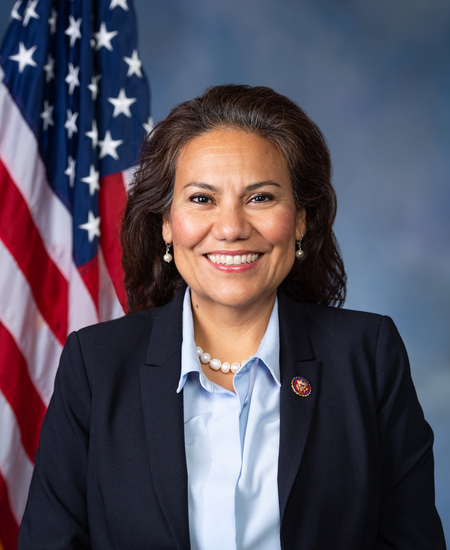
Rep. Veronica Escobar
Sponsored bills
Homeland Security Improvement Act This bill establishes various bodies and policies related to border security operations. It also limits when the Department of Homeland Security (DHS) may separate a child from a parent or legal guardian. The bill establishes the independent DHS Border Oversight Commission. The commission's duties shall include recommending policies to protect civil rights and improve the safety of U.S. Customs and Border Protection (CBP) and U.S. Immigration and Customs Enforcement (ICE) officers. The bill establishes the Office of the Ombudsman for Border and Immigration Related Concerns. The office shall independently receive and resolve complaints and requests for assistance regarding border security and immigration activities. The office shall have the power to provide redress, including immigration relief and monetary damages. The bill establishes the Border Community Liaison Office. The office's duties include consulting with communities in sectors on the northern and southern borders when developing policies and programs. DHS must ensure CBP officers receive continual education and training each year on topics including interaction with vulnerable populations and professional conduct standards. The bill imposes data collection requirements on law enforcement officials conducting border and immigration-related stops and searches. A child may not be removed from a parent or legal guardian at or near a port of entry or within 100 miles of the border except in certain instances, such as when a court determines that removal of the child is in the child's best interests. The bill requires various reports, including a Government Accountability Office report on the use of force by CBP and ICE.
Menstrual Equity For All Act of 2021 This bill expands access to free sanitary napkins and tampons (i.e., menstrual products) in certain locations and for particular groups. It also requires Medicaid to cover menstrual products, as well as liners, cups, and similar items used by individuals with respect to menstruation. Specifically, the bill imposes requirements to make free menstrual products available in federal and state correctional facilities (including facilities that house aliens detained by the Department of Homeland Security) and restrooms in federal buildings that are open to the public. It also establishes a demonstration grant program to support the provision of free menstrual products on campuses of institutions of higher education and permits elementary and secondary schools to use certain grants to provide menstrual products to students. Furthermore, the bill requires employers with at least 100 employees to provide free menstrual products for employees. It also permits the use of certain grants for emergency food and shelter to provide menstrual products to homeless individuals.
Keeping Our Promise Act This bill authorizes issuing visas to certain individuals who were previously refused a diversity immigrant visa or admission into the United States because of certain executive orders or the COVID-19 public health emergency. (Diversity immigrant visas are available to eligible immigrants from countries with relatively low rates of immigration to the United States.) Specifically, this bill applies to individuals who were refused such a visa solely due to certain executive orders from 2017 to 2020, including orders which suspended the entry of individuals from certain countries. The bill also applies to diversity visa applicants who, because of the COVID-19 emergency, were (1) unable to receive a visa interview despite requesting one, or (2) unable to be admitted into the United States despite being approved for a visa. The Department of State must notify each individual covered under this bill of the individual's visa eligibility. To retain eligibility, an individual must respond to the State Department's notice within one year of the notice. An individual may also lose eligibility if the State Department determines that the applicant fails to meet certain requirements. The bill also relaxes certain annual numerical limits for individuals obtaining a visa under this bill. An individual who was a child when initially selected for a visa shall be treated as a child for the purposes of a visa application under this bill.
Extreme Risk Protection Order Act of 2021 This bill establishes grants to support the implementation of extreme risk protection order laws at the state and local levels, extends federal firearms restrictions to individuals who are subject to extreme risk protection orders, and expands related data collection. Extreme risk protection order laws, or red flag laws, generally allow certain individuals (e.g., law enforcement officers or family members) to petition a court for a temporary order that prohibits an at-risk individual from purchasing and possessing firearms. Among its provisions, the bill directs the Office of Community Oriented Policing Services within the Department of Justice to establish a grant program to help states, local governments, Indian tribes, and other entities implement extreme risk protection order laws; extends federal restrictions on the receipt, possession, shipment, and transportation of firearms and ammunition to individuals who are subject to extreme risk protection orders; and requires the Federal Bureau of Investigation to compile (and later destroy) records from federal, tribal, and state courts and other agencies that identify individuals who are subject to extreme risk protection orders.

Abortion Care Awareness Act of 2022 This bill requires the Department of Health and Human Services to carry out a campaign to educate the public about how to access abortion and related health services. The campaign must address, among other matters, the legality of interstate travel to obtain abortions and related services and accurate information about medication abortions.
HHS Reproductive and Sexual Health Ombuds Act of 2022 This bill creates a position within the Department of Health and Human Services to support access to reproductive and sexual health services (including services relating to pregnancy and the termination of a pregnancy) that are evidence-based and medically accurate.
Major Richard Star Act This bill provides that combat-disabled uniformed services retirees with fewer than 20 years of creditable service may concurrently receive, without reduction, veterans' disability compensation and retired pay or combat-related special compensation.
Advancing Justice for Servicemembers Act This bill requires authorized officials to ensure procedures and requirements for a complaint are completed within 180 days after the complaint is received for complaints from members of the Armed Forces related to harassment or prohibited discrimination. If an authorized official does not take final action on a harassment or prohibited discrimination complaint within 180 days or provide the member a written explanation of the final action in relation to the complaint, a member of the Armed Forces may seek a court order directing the military department concerned to take final action or provide a written explanation.
Fiscal Year 2022 Veterans Affairs Major Medical Facility Authorization Act This act authorizes the Department of Veterans Affairs to carry out specified major medical facility projects during FY2022. The act also indicates the maximum amount that can be spent on each project.