

Maddy summaryHR 4166, the Support UNFPA Funding Act, authorizes annual U.S. funding for the United Nations Population Fund (UNFPA) over five years. It directly supports UNFPA’s global programs serving women and girls in over 150 countries, particularly focusing on reducing preventable maternal deaths, expanding access to contraception, ending gender-based violence, and addressing harmful practices like female genital mutilation and child marriage. The bill specifically directs funding toward UNFPA’s core work in developing nations, humanitarian crises (such as in Ukraine and Yemen), and rebuilding health systems post-pandemic, without altering UNFPA’s existing operations or policies.
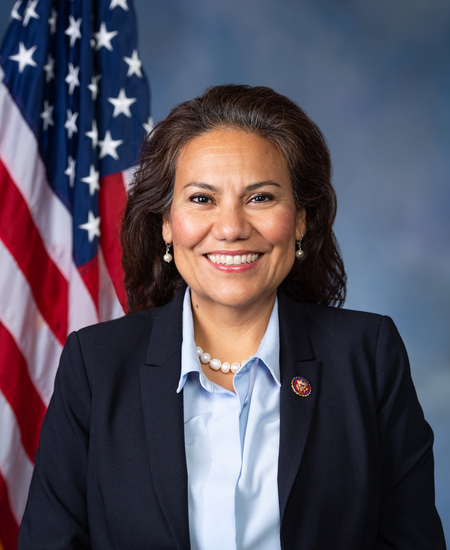
Rep. Veronica Escobar
Sponsored bills
Maddy summaryThe American Dream and Promise Act of 2023 would create two pathways to permanent residency for certain immigrants. The "Dream Act" portion would provide conditional permanent resident status to individuals who entered the U.S. as children, have lived continuously in the U.S. since January 1, 2021, and meet educational requirements (such as completing high school, earning a degree, or enrolling in education programs). The "American Promise Act" portion would provide permanent residency to individuals eligible for Temporary Protected Status (TPS) or Deferred Enforced Departure (DED) as of specific dates (January 1, 2017, or January 20, 2021). The bill includes provisions for background checks, fee exemptions for low-income applicants, and processes for removing conditional status after meeting specific criteria like completing higher education or earning income.
Maddy summaryHRES 272 is a non-binding resolution passed by the U.S. House of Representatives calling on Russia to immediately release Paul Whelan, a U.S. citizen and Michigan resident imprisoned since 2018 on espionage charges without evidence. It demands Russia provide Whelan with consular access, ensure due process rights, and release him from his 16-year labor camp sentence. The resolution also thanks Canada, Ireland, and the U.K. for their efforts to secure his freedom and expresses sympathy to his family. As a formal statement of congressional position, it does not compel action but underscores the House's stance on Whelan's case.
Maddy summaryThe College for All Act of 2023 would create a federal-state partnership to eliminate tuition and required fees for eligible students at public community colleges and 4-year institutions. It would provide federal funding to cover tuition costs for students from families earning up to $125,000 annually (or $250,000 for married couples) at public institutions, with states gradually increasing their financial contribution over time. The bill also includes provisions to support historically Black colleges and universities, minority-serving institutions, and expands Pell Grant eligibility to include Dreamers. States would be required to maintain funding levels for higher education and implement specific reforms to improve student outcomes, including transfer pathways and support services.
Maddy summaryThis bill requires federal agencies collecting demographic survey data to begin including questions on sexual orientation, gender identity, and variations in sex characteristics (intersex traits) within 360 days of enactment. Agencies must review existing surveys to identify gaps, develop privacy-protective methods for collecting this data (including anonymization and data destruction protocols), and incorporate it into relevant reports within three years. The law applies to all federal surveys that collect standard demographic data (like race, ethnicity, and age), such as the census or health surveys, but does not compel individuals to disclose their status. It emphasizes maintaining confidentiality, allows limited agency waivers if standards can't be met, and mandates a congressional report on implementation within two years.
Maddy summaryHR 3973, the Judicial Ethics and Anti-Corruption Act of 2023, establishes new ethics rules for federal judges and justices. The bill prohibits judges from owning stocks, commercial real estate, business interests, and certain trusts, while creating a Federal Employee Investment Account for permitted investments. It requires judges to disclose potential conflicts of interest, restricts privately funded judicial education events, and creates a Supreme Court Complaints Review Committee to handle complaints against justices. The bill aims to increase transparency and reduce conflicts of interest for federal judges and justices.
Maddy summaryHRES 483 is a symbolic resolution recognizing June 2023 as "Immigrant Heritage Month" to celebrate immigrants and their children for their contributions to U.S. health, safety, diversity, and prosperity. It highlights immigrants' roles in critical sectors like healthcare (including 27% of physicians) and the economy (e.g., 44% of Fortune 500 companies founded by immigrants or their descendants). The resolution urges the House to celebrate immigrant contributions, welcome immigrants, and work toward "smart and just immigration policy." As a non-binding resolution, it does not change laws but formally acknowledges immigrants' historical and ongoing impact on U.S. society.
Maddy summaryThe American Family Act establishes a monthly child tax credit of $250 per month for each child under age 6 and $300 per month for each child aged 6-18, with income limits of $150,000 for joint filers and $112,500 for other filers. The credit is refundable, meaning it can be paid even if the taxpayer owes no income tax, and will be adjusted annually for inflation. The bill includes detailed rules for determining eligibility, including requirements that the child resides with the taxpayer for more than half the month and provisions to prevent fraud through recapture of improperly received payments. The credit will be paid monthly in advance rather than as a single annual payment, with specific mechanisms for calculating and distributing the payments.
Uyghur Genocide Intelligence Review Act This bill requires all elements of the U.S. intelligence community to ensure timely and effective intelligence collection relating to the Uyghur genocide. (The Uyghurs are a predominantly Muslim ethnic minority group living primarily in the Xinjiang Uyghur Autonomous Region in China. In 2021, the Department of State determined that China had committed genocide against the Uyghurs and other ethnic and religious minority groups in Xinjiang.) The bill also requires the Office of the Director of National Intelligence to submit an annual report to Congress on the Uyghur genocide. This report must include information related to topics such as forced sterilization, forced abortion, torture, surveillance, forced labor, and work conditions of Uyghurs.
Maddy summaryHR 698, the Assault Weapons Ban of 2023, prohibits the sale, manufacture, transfer, and possession of specific firearms and ammunition devices commonly referred to as "assault weapons" and "large capacity magazines" in interstate commerce. The bill defines "semiautomatic assault weapons" to include rifles like AR-15s and AK-47s, as well as firearms with specific features such as folding stocks, pistol grips, threaded barrels, and detachable magazines holding more than 15 rounds. It exempts law enforcement, military, antique firearms, and weapons already lawfully owned before the law's enactment (known as "grandfathered" weapons). The bill also requires new identification markings on these weapons and large capacity magazines, and adds background check requirements for transfers of grandfathered weapons.