

Maddy summaryHR 9274, the SHAWL Act, establishes two new Smithsonian museums: the National Museum of the American Latino and the American Women’s History Museum. It authorizes both museums to be located within the National Mall’s "Reserve" area, overriding prior restrictions, and requires federal agencies managing potential sites to transfer jurisdiction to the Smithsonian after notifying congressional committees. The bill mandates that both museums accurately represent diverse cultures, histories, and viewpoints within Latino and women’s communities through exhibits and programs, requiring input from a broad range of community experts. It also requires the Smithsonian to submit biennial reports to Congress detailing compliance with these representation requirements.
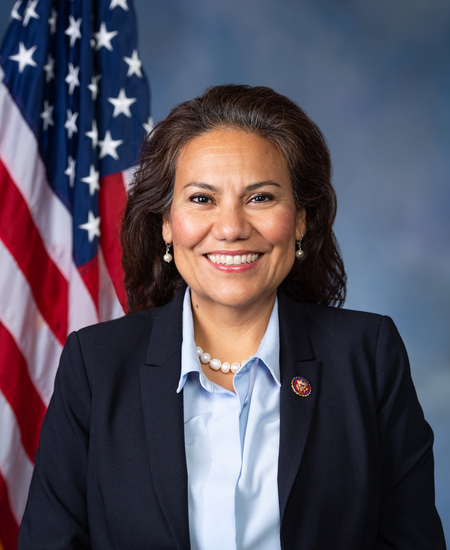
Rep. Veronica Escobar
Sponsored bills
Maddy summaryThe Active Shooter Alert Act of 2024 establishes a national coordination system for active shooter alerts by designating a Department of Justice Coordinator. The Coordinator will work with federal agencies (FEMA, FCC, Transportation) and state/local governments to develop voluntary best practices for alert systems, including geotargeted notifications, multilingual messaging, and training for transportation authorities. The bill requires annual reports to Congress on state adoption of protocols and mandates a Comptroller General study on state response times to active shooter alerts, funded by $2 million for the Department of Justice. It does not mandate state adoption but encourages coordination to improve alert effectiveness.
Maddy summaryH.J. Res. 193 proposes a constitutional amendment to eliminate legal immunity for federal officials, including the President, from criminal prosecution for actions taken while performing official duties. It also prohibits the President from granting a pardon to themselves. The amendment would apply to all federal officers (such as the President, Vice President, and members of Congress) except for Congress members acting in their legislative role as defined in the Constitution. If ratified by 38 states, this change would become part of the U.S. Constitution, requiring no further congressional action.
Maddy summaryThis bill designates the U.S. Postal Service facility at 4650 East Rosedale Street in Fort Worth, Texas, as the "Dionne Phillips Bagsby Post Office Building." It updates all official references (in laws, maps, documents, etc.) to this specific location to reflect the new name. The bill has no policy provisions or direct impact on constituents beyond renaming the post office facility.
Maddy summaryHR 6362, the Protecting Benefits for Disabled Veterans Act of 2023, allows the VA to assign a total disability rating to veterans with service-connected disabilities who cannot work due to those conditions. It specifies that veterans qualify if they have one disability rated at least 60% or multiple disabilities totaling 70% (with at least one at 40%), and the VA must consider certain disability combinations as a single condition. The bill prohibits the VA from considering a veteran’s age or Social Security benefits when making this determination, and clarifies that veterans maintaining marginal employment (below the poverty threshold) may still qualify for total disability. This change directly affects disabled veterans seeking full benefits by providing clearer pathways to qualify for total disability ratings based on employment impact.
Maddy summaryHRES 1353 is a resolution introduced by House members to impeach Supreme Court Associate Justice Clarence Thomas. The resolution outlines three articles of impeachment alleging Thomas failed to disclose gifts and financial transactions with donor Harlan Crow over 15 years, refused to recuse from cases involving his spouse's financial interests, and participated in cases concerning the 2020 election results despite his spouse's involvement in efforts to overturn them. These allegations claim Thomas violated federal ethics laws requiring judicial disclosure and recusal to maintain impartiality. The resolution would be referred to the Senate for trial if passed by the House, but it is not a law that would directly affect anyone beyond the impeachment process.
Maddy summaryThis resolution (HRES 1354) is a formal House of Representatives impeachment action against Supreme Court Justice Samuel Alito, introduced by multiple Democratic representatives on July 10, 2024. It alleges two violations: (1) Alito failed to recuse himself from three election-related cases (Trump v. United States, Fischer v. United States, and Trump v. Anderson) despite flying flags associated with the 2020 election denial movement outside his homes, which the resolution claims demonstrated bias; and (2) Alito allegedly failed to disclose luxury travel gifts from donors, violating financial disclosure laws. The resolution argues these actions breached his judicial oaths and federal recusal statutes (28 U.S.C. § 455) and financial disclosure requirements (5 U.S.C. §§ 13103-13104). As a procedural resolution, it initiates impeachment proceedings but does not change law or policy; the Senate would need to hold a trial for removal.
Maddy summaryThis bill increases military pay rates for all service members across pay grades and years of service, effective January 1, 2025, with specific rate adjustments detailed in the legislation. It expands eligibility for the basic needs allowance to 200% of current rates and authorizes $1.2 billion for housing allowances in fiscal year 2025. The bill also improves child care access by requiring competitive pay for military child care staff, reducing fees for children of child care employees, and mandating regular reports on child care services. Additionally, it enhances health care access by waiving referral requirements for certain services in military medical facilities and establishes a permanent program to support military spouses' employment.
Maddy summaryThis bill (HR 2365, Public Law 118-66) directs the U.S. Department of Health and Human Services (HHS) to establish the National Parkinson’s Project. It requires HHS to create and update a coordinated national plan for preventing, diagnosing, treating, and researching Parkinson’s disease and related disorders (including multiple system atrophy and progressive supranuclear palsy), while coordinating federal research and care efforts across agencies like the NIH, CDC, and VA. The law mandates annual progress assessments, an advisory council with patient advocates and diverse experts, and annual reports to Congress on federal Parkinson’s programs and recommendations for improvement. It affects federal agencies managing Parkinson’s-related programs and aims to improve care coordination and research efficiency for patients and caregivers, with the law sunsetting in 2035.
Maddy summaryThis bill creates a federal framework for "extreme risk protection orders" (ERPOs) that temporarily remove firearms from individuals who pose a risk of harming themselves or others. Family members or law enforcement officers can petition a federal court for a temporary order (up to 14 days) based on probable cause, followed by a hearing within 72 hours to determine if a longer-term order (up to 180 days) is warranted. The bill requires clear and convincing evidence of risk at the hearing and mandates respondents to surrender firearms to law enforcement within 48 hours. It also includes provisions for reporting, training law enforcement on ERPOs, and a federal grant program to support state ERPO implementation, without preempting state laws.