

Maddy summaryThis bill amends Medicare eligibility rules to clarify that beneficiaries needing occupational therapy *or* speech therapy qualify for home health services. It updates two sections of the Social Security Act (Parts A and B) to replace "need occupational therapy or speech therapy" with "need occupational, or speech therapy," ensuring both therapies are explicitly covered. The change directly affects Medicare beneficiaries requiring either therapy for home-based care, removing potential confusion about eligibility. The updated rules will take effect for services provided on or after January 1, 2026.
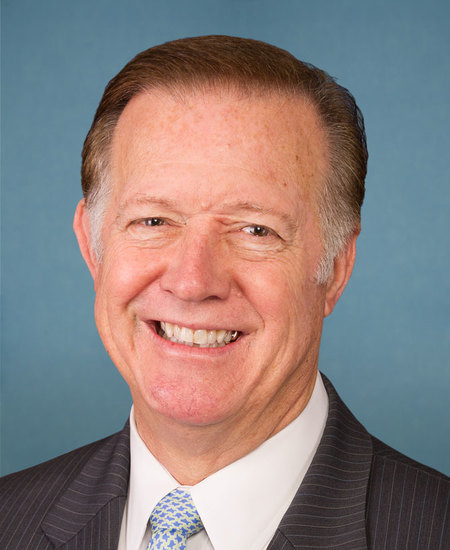
Rep. Randy K. Weber, Sr.
Sponsored bills
This bill designates the facility of the United States Postal Service located at 620 East Pecan Boulevard in McAllen, Texas, as the "Agent Raul H. Gonzalez Jr. Memorial Post Office Building".
Maddy summaryThis bill amends the Clean Air Act to update the definition of fossil fuel, explicitly including "fuel for ocean-going vessels" alongside home heating oil and jet fuel. It directly affects the shipping industry by requiring the Environmental Protection Agency (EPA) to issue regulations within one year of enactment to implement this updated definition. The key mechanism is changing the statutory definition to ensure ocean vessel fuels are covered under existing fossil fuel regulations, potentially influencing future clean fuel standards for ships. The EPA must also submit a report to Congress on implementation within one year of finalizing these regulations.
Maddy summaryThis resolution formally censures Representative Al Green (D-TX) for disrupting President Trump's address during a joint session of Congress on March 4, 2025. It requires him to appear in the House chamber for the public reading of the censure resolution, which states his actions violated decorum rules and brought disrepute to Congress. As a procedural resolution, it does not enact policy changes but serves as a formal reprimand for conduct during a congressional session.
Maddy summaryThe SPEED for BEAD Act (HR 1870) amends the federal broadband deployment program (BEAD) to accelerate network expansion. It defines "gigabit-level broadband" as 1,000 Mbps download speeds, requires unused funds to be returned to the Treasury instead of reallocated, and allows states to remove high-cost locations from project areas. The bill prohibits grant conditions related to labor practices (e.g., union requirements), diversity initiatives, climate policies, or network management rules, while ensuring all broadband technologies meeting speed standards are eligible. It also explicitly bans government regulation of broadband pricing, directly affecting states administering BEAD funds and the internet providers they fund.
Maddy summaryHR 1850, the CRUDE Act, amends existing law to modify crude oil export licensing requirements. It requires the Secretaries of Defense, Energy, and Commerce to jointly report to Congress if U.S. crude oil exports cause sustained supply shortages or prices significantly above world market levels, and if those conditions lead to adverse employment effects in the U.S. If such a report is issued, the President could declare a national emergency based on those findings. The bill does not change current export rules but adds this reporting and emergency declaration mechanism as a potential safeguard.
Maddy summaryHR 1879, the "No Tax Breaks for Sanctuary Cities Act," denies tax-exempt status for bonds issued by jurisdictions classified as "sanctuary jurisdictions." A sanctuary jurisdiction is defined as a city or state that either restricts sharing immigration status information with federal authorities or fails to comply with federal detainer requests under immigration law. The bill requires the Treasury Secretary to publish an annual list of such jurisdictions within 180 days of enactment. This policy directly affects local governments meeting the definition by removing a key funding tool - tax-exempt municipal bonds - used for public projects like schools or infrastructure. The law applies to bonds issued after enactment and does not alter existing sanctuary policies themselves.
Maddy summaryHR 1794 establishes an "Abraham Accords Office" within the Food and Drug Administration (FDA) to foster regulatory cooperation with countries that signed the Abraham Accords (e.g., UAE, Bahrain). The office, to be created within two years, will provide technical assistance to help these countries align their medical product regulations with FDA standards and facilitate information sharing about U.S. regulatory pathways. It requires the FDA to report to Congress after three years on the office’s progress, including metrics on how many entities it assisted and recommendations for improving collaboration. The bill does not alter existing security protocols and explicitly states it cannot override national security directives.
Maddy summaryHR 1786 amends the Robert T. Stafford Disaster Relief Act to explicitly include "algal blooms" as a qualifying event for federal disaster declarations. This change expands eligibility for federal disaster assistance to communities affected by harmful algal blooms, which can contaminate water and harm ecosystems. The bill modifies Section 102(2) of the Stafford Act (42 U.S.C. 5122) by adding "algal blooms" to the list of recognized disasters alongside drought. It is a procedural adjustment to the law's definition, not a new funding or program.
Federal Firearms Licensee Protection Act of 2025 This bill modifies criminal penalties for an offense involving the theft of a firearm from a licensed importer, manufacturer, or dealer, or from their business premises. Specifically, the bill does the following: increases from 10 to 20 years the maximum prison term, and creates a 3- or 5-year mandatory minimum prison term for an offense that occurs during the commission of a burglary or robbery. An attempt to commit an offense is subject to the same penalties as a substantive offense.