

Maddy summaryThe Protecting Gun Owners in Bankruptcy Act would amend federal bankruptcy law to allow individuals filing for bankruptcy to keep firearms they own, up to a total value of $3,000. It adds a specific exemption for firearms in bankruptcy property protections, covering either a single firearm or multiple firearms collectively valued at $3,000 or less. This means creditors cannot force the sale of qualifying firearms during bankruptcy proceedings. The change would only apply to bankruptcy cases filed after the law takes effect.
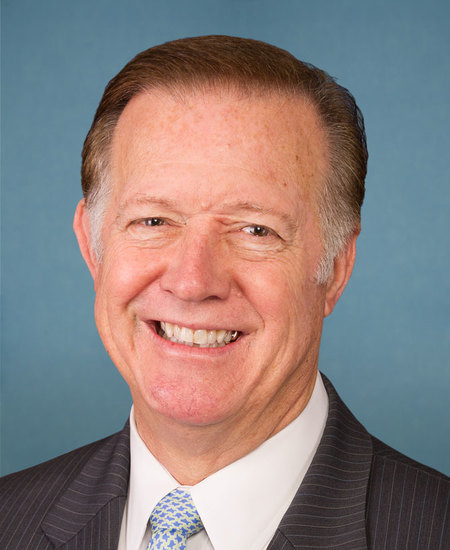
Rep. Randy K. Weber, Sr.
Sponsored bills
Maddy summaryHR 4065, the "Bring the Space Shuttle Home Act," directs NASA to move the Discovery space shuttle from the Smithsonian’s Udvar Hazy Center near Washington, DC, to Houston’s Johnson Space Center within 18 months. It requires NASA and the Smithsonian to jointly develop a transfer plan with cost and timeline details, submit it to Congress within 90 days, and ensure the shuttle is displayed publicly for STEM education within 5 miles of Johnson Space Center. After NASA takes title one year post-transfer, the shuttle must be handed to a nonprofit entity for continued public exhibition focused on science and technology learning. The bill affects NASA, the Smithsonian, and Houston’s educational community through this physical relocation and exhibition mandate.
Maddy summaryHRES 520 is a House resolution honoring former First Lady Barbara Pierce Bush on the occasion of her 100th birthday, recognizing her life, achievements, and public service. It specifically highlights her advocacy for literacy - including establishing the Barbara Bush Foundation for Family Literacy and supporting the National Literacy Act - and her roles as Second Lady and First Lady during her husband George H.W. Bush's presidency. This commemorative resolution does not create new laws or policies; it serves only to formally acknowledge her legacy. The resolution was introduced by House members on June 17, 2025.
Maddy summaryThis bill requires major internet companies (including social media, streaming services, and app stores) and broadband providers to contribute to the Universal Service Fund, which subsidizes affordable broadband in rural and high-cost areas. It exempts smaller companies that transmit less than 3% of U.S. broadband data or earn under $5 billion annually. The Federal Communications Commission must create a new support mechanism to help rural broadband providers cover costs, while ensuring contributions remain fair and predictable. The bill explicitly states it does not grant the FCC new authority over these companies.
Maddy summaryH.J.Res. 88 disapproves an Environmental Protection Agency (EPA) rule that would have allowed California to enforce its "Advanced Clean Cars II" vehicle emission standards. This rule, submitted by the EPA on January 6, 2025, sought to grant California a waiver to override federal preemption for its stricter vehicle pollution controls. The resolution, passed by Congress and signed into law on June 12, 2025, formally nullifies the EPA rule, preventing California from implementing its Advanced Clean Cars II program under this specific waiver. The bill directly affects California's ability to set its own vehicle emission standards for passenger cars and light trucks.
Maddy summaryThis bill changes how federal Bureau of Prisons employees in the "Rest of U.S." pay locality receive compensation. It directs that employees whose official worksite is in "Rest of U.S." be treated as working in the nearest other pay locality (within 200 miles) with the highest comparability payment, rather than the default "Rest of U.S." rate. This adjustment applies to all Bureau of Prisons employees, including prevailing rate staff, and takes effect 180 days after enactment. The change directly affects federal correctional officers and staff working in remote locations currently covered by the "Rest of U.S." pay rate.
Maddy summaryHR 3875, the TERMS Act, requires online service providers (like social media platforms or apps requiring user accounts) to clearly explain their rules for suspending or terminating accounts. It mandates that providers publicly disclose their acceptable use policies in plain language, including what actions could lead to account restrictions, how enforcement works, and appeal options. Providers must also give users advance written notice before restricting accounts (with limited exceptions for court orders or immediate safety risks) and publish annual reports detailing how often they enforced their policies. These requirements aim to give users transparency about account decisions and promote competition by making platform rules more understandable.
Maddy summaryThis bill would make non-citizens deportable if they incite or participate in riots during civil unrest involving assaults on law enforcement or military personnel, or destruction of public property, and who were unlawfully present, had DACA, or were lawful permanent residents at the time of the offense. It permanently bars such individuals from reentering the U.S. or accessing any relief from deportation, including asylum, cancellation of removal, or future DACA benefits. During declared emergencies (such as national disasters or state emergencies), the law mandates expedited removal and mandatory detention for those covered, with no discretion for enforcement.
Maddy summaryHR 589, the FACE Act Repeal Act of 2025, would repeal a federal law (Section 248 of Title 18, U.S. Code) that prohibited obstructing access to reproductive health care facilities through physical means, intimidation, or violence. This repeal would eliminate the federal criminal penalty for such conduct, meaning federal prosecutors could no longer charge individuals under this specific law. The bill applies to all pending or future federal prosecutions related to these actions. It does not affect state laws that may still regulate access to reproductive health care facilities.
Maddy summaryHRES 481 is a symbolic resolution condemning recent antisemitic attacks in the U.S., specifically referencing the June 1, 2025, Boulder, Colorado, assault on a Jewish community gathering and other incidents like the May 2025 Washington, D.C., embassy shooting. It formally recognizes a pattern of violence targeting Jewish individuals and institutions, including attacks during religious events. The resolution calls on law enforcement to thoroughly investigate and prosecute such incidents and urges elected officials to publicly oppose antisemitism and politically motivated violence. As a non-binding resolution, it does not create new laws or allocate funding but serves to affirm congressional stance against antisemitism.