

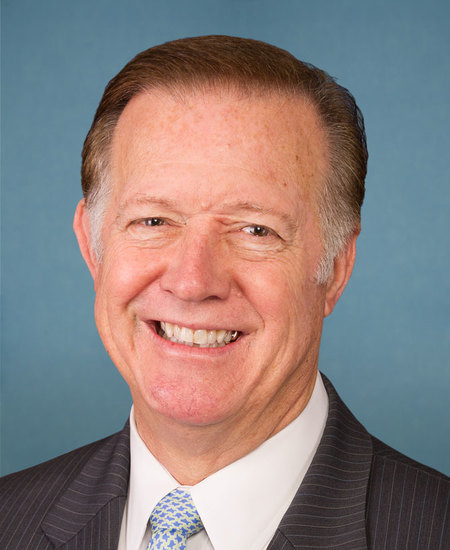
Photo of Randy K. Weber, Sr.
R United States House · District 14 · Texas On the 2026 ballot

Rep. Randy K. Weber, Sr.

Compare
Total votes
2,837
all sessions
Attendance
98%
68 missed
Near the chamber average
With party
92%
of cast votes
Near the chamber average
Bipartisan score
4%
crosses aisle rarely
Near the chamber average
Sponsored
1,847
bills & resolutions
Higher than 84% of chamber peers
Committees
6
assignments
1,847 bills and resolutions

Sponsored bills

Total
1,847
Primary
60
Co-sponsor
1,787
This page
1,847
matching current filters
Co-sponsor HR 3413
In committee · Indiana House · Co-sponsor
Agricultural Security Risk Review Act

Agricultural Security Risk Review Act This bill expands the membership of the Committee on Foreign Investment in the United States to include the Secretary of Agriculture. (The committee reviews the national security implications of certain foreign investments in U.S. businesses or real estate, including critical infrastructure or technologies.)

In committee May 21, 2021 1 co-sponsor
Co-sponsor HR 3430
In committee · Indiana House · Co-sponsor
Washington Bureaucrat Accountability Act

Washington Bureaucrat Accountability Act This bill rescinds funding that was provided to the Department of Transportation for certain unused earmarks. Under the bill, the term earmark generally refers to congressionally directed spending that would benefit a specific entity or state, locality, or congressional district other than through a statutory or administrative formula or competitive award process. The bill also requires (1) the rescinded funds to be deposited into the Treasury for the purpose of deficit reduction, and (2) federal agencies to submit certain reports regarding unobligated funds that were provided for earmarks.

In committee May 21, 2021 1 co-sponsor
Co-sponsor HR 2081
In committee · Indiana House · Co-sponsor
LOCAL Act

Local Opportunities, Conservation, and American Lands Act or the LOCAL Act This bill directs that the headquarters for the Bureau of Land Management (BLM) shall remain located in Grand Junction, Colorado. The Department of the Interior shall study the feasibility of relocating more existing BLM employee positions to Grand Junction or Alaska, Arizona, California, Colorado, Idaho, Montana, Nevada, New Mexico, Oregon, Utah, Washington, or Wyoming. Interior must determine, among other things, whether such relocation will improve management of federal lands, increase coordination with local communities, and strengthen tourism, conservation, outdoor recreation, grazing, or responsible energy production.

In committee May 21, 2021 1 co-sponsor
Co-sponsor HR 1692
In committee · Indiana House · Co-sponsor
RESTORE Act

Rehabilitating Economic Success Through Overcoming Rural Emergencies Act or the RESTORE Act This bill expands the Department of Agriculture's Wildfire and Hurricane Indemnity Program Plus (WHIP+) to include coverage for losses of crops due to high winds or derechos, polar vortexes (including losses to dairy cooperatives due to power outages or curtailments), hailstorms, freeze, and droughts occurring in the 2020 and 2021 calendar years, with specified limitations. Under current law, the program provides disaster payments to agricultural producers who suffered crop, tree, bush, and vine losses resulting from hurricanes, wildfires, and other qualifying natural disasters that occurred in the 2018 and 2019 calendar years.

In committee May 21, 2021 1 co-sponsor
Co-sponsor HRES 417
In committee · Indiana House · Co-sponsor
Recognizing the national debt as a threat to national security.

This resolution recognizes that the national debt is a threat to national security and that deficits are unsustainable, irresponsible, and dangerous. It also commits to (1) restoring regular order to the appropriations process, and (2) addressing the fiscal crisis faced by the United States.

In committee May 20, 2021 1 co-sponsor
Co-sponsor HR 3425
In committee · Indiana House · Co-sponsor
Saving Gig Economy Taxpayers Act

Saving Gig Economy Taxpayers Act This bill modifies requirements for third party settlement organizations to eliminate their reporting requirement with respect to the transactions of their participating payees unless they have earned more than $20,000 on more than 200 separate transactions in an applicable tax period. A third party settlement organization is the central organization that has the contractual obligation to make payments to participating payees (generally, a merchant or business) in a third party payment network. This reverses a provision in the American Rescue Plan Act of 2021 that lowered the reporting threshold to $600 with no minimum on the number of transactions.

In committee May 20, 2021 1 co-sponsor
Co-sponsor HR 3403
In committee · Indiana House · Co-sponsor
See the Crisis Act

See the Crisis Act This bill limits international travel by the Vice President until after certain activities are undertaken regarding the southwest border. Specifically, the bill prohibits the obligation or expenditure of federal funds for the Vice President's travel expenses to travel outside of the United States until the Vice President (1) personally travels to at least one of several specified counties along the border to review the activities of federal agencies responsible for enforcing and implementing immigration laws, and (2) submits a report relating to the situation at the border.

In committee May 20, 2021 1 co-sponsor
Co-sponsor HR 210
Passed · Indiana House · Co-sponsor
Rural STEM Education Research Act

Rural STEM Education Research Act This bill specifies federal scientific research and development efforts towards STEM (science, technology, engineering, and mathematics, including computer science) workforce development and rural STEM education. (Sec. 3) The bill amends the objectives of the Manufacturing Extension Partnership program to include the provision to secondary schools of information about the job skills needed in manufacturing companies, and the promotion and expansion of certification systems offered through local high schools. The activities of a manufacturing extension center are expanded to include local high schools in the facilitation of collaborations and partnerships between manufacturing companies and schools to help those entities better understand the specific needs of manufacturers and to help manufacturers better understand the skill sets that students learn in school programs. The National Institute of Standards and Technology (NIST) must award prizes to stimulate research and development of creative technologies in order to deploy affordable and reliable broadband connectivity to underserved rural communities. NIST may award not more than a total of $5 million in prizes. (Sec. 4) The Office of Science and Technology Policy must establish a broadband research and development working group to address national research challenges and opportunities for improving broadband access and adoption across the United States. (Sec. 5) The National Science Foundation (NSF) shall enter into an agreement with the National Academy of Sciences under which the National Academy of Sciences agrees to evaluate aspects of STEM education and workforce development in rural areas. (Sec. 6) The Government Accountability Office shall conduct a study on the engagement of rural populations in federal STEM programs. (Sec. 7) Experimental Program to Stimulate Competitive Research (EPSCoR) programs shall consider modifications to award structures to increase the capacity of rural communities to provide quality STEM education and STEM workforce development programming to students and teachers. (Sec. 8) The NSF must award grants to institutions of higher education or nonprofit organizations for (1) research and development to advance innovative approaches to support and sustain high-quality STEM teaching in rural schools, (2) research and development of programming to identify the barriers rural students face in accessing high-quality STEM education, (3) development of innovative solutions to improve the participation and advancement of rural students in grades Pre-K through 12 in STEM studies, and (4) research on online STEM education courses for rural communities. The NSF may establish a pilot program of regional cohorts in rural areas to provide peer support, mentoring, and hands-on research experiences for rural STEM educators of students in grades Pre-K through 12 in order to build an ecosystem of cooperation among educators, researchers, academia, and local industry.

Passed May 19, 2021 1 co-sponsor
Co-sponsor HR 144
Passed · Indiana House · Co-sponsor
Supporting Early-Career Researchers Act

Supporting Early-Career Researchers Act This bill authorizes the National Science Foundation to establish a two-year pilot program to award grants to highly qualified early-career investigators to carry out an independent research program at the institution of higher education chosen by such investigator, to last for a period not greater than two years. The NSF shall select grantees from among citizens, nationals, and lawfully admitted permanent resident aliens of the United States. The NSF shall conduct program outreach to recruit fellowship applicants (1) from all regions of the country; (2) from historically underrepresented populations in the fields of science, technology, engineering, and mathematics (STEM); and (3) who graduate from or intend to carry out research at a variety of types of institutions of higher education, including Historically Black Colleges and Universities.

Passed May 19, 2021 1 co-sponsor
Co-sponsor HR 1927
In committee · Indiana House · Co-sponsor
End Taxpayer Funding of Gender Experimentation Act of 2021

End Taxpayer Funding of Gender Experimentation Act of 2021 This bill modifies provisions relating to federal funding for, and health insurance coverage of, gender reassignment medical interventions, which include surgical remedies and hormone therapy arising from a conflict between an individual's gender identity and the sex the individual has or was identified as having at birth. Specifically, the bill prohibits the use of federal funds for gender reassignment medical interventions or for health coverage that includes such interventions. Additionally, such interventions may not be provided in a federal health care facility or by a federal employee. Under current law, coverage of these interventions through Medicare and Medicaid is generally determined at the state level. The bill's restrictions regarding the use of federal funds do not apply to treatment of individuals with medically verifiable disorders of sex development, such as individuals born with atypical development of chromosomal, gonadal, or anatomical sex. The bill also prohibits qualified health plans from including coverage for gender reassignment medical interventions. Further, plans that include coverage for such interventions are not eligible for federal subsidies.

In committee May 18, 2021 1 co-sponsor
Showing 1,651 to 1,660 of 1,847 bills