Human Trafficking Prevention Act of 2022 This act requires the posting of contact information of the national human trafficking hotline in specific places. Specifically, the information must be posted in a visible place in all federal buildings; in the restrooms of each U.S. aircraft, airport, over-the-road bus, bus station, passenger train, and passenger railroad station; and at each port of entry.
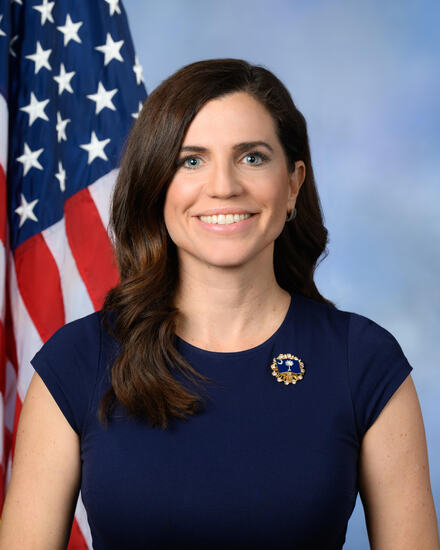
Rep. Nancy Mace
Sponsored bills
This act requires the Department of Veterans Affairs (VA) to seek to enter into an agreement with the National Academies of Sciences, Engineering, and Medicine (NASEM) to conduct a comprehensive review of VA medical examinations provided to individuals who submit claims for compensation for a service-connected disability related to military sexual trauma. Specifically, NASEM must review VA examinations that are provided for mental and physical conditions linked to military sexual trauma and are conducted to assess the impairments of individuals arising from such trauma. NASEM must report on its review, and the VA must report on its plans to implement actions based on NASEM's findings and recommendations.
This act designates the facility of the United States Postal Service located at 213 William Hilton Parkway in Hilton Head Island, South Carolina, as the Caesar H. Wright Jr. Post Office Building.
This act designates the outpatient clinic of the Department of Veterans Affairs in Greenville, South Carolina, as the Lance Corporal Dana Cornell Darnell VA Clinic.
This act designates the facility of the United States Postal Service located at 1550 State Road S-38-211 in Orangeburg, South Carolina, as the J.I. Washington Post Office Building.
This act prescribes that a peer support specialist of the Department of Veterans Affairs (VA) must not be responsible for providing assistance to a veteran regarding a claim for compensation for a covered mental health condition (e.g., post-traumatic stress disorder) based on military sexual trauma (MST) experienced during active service. Such specialists must only provide counseling services, guidance, and support and must not participate in the adjudication of the claim. As part of the forms for claims for compensation for a covered mental health condition based on MST, the VA must include an option for a veteran to elect to be referred to a MST trauma coordinator at the VA facility closest to the veteran's residence. Additionally, the VA must (1) ensure that its peer support specialists receive annual training on providing peer support regarding MST, and (2) provide annual training on the processing of claims for compensation for covered mental health conditions based on MST to its MST coordinators and peer specialists.
Quantum Computing Cybersecurity Preparedness Act This act addresses the migration of executive agencies' information technology systems to post-quantum cryptography. Post-quantum cryptography is encryption strong enough to resist attacks from quantum computers developed in the future. The act does not apply to national security systems. The Office of Management and Budget (OMB) shall issue guidance on the migration of information technology to post-quantum cryptography. Each executive agency must maintain an inventory of all information technology in use by the executive agency that is vulnerable to decryption by quantum computers. After the National Institutes of Standards and Technology (NIST) has issued post-quantum cryptography standards, the OMB shall issue guidance requiring each executive agency to develop a plan to migrate information technology of the agency to post-quantum cryptography. OMB shall submit to Congress a report on a strategy to address the risk posed by the vulnerabilities of information technology of executive agencies to weakened encryption due to the potential and possible capability of a quantum computer to breach such encryption; the funding needed by executive agencies to secure such information technology from the risk posed by an adversary of the United States using a quantum computer to breach the encryption; and a description of federal civilian executive branch coordination efforts led by NIST, including timelines, to develop standards for post-quantum cryptography.
This act directs the Speaker of the House of Representatives and the President pro tempore of the Senate to arrange for the posthumous award of a Congressional Gold Medal to commemorate Glen Doherty, Tyrone Woods, J. Christopher Stevens, and Sean Smith, four Americans killed in the September 11, 2012, attack on the U.S. consulate in Benghazi, Libya. (Stevens was the U.S. Ambassador to Libya at the time, Smith was an officer in the Foreign Service, and Doherty and Woods were both government contractors and former Navy SEALs.) After the medal has been awarded, it shall be given to the Central Intelligence Agency Museum.
Big Cat Public Safety Act This act revises requirements governing the trade of big cats (i.e., species of lion, tiger, leopard, cheetah, jaguar, or cougar or any hybrid of such species) under the Lacey Act to limit the possession, breeding, and exhibition of big cats. The Lacey Act prohibits any person from importing, exporting, buying, selling, transporting, receiving, or acquiring big cats across state lines or the U.S. border. However, some exemptions are provided for certain entities, such as universities and wildlife sanctuaries. (Sec. 3) The act expands the Lacey Act prohibitions to include a prohibition on possessing or breeding big cats. Breeding means facilitating propagation or reproduction (whether intentionally or negligently), or failing to prevent propagation or reproduction. Owners of big cats that were born before this act's enactment may keep their big cats, but the owners must register them with the U.S. Fish and Wildlife Service. The act modifies the list of entities that are exempt from prohibitions to export, buy, sell, transport, receive, acquire, possess, or breed big cats. The modified list includes exemptions for entities or facilities exhibiting animals to the public if they (1) hold a Class C license in good standing under the Animal Welfare Act, and (2) do not allow individuals to come into direct physical contact with big cats. However, direct contact is allowed if the individual is a trained professional, a veterinarian, or directly supporting conservation programs that do not involve commercial activities and meet other specified restrictions. (Sec. 4) A person who knowingly violates the act must be fined not more than $20,000, or imprisoned for no more than five years, or both. The act considers each violation to be a separate offense. The offense must be deemed to have been committed not only in the district where the violation first occurred, but also in any district in which the defendant may have taken or been in possession of the prohibited wildlife species. (Sec. 5) The act extends forfeiture provisions to fish, wildlife, or plants that are bred or possessed; thus, big cats bred or possessed in violation of the act are subject to forfeiture. (Sec. 6) The Department of the Interior must issue regulations to implement this act.

FEMA Caseworker Accountability Act This bill directs the Government Accountability Office (GAO) to report to Congress on case management personnel turnover at the Federal Emergency Management Agency (FEMA). Specifically, the GAO must report on the turnover rate for FEMA case management personnel, the average and median length of employment for such personnel, the steps that FEMA is taking or plans to take to lower the turnover rate, the number of FEMA personnel detailed to work disaster recovery, and personnel rotations.