

Maddy summaryHR 1748, the Quantum in Practice Act, amends the National Quantum Initiative Act to explicitly include "quantum molecular modeling or simulation" as a priority research area. This change directs federal funding and research efforts toward advancing quantum computing applications for molecular-level simulations. The bill directly affects scientists and researchers working under the National Quantum Initiative Act by expanding their program focus to include modeling chemical processes, materials, and reactions. Key provisions add this specific research category to existing funding priorities, aiming to accelerate breakthroughs in fields like sustainable fertilizers, drug development, and advanced materials. The policy change is purely procedural, redirecting existing program resources without creating new funding.
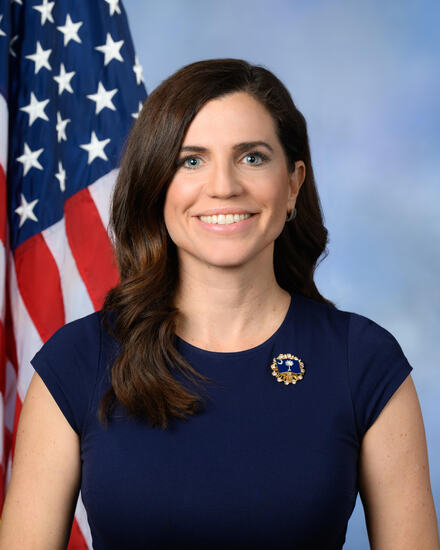
Rep. Nancy Mace
Sponsored bills
Building Credit Access for Veterans Act of 2023 This bill requires the Department of Veterans Affairs (VA) to implement a pilot program to assess the feasibility and advisability of using alternative credit scoring information or models to improve the determination of creditworthiness of certain individuals and to increase the number of such individuals who are able to obtain VA housing and small business loans. Specifically, the program is for veterans or members of the Armed Forces who are eligible for VA housing or small business loans and have insufficient credit history. Under the program, the VA must assess the feasibility and advisability of establishing criteria for acceptable commercially available credit scoring models to be used by lenders for the purpose of guaranteeing or insuring a VA housing or small business loan. Participation is voluntary on an opt-in basis for lenders, borrowers, and individuals. The VA must conduct outreach to lenders and individuals to inform them of the pilot program.
Maddy summaryHR 1703, the SECURE Flights Act, prohibits the use of specific immigration forms (like I-94 arrival records or I-200 warrants) as valid ID at airport security checkpoints. If such a document is presented, TSA must notify U.S. immigration and law enforcement agencies, and the individual may be barred from entering secure airport areas unless traveling for deportation or presenting a valid "covered ID" (e.g., passport, Global Entry card, or driver’s license). The bill also requires TSA to collect biometric data (like fingerprints or facial scans) from travelers who cannot verify U.S. citizenship and lack a covered ID, submitting this to the Homeland Security IDENT system. It directly affects travelers using non-standard immigration documents at airports, aiming to enhance security coordination between TSA and immigration authorities.
Maddy summaryThis bill establishes the Agent Orange Veterans Service Medal, a commemorative award for veterans who receive compensation under 38 U.S.C. §§ 1116 or 1116A (for health conditions linked to Agent Orange exposure). The Secretary of Defense must design and issue the medal upon request by eligible veterans or their next-of-kin if the veteran has passed away. Veterans must apply through a process created by the Department of Defense to receive the medal, which serves solely as a symbolic recognition of service. The bill does not alter existing benefits or create new entitlements.
Correcting Guam's History in the PACT Act This bill expands eligibility for a presumption of service-connection for specified diseases associated with exposure to certain herbicide agents. Under a presumption of service-connection, specific conditions diagnosed in certain veterans are presumed to have been caused by the circumstances of their military service. Health care benefits and disability compensation may then be awarded. Under the bill, service performed in Guam or its territorial waters between August 15, 1958, and July 31, 1980, provides a veteran who has a specified disease that is associated with exposure to certain herbicide agents with eligibility for a presumption of service-connection. (Under current law, the eligible time frame for service in Guam is between January 9, 1962, and July 31, 1980.)
Maddy summaryHR 1619 requires schools participating in the National School Lunch Program to provide fluid milk substitutes (like soy or almond milk) upon request by a student or their parent/guardian. The bill removes the previous requirement that substitutions needed a medical authority's written statement for most dietary needs, instead allowing requests based on the student's or parent's request alone. It aligns the definition of acceptable substitutes with current Dietary Guidelines for Americans. This change directly affects students with dietary restrictions, making it simpler for schools to accommodate their needs without extra medical documentation.
Greater Access to Contraceptive Options Act This bill requires the Food and Drug Administration to prioritize review of supplemental applications for over-the counter, self-administered contraceptives (i.e., contraception that is administered without the intervention of a health care professional).
Maddy summaryThis bill creates a new definition for "currently accepted medical use with severe restrictions" under the Controlled Substances Act, specifically for certain investigational drugs. It applies to drugs designated as breakthrough therapies by the FDA or authorized for expanded patient access under specific emergency protocols for serious diseases with no other treatment options. The definition excludes drugs that are already fully approved under standard FDA pathways or that lose their expanded access status. If a drug no longer meets these strict criteria, the Attorney General must reclassify it into the highest restriction category (Schedule I) within 90 days of notification from the Health Secretary. This changes how certain experimental treatments are classified under federal drug laws.
Maddy summaryThis bill authorizes a Congressional Gold Medal to honor the "Hello Girls" - female telephone operators who served in the Army Signal Corps during World War I. They provided critical battlefield communications in France (connecting 26 million calls), wore military uniforms, and faced combat risks, but were denied veteran benefits for 60 years due to being classified as civilian contractors. The medal recognizes their pioneering service, devotion, and the decades-long struggle to gain military recognition. The award follows similar recognition for other WWII women veterans and aims to correct the historical injustice they faced.
Maddy summaryHR 140, the Protecting Speech from Government Interference Act, prohibits federal employees from using their authority to censor speech, particularly affecting individuals with pending applications (like grants or permits) or under investigation by the agency. It bans employees from advocating censorship of speech, suppressing speech of people involved in agency matters, or engaging in censorship while on duty in government spaces, wearing uniforms, or using government vehicles. Exceptions cover law enforcement actions against child pornography, human trafficking, or national security threats. Violations can result in penalties including removal, fines up to $10,000, or reprimands. The bill defines "censorship" broadly to include removing speech from platforms or adding disclaimers.