This bill prohibits federal agencies from restricting a person's use of convertible virtual currency for their own purposes or to conduct transactions through a self-hosted wallet.
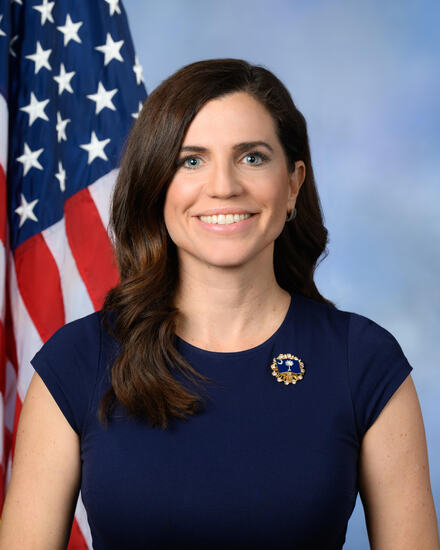
Rep. Nancy Mace
Sponsored bills
Ban IRS Biometrics Act This bill prohibits the Department of the Treasury from requiring taxpayers to provide biometric information as a condition of filing any tax return, receiving any service, or accessing taxpayer information. The bill defines biometric information as any information regarding any measurable physical characteristic or personal behavioral trait used to recognize the identity, or verify the claimed identity or location, of an individual, including facial images, fingerprints, and iris scans. Treasury must also develop a plan for the safe and secure destruction and disposal of any biometric information collected or used prior to the enactment of this bill.
This bill creates additional eligibility requirements for entities to enter into contracts or agreements with the Department of Veterans Affairs (VA) to provide case management services to certain veterans participating in the Department of Housing and Urban Development-VA Supportive Housing (HUD-VASH) program. In addition to existing requirements, an eligible entity must have demonstrated experience in providing case management services to veterans for obtaining suitable housing at varying locations nationwide, or in the area or areas similar to where the services will be provided under the relevant contract or agreement.
Health Care for Burn Pit Veterans Act This bill updates policies and procedures related to Department of Veterans Affairs (VA) health care and benefits for veterans who have been exposed to toxic substances. Specifically, the bill extends the eligibility period for VA hospital care, medical services, and nursing home care for combat veterans who served after September 11, 2001, and were exposed to toxic substances, radiation, or other conditions, including those who did not enroll to receive VA care during the eligibility period. The VA must incorporate into its existing health care screening a screening to help determine potential exposures to toxic substances during military service. Among other requirements, the VA must also provide annual training to health care and benefits personnel with respect to veterans who were exposed to toxic substances; analyze total and respiratory disease mortality in veterans who served in specified locations on specified dates; conduct an epidemiological study on the health trends of veterans who served in the Armed Forces after September 11, 2001; conduct a study to determine trends in the rates of the incidence of cancer in veterans; publish a list of VA resources for veterans who were exposed to toxic substances, families and caregivers of such veterans, and survivors of such veterans who are receiving death benefits; and report on the data quality of the Individual Longitudinal Exposure Record and its usefulness in supporting veterans in receiving VA health care and benefits.
Informed Lawmaking to Combat Inflation Act This bill requires the Congressional Budget Office to provide inflation estimates for certain legislation that is projected to cause an annual gross budgetary effect of at least 0.25% of the projected gross domestic product of the United States. The estimates must determine whether the legislation will have no significant impact on inflation, a quantifiable inflationary impact on the consumer price index, or a significant impact on inflation that cannot be quantified at the time the estimate is prepared. The requirement does not apply to legislation that (1) provides for emergency assistance or relief at the request of any state, local, or tribal government; or (2) is necessary for the national security or the ratification or implementation of international treaty obligations.
Keep Schools Open Act This bill generally prohibits federal education funding for elementary or secondary schools, local or state educational agencies, or institutions of higher education (IHEs) that do not provide in-person instruction. Specifically, the bill prohibits a school, educational agency, or IHE from receiving federal education funds unless the school, educational agency, or IHE (1) demonstrates to the Department of Education (ED) that it provides in-person instruction to students, and (2) certifies to ED that it will not discontinue in-person instruction for students due to COVID-19. This prohibition does not apply to a school, educational agency, or IHE that provides distance education or other virtual instruction to students in the regular course of its operations for reasons that are unrelated to COVID-19.
Federal Information Security Modernization Act of 2022 This bill addresses federal information security management, notification and remediation of cybersecurity incidents, and the roles of the Office of Management and Budget (OMB) and the Cybersecurity and Infrastructure Security Agency (CISA). CISA must perform, on an ongoing and continuous basis, assessments of federal risk posture. The bill requires evaluation by each agency of whether additional cybersecurity procedures are appropriate at least once every three years. An agency, as expeditiously as practicable and without unreasonable delay, and within 45 days after it has a reasonable basis to conclude that a breach has occurred, must (1) determine whether notice to any individual potentially affected by the breach is appropriate based on a risk assessment; and (2) as appropriate, provide written notice to each individual potentially affected. Notification may be delayed under specified circumstances. Each agency must provide any information relating to a major incident to CISA, the OMB, the Office of the National Cyber Director, the agency's office of inspector general, the Government Accountability Office, and Congress. An agency's contractors and grant recipients must notify the agency of an incident involving federal information within a specified time frame. Each agency shall develop training for individuals at the agency with access to federal information or information systems on how to identify and respond to an incident. CISA must establish a program to provide ongoing, hypothesis-driven threat-hunting services on the network of each agency. The bill establishes specified pilot programs to enhance federal cybersecurity.

Fair Chance Improvement Act This bill revises provisions regarding the prohibition on federal contractors, including defense contractors, inquiring about applicants' criminal histories prior to conditional offers of employment. The bill allows the Department of Labor to investigate compliance by a contractor by conducting a compliance evaluation. Currently, Labor investigates compliance pursuant to an applicant's complaint. The bill also expands the sanctions that Labor may impose on a contractor with more than one violation of the prohibition.
Designates the facility of the United States Postal Service located at 11 Robert Smalls Parkway Suite C, in Beaufort, South Carolina, as the "Robert Smalls Post Office."
This resolution expresses the sense of the House of Representatives that (1) any giant panda born in the United States should belong to the United States, and (2) the United States should seek the coordination of its allies to establish collaborative giant panda breeding programs.