

Maddy summaryThe SPEED and Reliability Act of 2024 creates a new process for designating major electricity transmission projects as "national interest high-impact transmission facilities." To qualify, projects must transmit at 345+ kilovolts, add or increase capacity by 750+ megawatts, and cross multiple states or the outer continental shelf. The bill streamlines permitting by directing the Federal Energy Regulatory Commission (FERC) to issue construction permits within 90 days for qualifying projects, while exempting them from standard National Environmental Policy Act (NEPA) reviews. This directly affects transmission project sponsors (like utilities), project states, and local authorities by accelerating approvals for large-scale infrastructure needed to address grid congestion and reliability.
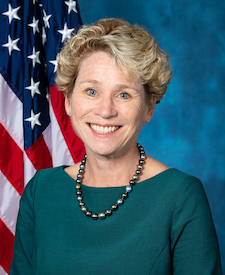
Rep. Chrissy Houlahan
Sponsored bills
Maddy summaryThe AADAPT Act reauthorizes and expands the Project ECHO grant program to specifically address Alzheimer's disease and dementia care. It provides $1 million annually (2026-2031) for grants to eligible health care entities - such as rural clinics, tribal organizations, or community health centers - to develop online training programs for primary care providers working in underserved areas (including rural, frontier, or medically underserved communities). These programs aim to improve provider retention, increase early diagnosis of dementia, and enhance quality care. The bill requires grantees to report on outcomes and ensures funding supplements, rather than replaces, existing resources.
Maddy summaryHR 7770, the Rosie the Riveter Commemorative Coin Act, authorizes the U.S. Mint to produce and sell three commemorative coins honoring women who worked on the U.S. home front during World War II. It specifies $5 gold coins (max 50,000), $1 silver coins (max 400,000), and half-dollar coins (max 750,000), all to be issued between January 1, 2025, and December 31, 2025. Each coin sale includes a surcharge ($35 for gold, $10 for silver, $5 for half-dollar), with all surcharge funds directed to the Rosie the Riveter Trust for maintaining the Rosie the Riveter WWII Home Front National Historical Park and educational programs. The coins will feature designs reflecting the legacy of diverse women workers and must meet specific weight, diameter, and composition standards.
Maddy summaryHR 7771 designates March 21 as National Rosie the Riveter Day to honor the over 6 million American women who joined the workforce during World War II. The bill requests the President issue an annual proclamation encouraging all levels of government to observe the day with ceremonies and educational programs. It does not create new programs or funding but formally recognizes these women's contributions to the war effort and their legacy of empowerment. This procedural resolution directly affects the President and government entities through ceremonial recognition, not policy changes.
Maddy summaryHR 6610, the Passport System Reform and Backlog Prevention Act, aims to reduce delays in U.S. passport processing for citizens applying for routine new or renewal passports. It mandates a 30-day processing standard from document submission to mailing, requires technology upgrades like digital tracking dashboards and mobile apps for applicant updates, and authorizes hiring up to 100 temporary staff annually for passport offices. The bill also sets cybersecurity standards, maintains affordable fees, and requires regular progress reports to Congress on implementation. These changes directly affect U.S. citizens seeking passports, particularly those in remote areas with limited access to processing centers.
Maddy summaryHR 7699 requires the Director of National Intelligence to develop a strategy within 90 days for sharing government intelligence with private companies involved in U.S. critical mineral projects abroad. The strategy must address threats like foreign adversary tactics undermining U.S. projects, risks from foreign government control of entities engaging in deceptive activities, and economic espionage targeting intellectual property. It also mandates an implementation plan for the strategy within 30 days of its completion, to be submitted to congressional intelligence committees. This bill directly affects U.S. companies operating in critical mineral supply chains and aims to enhance information sharing to protect national security interests.
Maddy summaryHR 7698 establishes a new Office of Civic Bridgebuilding within the Corporation for National and Community Service to support programs reducing polarization and improving social cohesion. It authorizes $25 million annually (2025-2027) for competitive grants to nonprofits, community groups, and educational institutions to fund projects addressing local needs like healthcare gaps or environmental concerns through research-backed methods. Grantees must demonstrate how projects engage diverse communities, ensure participant safety (especially for marginalized groups), and use standardized metrics to track effectiveness. The Office will oversee grants, support training, and maintain a public research base on civic bridgebuilding best practices.
Maddy summaryThis concurrent resolution (HCONRES 97) recognizes the gender wage gap, noting that women working full-time earn 84 cents for every dollar earned by men. It highlights racial disparities (e.g., Latinas earn 57 cents, Black women 69 cents) and the economic impact of the gap, including $965 billion in annual lost wages for women. As a symbolic resolution, it does not create new laws or policies but formally acknowledges the issue and reaffirms Congress’s commitment to addressing wage inequality.
Maddy summaryHRES 1075 is a ceremonial resolution recognizing AmeriCorps members, alumni, and AmeriCorps Seniors volunteers for their community service. It highlights their contributions over 30 years, including supporting vulnerable populations, disaster response, education, and environmental protection through nearly 200,000 annual volunteers. The resolution encourages nationwide recognition during AmeriCorps Week (March 10-16, 2024), urging the public to salute volunteers and promote community service. It has no funding or policy changes - only symbolic acknowledgment of existing program impacts.
Maddy summaryThis bill requires the Defense and Veterans Affairs Secretaries to evaluate existing research on menopause, perimenopause, and mid-life health in female service members and veterans. They must identify gaps in knowledge about treatments, military service impacts (including combat roles, burn pits, and toxic chemicals like PFAS), and mental health effects, then report findings and create a strategic research plan within 180 days. The bill also mandates both departments to conduct or fund new research on these issues. It directly affects women currently serving in the military and veterans who experience menopause-related health challenges. The law focuses on gathering evidence to address specific health gaps unique to this population.