

Maddy summaryThe WISER Act of 2025 provides automatic discharge status upgrades and a $25,000 one-time payment to eligible female veterans involuntarily separated from military service between April 1951 and February 1976 under Executive Order 10240. It directly affects women veterans who served during that period and were separated due to pregnancy, childbirth, or childcare responsibilities. The bill establishes two programs: one to upgrade discharge status (treating veterans as if they completed their service) and another to pay $25,000 to eligible veterans or their surviving spouses if the veteran dies after enactment. Eligibility is automatic for those separated under Executive Order 10240, with additional consideration for veterans who had childbirth-related events within 10 months of separation.
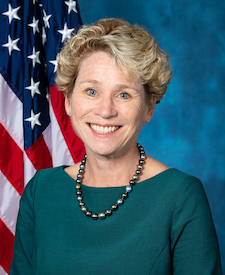
Rep. Chrissy Houlahan
Sponsored bills
Maddy summaryHR 1787 authorizes the U.S. Mint to produce commemorative coins honoring baseball legend Roberto Clemente, including $5 gold, $1 silver, and half-dollar coins, with specific specifications for weight, size, and metal content. The bill requires the coins to feature Clemente's image and commemorative inscriptions, and mandates a surcharge ($35 for gold, $10 for silver, $5 for half-dollar) paid to the Roberto Clemente Foundation for its educational, youth sports, and disaster relief programs. All coins must be minted in 2027, sold at face value plus surcharge and production costs, and will be legal tender. The bill focuses solely on the coin program, not broader policy changes.
Safe Schools Improvement Act This bill requires states to direct their local educational agencies (LEAs) to establish policies that prevent and prohibit bullying and harassment of elementary and secondary school students. In particular, these policies must prohibit bullying and harassment based on race, color, national origin, disability, religion, or sex. Sex includes sexual orientation, gender identity, and sex characteristics (including intersex traits). Further, LEAs must provide (1) students, parents, and educational professionals with annual notice of the conduct prohibited in their disciplinary policies; (2) students and parents with grievance procedures that target such conduct; and (3) the public with annual data on the incidence and frequency of that conduct at the school and LEA level. The Department of Education must conduct and report on an independent biennial evaluation of programs and policies to combat bullying and harassment in elementary and secondary schools. The National Center for Education Statistics must collect state data to determine the incidence and frequency of the conduct prohibited by LEA disciplinary policies.
Maddy summaryThe NETWORKS Act imposes sanctions on foreign telecommunications companies (particularly those based in China) that produce fifth-generation or future mobile network technology and pose national security risks. It blocks U.S. transactions involving such companies' property after a 90-day delay, targeting vendors deemed "untrusted" under existing law. Exceptions cover humanitarian aid (food, medicine, medical supplies) and intelligence activities, while the President may temporarily waive sanctions for national security reasons. The bill directly affects global telecom vendors competing in U.S. markets, with no impact on consumers or standard network services. It aims to secure U.S. communications infrastructure by restricting business with companies linked to surveillance states.
Maddy summaryHCONRES 16 is a concurrent resolution scheduling a joint session of Congress in Philadelphia, Pennsylvania, on July 2, 2026. The session will commemorate the 250th anniversary (semiquincentennial) of the Declaration of Independence, which was approved in Philadelphia on July 4, 1776. This ceremonial gathering at Independence National Historical Park follows past congressional meetings held outside Washington, D.C., for historical milestones, such as the 1987 Constitution bicentennial event. The bill does not create new laws or alter policies - it solely directs the timing and location of a commemorative event.
Maddy summaryThe Technology for Energy Security Act (HR 1752) extends a federal tax credit for investments in fuel cell technology. It changes the deadline for claiming this credit from January 1, 2025, to January 1, 2033, for projects starting construction after December 31, 2024. This directly affects businesses and individuals installing fuel cell systems by allowing them to claim the tax incentive for an additional eight years. The bill does not alter the credit amount but expands the timeframe for eligible projects.
Maddy summaryThis bill designates the U.S. Postal Service facility at 28 East Airy Street in Norristown, Pennsylvania, as the "Charles L. Blockson Post Office Building." It updates all official federal references - such as laws, maps, and documents - to use this new name for the facility. The bill directly affects the postal service location and federal records referencing it. This is a ceremonial naming bill with no substantive policy changes.
Maddy summaryHR 1699, the TOTAL Care Act, removes referral requirements for obstetrical and gynecological (OB/GYN) care under the TRICARE Prime health plan. It allows female TRICARE Prime beneficiaries to directly choose an OB/GYN provider as their primary care manager, eliminating the need for a prior referral from another provider. The bill establishes a 5-year pilot program to test this change, requiring the Secretary of Defense to report on enrollment shifts, cost impacts, and other outcomes after four years. This directly affects female military family members enrolled in TRICARE Prime who opt into the pilot.
Maddy summaryHR 1757, the EMPSA Act, modifies Supplemental Security Income (SSI) rules to eliminate a "marriage penalty" for married individuals with intellectual or developmental disabilities. It directly affects married adults with these disabilities who currently face reduced benefits due to their spouse's income. Key provisions include: (1) allowing eligibility based solely on the individual's own income/resources (excluding spouse's), (2) calculating benefits at the standard rate minus the individual's own income (not spouse's), and (3) excluding the spouse's income/resources from eligibility determinations. This change ensures married individuals with qualifying disabilities receive full SSI benefits without penalty for their spouse's financial situation.
Maddy summaryThe American Dream and Promise Act of 2025 would create pathways to permanent residency for certain immigrant youth who entered the U.S. as children (Dream Act component) and for individuals from countries with Temporary Protected Status or Deferred Enforced Departure (American Promise Act component). To qualify, applicants must meet continuous physical presence requirements (since January 1, 2021 for Dream Act applicants, and for 3+ years for American Promise applicants), pass background checks, and satisfy educational or employment criteria. Conditional permanent resident status would be granted initially, with the option to convert to full permanent residency after meeting additional requirements like earning a degree, serving in the military for two years, or demonstrating three years of earned income. The bill includes fee exemptions for low-income applicants, establishes a grant program to assist applicants with legal help, and creates specific procedures for background checks and appeals.