

This joint resolution proposes a constitutional amendment authorizing Congress and the states to set reasonable limits on the raising and spending of money by candidates and others to influence elections. The amendment grants Congress and the states the power to implement and enforce this amendment by legislation. They are allowed to distinguish between natural persons and corporations or other artificial entities created by law, including by prohibiting such entities from spending money to influence elections.
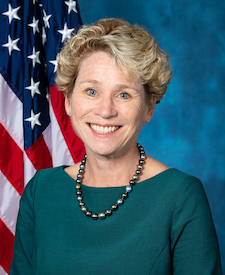
Rep. Chrissy Houlahan
Sponsored bills
Nutrition Counseling Aiding Recovery for Eating Disorders Act of 2021 or the Nutrition CARE Act of 2021 This bill provides for Medicare coverage of medical nutrition therapy services for individuals with eating disorders. Such services must be furnished by a registered dietitian or nutrition professional pursuant to a referral from a physician, psychologist, or other authorized mental health professional.
Treat and Reduce Obesity Act of 2021 This bill expands Medicare coverage of intensive behavioral therapy for obesity. Specifically, the bill allows coverage for therapy that is provided by (1) a physician who is not a primary care physician; or (2) other health care providers (e.g., physician assistants and nurse practitioners) and approved counseling programs, if provided upon a referral from, and in coordination with, a physician or primary care practitioner. Currently, such therapy is covered only if provided by a primary care practitioner. The bill also allows coverage under Medicare's prescription drug benefit of drugs used for the treatment of obesity or for weight loss management for individuals who are overweight.
Build America's Libraries Act This bill establishes and provides funds through FY2024 for the Build America's Libraries Fund, from which the Institute of Museum and Library Services (IMLS) must allocate funding to states and, through them, need-based grants to libraries to make long-term improvements to library facilities. The IMLS must also award grants to Indian tribes and organizations that primarily serve and represent Native Hawaiians. Specifically, the bill requires each state that receives an allocation, and each library that receives a grant, to carry out certain activities to improve library facilities. These activities include constructing and renovating library facilities, investing in infrastructure projects to improve internet access and connectivity, improving indoor air quality, and making facilities accessible to individuals with disabilities. The bill also outlines administrative and oversight provisions, including by requiring library projects to use iron and steel products that are produced in the United States.
Youth Financial Learning Act This bill directs the Department of Education to award competitive grants to state educational agencies and, through them, subgrants to local educational agencies to integrate financial literacy education into public elementary or secondary schools.
Research Investment to Spark the Economy Act of 2021 or the RISE Act of 2021 This bill authorizes the Departments of Agriculture, Commerce, Defense, Education, Energy, the Interior, Health and Human Services, and Transportation, National Aeronautics and Space Administration (NASA), National Science Foundation, and Environmental Protection Agency to provide support for research regarding COVID-19 (i.e., coronavirus disease 2019) or research disrupted by the COVID-19 pandemic. Support may be used to provide supplemental funding to extend the duration of a grant to a research institution, national laboratory, or individual that was awarded prior to the enactment of this bill, or to expand the purposes of such a grant as specified; issue awards to research the effects of the current pandemic and potential future pandemics; and provide flexibility on awards to account for facility closures or other limitations during the COVID-19 public health emergency. Agencies must provide the support as rapidly as possible. Provided funds shall remain available through FY2021.
Military Spouses Retirement Security Act This bill allows a small business employer a tax credit for each employee who is a military spouse and eligible to participate in the employer's defined contribution retirement plan.
Black History is American History Act This bill requires entities (e.g., institutions of higher education, libraries, and museums), in order to be eligible for certain grants administered by the Department of Education (ED), to include Black history in their teaching of American history. It also requires Black history to be included in tests administered by the National Assessment of Educational Progress (NAEP). Specifically, the bill mandates the inclusion of Black history as a required component of American history for such entities to be eligible for American History and Civics Academies' competitive grants. These grants support the establishment of (1) Presidential Academies for Teachers of American History and Civics, which offer workshops to teachers of American history and civics to strengthen their knowledge and prepare them to teach in these subjects; and (2) Congressional Academies for Students of American History and Civics, which support high school students in developing an understanding of these subjects. (Currently, Black history is not a required component of American history for either academy.) In addition, ED must give priority to grant applicants that align their activities with programs and resources of the Smithsonian Institution's National Museum of African American History and Culture. The bill also requires the inclusion of Black history in tests administered by the NAEP, which measures student academic achievement in various subjects.
Telehealth Modernization Act This bill modifies requirements relating to coverage of telehealth services under Medicare. Specifically, the bill extends certain flexibilities that were initially authorized during the public health emergency relating to COVID-19 (i.e., coronavirus disease 2019). Among other things, the bill allows (1) rural health clinics and federally qualified health centers to serve as the distant site (i.e., the location of the health care practitioner); (2) the home of a beneficiary to serve as the originating site (i.e., the location of the beneficiary) for all services (rather than for only certain services); and (3) all types of practitioners to furnish telehealth services, as determined by the Centers for Medicare & Medicaid Services.
Children's Health Insurance Program Pandemic Enhancement and Relief Act or the CHIPPER Act This bill extends through FY2022 the 11.5% increase to the enhanced federal matching rate, also known as the enhanced Federal Medical Assistance Percentage (FMAP), that is otherwise applicable under the Children's Health Insurance Program (CHIP), subject to specified conditions. For example, in order to receive the increased FMAP in FY2021 and FY2022, a state must cover, without cost-sharing, testing and treatment for COVID-19 (i.e., coronavirus disease 2019), including vaccines, specialized equipment, and therapies.