

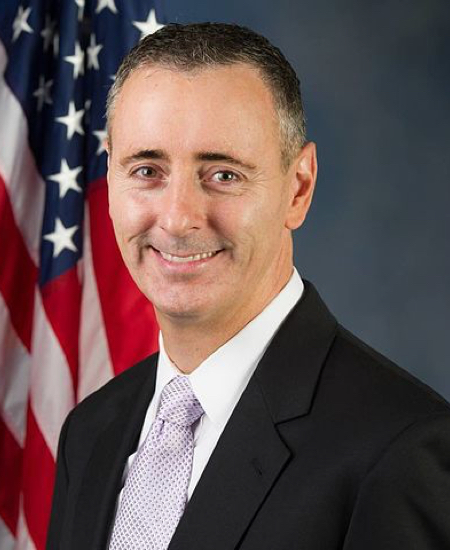
Photo of Brian K. Fitzpatrick
R United States House · District 1 · Pennsylvania On the 2026 ballot

Rep. Brian K. Fitzpatrick

Compare
Total votes
2,837
all sessions
Attendance
100%
9 missed
Higher than 75% of chamber peers
With party
76%
of cast votes
Lower than 98% of chamber peers
Bipartisan score
12%
some cross-party votes
Higher than 97% of chamber peers
Sponsored
4,059
bills & resolutions
Higher than 99% of chamber peers
Committees
6
assignments
4,059 bills and resolutions

Sponsored bills

Total
4,059
Primary
180
Co-sponsor
3,879
This page
4,059
matching current filters
Co-sponsor HR 5128
In committee · Indiana House · Co-sponsor
Feed Hungry Kids Act

Maddy summaryThe Feed Hungry Kids Act adjusts eligibility for schools participating in the federal school meal program. Starting in the 2025-2026 school year, schools must have at least 25% of students eligible for free or reduced-price meals to qualify for a provision allowing all students to receive free meals without individual applications. This change directly affects public schools nationwide that receive federal meal funding under the National School Lunch Program. The bill sets a specific, measurable threshold for program access without altering other aspects of school meal eligibility.

In committee Sep 4, 2025 1 co-sponsor
Co-sponsor HR 5162
In committee · Indiana House · Co-sponsor
Colorectal Cancer Early Detection Act

Maddy summaryThis bill establishes federal grants to states for programs focused on early detection of colorectal cancer in individuals under age 45. It directly affects young adults (under 45), particularly those with specific risk factors like family history, inflammatory bowel disease, genetic syndromes, or symptoms like rectal bleeding, as well as underserved communities including rural areas, American Indian/Alaska Native populations, African Americans, and those with type 2 diabetes. Key provisions include funding for state-led outreach, education, and screening partnerships with clinics and tribal organizations to identify high-risk individuals early and provide referrals for diagnostic testing and genetic counseling. Grants also support public awareness campaigns, clinician training on early detection, and patient navigation services to help young people access care before age 45. The bill aims to address rising colorectal cancer rates in younger populations by improving targeted prevention efforts.

In committee Sep 4, 2025 1 co-sponsor
Co-sponsor HR 5134
In committee · Indiana House · Co-sponsor
Appalachian Trail Centennial Act

Maddy summaryThe Appalachian Trail Centennial Act designates the Appalachian Trail Conservancy as the official "Designated Operational Partner" for the Appalachian National Scenic Trail, establishing a formal framework for federal-volunteer partnerships in trail management. It creates processes for developing "land and resource protection priority lists" to guide federal funding decisions for trail conservation, while ensuring volunteer organizations can continue their crucial role in trail maintenance and stewardship. The bill also requires regular economic impact assessments for communities near the trail ("gateway communities") and sets protocols for determining visitor capacity on specific trail segments. This legislation codifies and enhances the longstanding partnership model that has successfully maintained the Appalachian Trail for over a century, with potential application to other national scenic and historic trails.

In committee Sep 4, 2025 1 co-sponsor
Co-sponsor HR 5151
In committee · Indiana House · Co-sponsor
Quiet Communities Act of 2025

Maddy summaryThe Quiet Communities Act of 2025 reestablishes the Environmental Protection Agency’s Office of Noise Abatement and Control, which was defunded in 1982. This office will provide grants to states for local noise control programs, conduct national research on noise health impacts, develop public education materials, and create regional technical assistance centers. The bill authorizes $25 million annually (2026-2030) to fund these activities, directly supporting communities affected by noise pollution - particularly the estimated 28 million U.S. residents with hearing impairments linked to noise exposure. It emphasizes state/local solutions, market incentives, and coordination with other agencies to address noise from aircraft, traffic, and other sources.

In committee Sep 4, 2025 1 co-sponsor
Co-sponsor HR 5123
In committee · Indiana House · Co-sponsor
Indoor Air Quality and Healthy Schools Act of 2025

Maddy summaryThis bill requires the EPA to establish guidelines for indoor air contaminants like radon, formaldehyde, and carbon monoxide that affect schools and childcare facilities. It mandates a national assessment of indoor air quality in these buildings, with updates every five years, and provides technical assistance to schools and childcare providers to implement air quality improvements. The EPA must publish science-based guidelines with recommended concentration limits for key contaminants and support voluntary building certifications for healthier indoor environments. These provisions directly impact local schools, childcare centers, and state/local governments responsible for building maintenance and health standards.

In committee Sep 3, 2025 1 co-sponsor
Co-sponsor HR 5122
In committee · Indiana House · Co-sponsor
NASA Talent Exchange Program Act

Maddy summaryHR 5122, the NASA Talent Exchange Program Act, establishes a formal process for temporary, paid exchanges between NASA civil servants and private sector employees. It allows NASA to assign its employees to private companies (or vice versa) for up to two years (renewable to a maximum of three years total), requiring a written agreement that mandates employees return to federal service for twice the assignment duration. The program includes strict safeguards, such as prohibiting access to sensitive information, limiting participation to 2% of NASA's workforce, and requiring annual reports to Congress on participation numbers, roles, and program impacts. Key provisions also prevent private entities from charging federal costs for employee pay during assignments and mandate oversight to avoid conflicts of interest or circumventing workforce rules.

In committee Sep 3, 2025 1 co-sponsor
Co-sponsor HR 5115
In committee · Indiana House · Co-sponsor
Protecting Older Americans Act of 2025

Maddy summaryHR 5115, the Protecting Older Americans Act of 2025, makes pre-dispute arbitration agreements unenforceable for age discrimination claims involving people aged 40 or older. The bill directly affects workers aged 40+ who face alleged age discrimination under federal, tribal, or state law, and their employers who might require arbitration. Key provisions require courts - not arbitrators - to decide if arbitration clauses apply in such cases, and prohibit enforcing these clauses for age discrimination disputes filed after the law’s enactment. This changes how age discrimination claims are resolved, ensuring affected individuals can pursue cases in court rather than mandatory arbitration.

In committee Sep 3, 2025 1 co-sponsor
Co-sponsor HR 5106
In committee · Indiana House · Co-sponsor
Restore Trust in Congress Act

Maddy summaryThis bill prohibits Members of Congress, their spouses, and dependent children from owning or trading certain investments, including stocks, commodities, and derivatives (referred to as "covered investments"). It requires affected individuals to divest these investments within 90-180 days, with specific exemptions for Treasury bonds, diversified mutual funds, small business interests, and family trusts meeting strict conditions. Violations incur penalties of 10% of the investment's value plus disgorgement of profits, paid directly to the U.S. Treasury. The law applies to all covered individuals during federal service, with exceptions for investments acquired through inheritance or occupational trading (e.g., a spouse’s finance job).

In committee Sep 3, 2025 1 co-sponsor
Co-sponsor HR 5105
In committee · Indiana House · Co-sponsor
UNLOCK Act

Maddy summaryHR 5105, the UNLOCK Act, amends the Housing and Community Development Act of 1974 to expand eligibility for federal housing funds. It allows metropolitan cities, urban counties, states, local governments, insular areas, and tribal entities to use Section 106 funds for constructing new residential housing for low- and moderate-income residents, with or without nonprofit partnerships. The key change adds a new funding category (paragraph 27) to existing housing programs, streamlining access to resources for affordable housing projects. This bill directly affects local governments and tribal entities seeking to build or support affordable housing without requiring mandatory nonprofit involvement.

In committee Sep 3, 2025 1 co-sponsor
Co-sponsor HR 4669
In committee · Indiana House · Co-sponsor
FEMA Act of 2025

Maddy summary# Summary of Proposed FEMA Reform Legislation (FEMA Act of 2025) This comprehensive legislative document proposes significant reforms to the Robert T. Stafford Disaster Relief and Emergency Assistance Act, with four main sections addressing: ## 1. Disaster Assistance Reforms - **Expanded eligibility** for assistance, including clarifying that absence of a fixed address doesn't disqualify individuals from sheltering assistance - **Improved rental assistance** with consideration of local post-disaster rent increases - **Direct assistance** for those unable to use financial assistance, with no requirement to show other assistance can cover costs (except insurance) - **Enhanced notices** for applicants, including documentation of denial decisions - **Clarification of displacement assistance** eligibility, stating insurance shouldn't be considered a duplication of benefits ## 2. Mitigation Program Enhancements - **Preapproved project mitigation plans** requiring states to develop plans with peer review processes - **Improved allocation of funds** with formulas prioritizing vulnerable communities, high-risk areas, and rural/economically distressed communities - **Resilient buildings** requirements for housing retrofits using the latest building codes - **Streamlined application processes** for hazard mitigation funds across multiple programs - **Study on mitigation benefits** to evaluate cost savings and effectiveness ## 3. Transparency and Accountability Measures - **Public dashboards** for both individual assistance (431) and public assistance (432) showing application status, approvals, denials, and funding - **Transparency requirements** for disaster declarations with detailed justifications for approvals/denials - **GAO studies** on numerous topics including: - Identity theft in disaster assistance (409) - Insurance utilization for public assistance facilities (410) - Wildfire management plans (411) - Effectiveness of alerting systems (412) - Cost savings of repair/rebuilding reforms (415) - **Prohibition on political discrimination** in assistance distribution ## 4. Workforce and Operational Improvements - **Study on workforce retention** in noncontiguous communities - **Pilot program** for preliminary damage assessments in remote communities - **Fast-moving disasters working group** to develop best practices for rapid response The legislation focuses on improving efficiency, transparency, and effectiveness of disaster relief programs while prioritizing vulnerable populations and communities with higher risk of disasters. It also emphasizes data-driven decision making through required studies and reports to continuously improve disaster management policies.

In committee Sep 3, 2025 1 co-sponsor
Showing 631 to 640 of 4,059 bills
Previous 1 … 63 64 65 … 406 Next