

Maddy summaryHR 7279, the Nurse Faculty Shortage Reduction Act of 2026, creates a federal program to address nurse faculty shortages by covering the pay gap between nursing faculty salaries and clinical nursing salaries. It authorizes $15 million annually (2027-2031) for nursing schools to supplement faculty salaries for up to three years, targeting faculty who previously worked in clinical practice or are new hires. Schools must submit detailed salary data comparing clinical nurse pay to faculty pay and demonstrate plans to sustain funding after the grant period. The program prioritizes schools in health professional shortage areas, serving vulnerable populations, or focusing on underrepresented faculty, with a report due to Congress within three years of enactment.
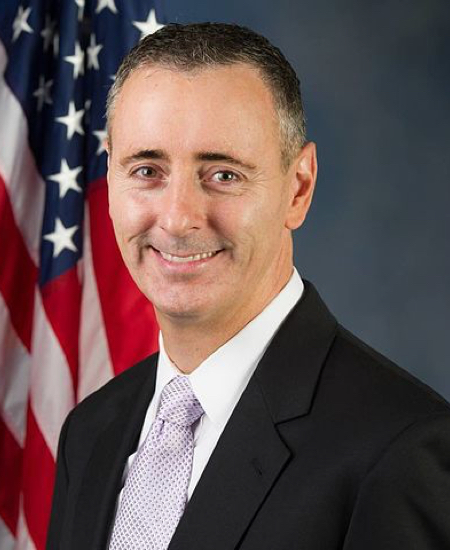
Rep. Brian K. Fitzpatrick
Sponsored bills
Maddy summaryThis bill requires most employers (those with 50+ employees for 20+ weeks annually) to display a clear notice about veterans' benefits in visible workplace areas. The notice, developed by the Labor and Veterans Affairs Departments, includes the Veterans Crisis Line, how to apply for benefits, and state-specific veteran resources. Employers must post the notice starting one year after the bill's enactment, with the notice updated twice yearly and made available online. A 180-day information campaign will also inform employers about the requirement.
Maddy summaryHR 7263, the Safe Intersections for Buses and Pedestrians Act, requires new motorcoaches (buses) sold in the U.S. to have a minimally obstructed forward view for drivers. The bill mandates the National Highway Traffic Safety Administration (NHTSA) to establish safety standards within one year of enactment, ensuring drivers can clearly see ahead without obstructions. Manufacturers may use camera systems meeting Federal Motor Vehicle Safety Standard 101 as an alternative to physical visibility improvements. This directly affects new bus manufacturers and NHTSA, aiming to improve driver visibility and safety for bus passengers and pedestrians.
Maddy summaryThis House resolution designates January 2026 as "National Stalking Awareness Month" to promote public education about stalking. It encourages government agencies, schools, victim services, and organizations to increase awareness and support for stalking victims. The resolution does not create new laws or funding but provides a designated period for coordinated awareness efforts.
Maddy summaryHRES 1022 is a non-binding congressional resolution expressing support for Catholic schools and celebrating the 52nd annual National Catholic Schools Week (January 25-31, 2026). It recognizes Catholic schools' contributions to education, noting their role in serving 1.7 million students across diverse backgrounds, with high graduation rates and community-focused values. The resolution specifically supports the week's goals, highlights the National Catholic Educational Association and U.S. Conference of Catholic Bishops' partnership, and applauds the 2026 theme "Catholic Schools: United in Faith and Community." It does not create new policies, allocate funding, or impose obligations.
Maddy summaryThe AI-WISE Act requires the Small Business Administration (SBA) to create and maintain free, publicly available online educational resources about artificial intelligence specifically for small business owners. These resources must cover practical topics like understanding AI limitations, identifying AI-generated outputs, managing risks, protecting user privacy, and determining when AI tools are suitable for business use - without favoring any specific AI product or company. The SBA must develop these materials within 180 days of the bill’s enactment, consulting with an Advisory Working Group of AI experts and small business outreach professionals. This initiative directly affects small business owners by providing accessible, neutral guidance to help them navigate AI adoption safely and effectively.
Maddy summaryThis bill creates a tax exclusion allowing eligible law enforcement officers to exclude up to $100,000 of their ordinary income from taxable income each year. To qualify, officers must have worked full-time as law enforcement for at least 5 cumulative years and earn up to $100,000 annually. It covers police, corrections officers, probation/parole officers, sheriffs, deputies, and school resource officers. The exclusion applies to the first $100,000 of ordinary income earned during a taxable year. The provision takes effect after the bill's enactment.
Maddy summaryThis bill requires the FBI, Consumer Financial Protection Bureau, and Federal Trade Commission to coordinate a government-wide strategy against scams. Within one year, they must establish a single definition of "scam," collect consistent data on scam types and losses, and report annual complaint numbers and dollar losses. By two years, they must produce a unified estimate of annual scam victims and total losses, including unreported cases. The agencies must also set metrics to evaluate the effectiveness of their anti-scam training programs and publicly share annual scam data. The bill directly affects federal agencies managing scam data, not the public.
Maddy summaryThe MOLD Act (HR 7188) establishes uniform health and safety standards for military housing managed by private contractors, directly affecting approximately 700,000 service members and their families living in privatized housing across 78 developments. It requires the Defense Secretary to set enforceable limits on indoor humidity (below 50%), mandate third-party inspections after tenant complaints or unit turnover, and hold contractors fully responsible for mold remediation, relocation costs, and property damage. The bill also mandates public reporting of complaints, inspection results, and remediation timelines, and requires contractors to use certified professionals for mold assessments. These provisions aim to reduce mold-related health risks and improve accountability in privatized military housing.
Maddy summaryHR 7178, the U.S.-Israel Anti-Killer Drone Act of 2026, requires enhanced U.S.-Israel cooperation to counter Iranian unmanned systems. The bill directs the U.S. and Israel to jointly develop, test, and deploy counter-drone technologies through their existing Operations Technology-Working Group, including sharing threat intelligence and conducting joint training. It increases annual funding for this cooperation from $55 million to $100 million and mandates detailed annual reports to Congress on progress, threat assessments, and the adequacy of current counter-drone capabilities. The bill directly affects U.S. and Israeli military forces by accelerating joint efforts to address threats from Iran-origin drones targeting U.S. allies and military assets in the Middle East.