

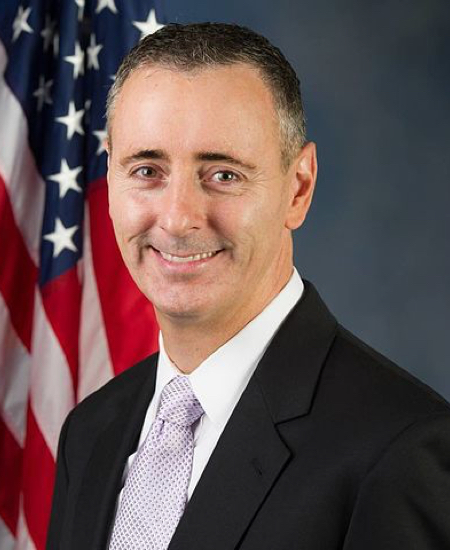
Photo of Brian K. Fitzpatrick
R United States House · District 1 · Pennsylvania On the 2026 ballot

Rep. Brian K. Fitzpatrick

Compare
Total votes
2,837
all sessions
Attendance
100%
9 missed
Higher than 75% of chamber peers
With party
76%
of cast votes
Lower than 98% of chamber peers
Bipartisan score
12%
some cross-party votes
Higher than 97% of chamber peers
Sponsored
4,052
bills & resolutions
Higher than 99% of chamber peers
Committees
6
assignments
4,052 bills and resolutions

Sponsored bills

Total
4,052
Primary
180
Co-sponsor
3,872
This page
4,052
matching current filters
Co-sponsor HR 8996
In committee · Indiana House · Co-sponsor
Rental Housing Investment Act

Maddy summaryThe Rental Housing Investment Act provides tax incentives to encourage the development of new long-term residential rental properties in the United States. It allows developers to take an accelerated depreciation deduction of up to $150,000 per unit for buildings containing at least two dwelling units, with an increased limit of $250,000 per unit for projects designated as affordable housing. To ensure these properties remain available for rent, the bill includes rules that require the buildings to be used for rental purposes for at least 10 years, or 15 years for affordable housing, before the tax benefits are recaptured. These changes apply to properties placed in service after a 12-month delay following the law's enactment.

In committee May 21, 2026 1 co-sponsor
Co-sponsor HR 8985
In committee · Indiana House · Co-sponsor
Housing for All Veterans Act of 2026

Maddy summaryThe Housing for All Veterans Act of 2026 creates a new rental assistance program specifically for low-income veterans and their families. It allows these households to apply for housing vouchers through existing public housing agencies, with eligibility criteria gradually expanding from extremely low-income in 2027 to broader low-income definitions by 2031. Key provisions include counting VA disability benefits as non-income, prohibiting discrimination against voucher holders, and providing service fees to agencies to help veterans secure leases. The bill also ensures that current veterans receiving support are not affected by the new rules and that the program supplements, rather than replaces, existing housing aid.

In committee May 21, 2026 1 co-sponsor
Co-sponsor HR 8978
In committee · Indiana House · Co-sponsor
Enhancing Mental Health and Suicide Prevention Through Campus Planning Act

Maddy summaryThis bill directs the U.S. Department of Education to encourage colleges and universities to create evidence-based plans for preventing suicide and improving mental health. The Department must coordinate these efforts with the Department of Health and Human Services and align them with existing federal suicide prevention programs. Additionally, the bill requires the Secretary of Education to submit reports to Congress on these initiatives within one year and three years of enactment. Crucially, the legislation explicitly states that it does not create new legal obligations for schools or grant the Department new regulatory authority.

In committee May 21, 2026 1 co-sponsor
Co-sponsor HR 8964
In committee · Indiana House · Co-sponsor
DONOR Milk Act

Maddy summaryThe DONOR Milk Act establishes new federal regulations to improve the safety and oversight of pasteurized donor human milk, which is milk collected from mothers and given to infants other than their own. This legislation requires facilities that produce or store this milk to undergo annual inspections, including unannounced visits, to ensure they meet food safety standards. To support these facilities in complying with the new rules, the bill authorizes an $8 million grant program to help with equipment upgrades and necessary certifications. These changes directly affect nonprofit organizations and food establishments that manufacture, process, pack, or hold donor human milk.

In committee May 21, 2026 1 co-sponsor
Primary HR 8955
In committee · Indiana House · Lead sponsor
Bipartisan Transparency for American Taxpayers Act

Maddy summaryThe Bipartisan Transparency for American Taxpayers Act prohibits the use of federal funds to pay claims submitted to the Anti-Weaponization Fund. This fund was established by the Department of Justice on May 18, 2026, and the bill specifically bars any money from being used for these payments. The legislation directly affects the Department of Justice and any individuals or entities seeking reimbursement from this specific fund. By restricting funding sources, the bill aims to prevent taxpayer money from being spent on claims directed to this newly created entity.

In committee May 21, 2026 0 co-sponsors
Co-sponsor HR 8163
In committee · Indiana House · Co-sponsor
Provider Reimbursement Stability Act of 2026

Maddy summaryThis bill, the Provider Reimbursement Stability Act of 2026, aims to create more predictable payment adjustments for physicians and other healthcare providers under the Medicare program. It directly affects medical practices and providers who receive reimbursement for services through the physician fee schedule. The legislation increases a threshold for certain budget neutrality calculations from $20 million to $54.3 million in 2027, with automatic increases every five years thereafter. It also requires the government to correct payment estimates when actual service usage differs significantly from projections, mandates regular updates to cost calculations for practice expenses, and limits how much Medicare payment rates can change from year to year to a maximum of 2.5 percent.

In committee May 21, 2026 1 co-sponsor
Co-sponsor HR 3164
In committee · Indiana House · Co-sponsor
Ensuring Community Access to Pharmacist Services Act

Maddy summaryThis bill would add pharmacist services to Medicare Part B coverage for beneficiaries, specifically covering pharmacist-led testing and treatment for illnesses like flu, COVID-19, or strep throat during public health emergencies. It defines covered services as those performed under state law, often requiring collaboration with a physician, and sets payment at 80% of the lesser of the actual charge or 85% of physician payment rates. Pharmacists would be prohibited from balance billing for these services, ensuring Medicare beneficiaries pay only their standard copayment. The changes would take effect January 1, 2026.

In committee May 21, 2026 1 co-sponsor
Co-sponsor HR 1993
Passed · Indiana House · Co-sponsor
25th Anniversary of 9/11 Commemorative Coin Act

Maddy summaryThis bill authorizes the U.S. Mint to produce commemorative $5 gold and $1 silver coins marking the 25th anniversary of the September 11, 2001, terrorist attacks. The coins must feature designs honoring victims and first responders (including the inscription "Never Forget") and will be sold only during 2027-2028. All surcharges ($35 per gold coin, $10 per silver coin) collected from sales will fund the National September 11 Memorial and Museum at the World Trade Center, with no net cost to the federal government. The coins are legal tender but primarily intended for collectors, not circulation.

Passed May 21, 2026 1 co-sponsor
Co-sponsor HR 1329
Failed · Indiana House · Co-sponsor
Smithsonian American Women’s History Museum Act

Maddy summaryThe Smithsonian American Women’s History Museum Act authorizes the creation of a new Smithsonian museum dedicated to women’s history, to be located within the National Mall Reserve in Washington, D.C. If the site is managed by another federal agency, the bill requires that agency to transfer the land after notifying Congress and relevant committees. The museum must ensure exhibits and programs accurately represent diverse women’s experiences by consulting a broad range of experts and community voices. The Smithsonian will submit biennial reports to Congress detailing how the museum meets these representation standards.

Failed May 21, 2026 1 co-sponsor
Co-sponsor HR 8933
In committee · Indiana House · Co-sponsor
Dietary Supplements Access Act

Maddy summaryThe Dietary Supplements Access Act allows individuals to use funds from specific tax-advantaged health accounts to purchase dietary supplements without paying income taxes on those withdrawals. This legislation directly affects holders of Health Savings Accounts, Archer Medical Savings Accounts, and Health Flexible Spending Arrangements by permitting up to $500 per year in tax-free spending on these products, with a lower limit of $250 for married couples filing separately. The bill explicitly defines dietary supplements according to federal law but excludes energy drinks, soft drinks, and sodas from this benefit. These tax advantages will only become effective for expenses incurred after December 31, 2025.

In committee May 20, 2026 1 co-sponsor
Showing 171 to 180 of 4,052 bills
Previous 1 … 17 18 19 … 406 Next