

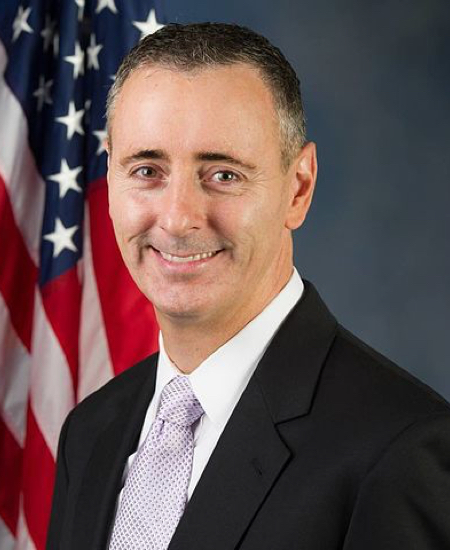
Photo of Brian K. Fitzpatrick
R United States House · District 1 · Pennsylvania On the 2026 ballot

Rep. Brian K. Fitzpatrick

Compare
Total votes
2,837
all sessions
Attendance
100%
9 missed
Higher than 75% of chamber peers
With party
76%
of cast votes
Lower than 98% of chamber peers
Bipartisan score
12%
some cross-party votes
Higher than 97% of chamber peers
Sponsored
4,052
bills & resolutions
Higher than 99% of chamber peers
Committees
6
assignments
4,052 bills and resolutions

Sponsored bills

Total
4,052
Primary
180
Co-sponsor
3,872
This page
4,052
matching current filters
Co-sponsor HR 2821
Passed · Indiana House · Co-sponsor
FDA Modernization Act 3.0

Maddy summaryHR 2821, the FDA Modernization Act 3.0, requires the FDA to update regulatory language within one year of enactment. It directs the agency to replace all references to "animal tests" with "nonclinical tests" in 22 specific sections of the Code of Federal Regulations related to drug development and approval processes. The bill also adds a definition for "nonclinical test" into relevant FDA regulations to align with prior legislative changes. This update applies directly to pharmaceutical manufacturers and FDA reviewers who follow these regulatory guidelines during drug development. The changes aim to modernize terminology without altering current testing requirements.

Passed Jul 21, 2026 1 co-sponsor
Co-sponsor HR 9764
In committee · Indiana House · Co-sponsor
HONOR Act

Maddy summaryThe HONOR Act prohibits U.S. taxpayers from claiming foreign tax credits for taxes paid to the Russian Federation for a specific period following the law's enactment. This restriction remains in effect until the United States resumes normal trade relations with Russia, at which point standard tariff rates will be restored. The provision explicitly overrides any conflicting international tax treaties to ensure the penalty applies regardless of existing agreements.

In committee Jul 16, 2026 1 co-sponsor
Co-sponsor HR 9693
In committee · Indiana House · Co-sponsor
Patients First Act of 2026

Maddy summaryThe Patients First Act of 2026 modifies how Medicare reimburses physicians and primary care providers to improve access and stabilize payments. It establishes a new hybrid payment model for primary care services from 2027 to 2031, which pays a monthly fee per patient to eligible independent practices while covering specific services like care management and telehealth without cost-sharing for patients. The bill also updates the formula for calculating reimbursement rates to account for high inflation years and requires more frequent updates to the costs used in calculating payments. Additionally, the legislation reforms the performance-based payment system by adding care efficiency measures, creating a task force to recommend new quality metrics, and adjusting penalties for providers who fail to report on certain data.

In committee Jul 15, 2026 1 co-sponsor
Co-sponsor HR 9641
In committee · Indiana House · Co-sponsor
Essential Caregivers Act of 2026

Maddy summaryThe Essential Caregivers Act of 2026 requires nursing homes, long-term care hospitals, rehabilitation facilities, and intermediate care facilities to allow two chosen family members or friends to visit residents during times when regular visitation is suspended. These essential caregivers must agree to follow the facility's existing safety and infection control rules, which are no more restrictive than those applied to staff. While facilities can limit access for the first seven days of a suspension or deny entry if a caregiver shows symptoms of a serious infectious disease, they cannot block visits for end-of-life care. Additionally, the bill mandates that complaints about denied access to essential caregivers be investigated and resolved within three days.

In committee Jul 15, 2026 1 co-sponsor
Co-sponsor HR 3514
In committee · Indiana House · Co-sponsor
Improving Seniors’ Timely Access to Care Act of 2025

Maddy summaryThis bill requires Medicare Advantage plans to implement electronic pre-approval systems for medical services by 2028 and meet transparency reporting standards starting in 2027. Plans must publicly report data on approval/denial rates, appeal outcomes, response times, and technology use for pre-approval requests, including details on how denials relate to clinical criteria. It establishes a 24-hour response timeframe for certain requests and mandates annual reviews of pre-approval requirements based on data and input from seniors and providers. The law directly affects Medicare Advantage plans, seniors enrolled in these plans, and healthcare providers who submit pre-approval requests. These changes aim to make the pre-approval process faster, more transparent, and more accountable for seniors seeking covered medical services.

In committee Jul 15, 2026 1 co-sponsor
Co-sponsor HR 139
Passed · Indiana House · Co-sponsor
Sunshine Protection Act of 2025

Maddy summaryThe Sunshine Protection Act of 2025 would make daylight saving time permanent across the United States, ending the current practice of changing clocks twice yearly. It repeals the 1966 law requiring seasonal time changes and adjusts time zone offsets to reflect permanent daylight saving time (e.g., shifting from "4 hours" to "3 hours" in historical references). States that currently opt out of daylight saving time (like Arizona and Hawaii) would retain their existing arrangements, while all other states would adopt permanent daylight saving time unless they choose to stay on standard time. This change would directly affect all U.S. residents by eliminating the need to reset clocks in spring and fall.

Passed Jul 15, 2026 1 co-sponsor
Co-sponsor HR 9684
In committee · Indiana House · Co-sponsor
PATH Act

Maddy summaryThe Pre-Apprenticeships To Hardhats Act authorizes $20 million annually to fund grants that help build and construction trade pre-apprenticeship programs. These programs are designed to prepare individuals from underrepresented groups, such as women, racial minorities, and veterans, for entry into registered apprenticeships by providing industry-aligned training and curriculum. Funding is awarded to nonprofit partnerships that include employers, labor organizations, and educational institutions, with a requirement that the training leads directly to available apprenticeship positions. The Department of Labor must evaluate the effectiveness of these projects based on participant success rates, and grants may be extended only if satisfactory performance is demonstrated.

In committee Jul 14, 2026 1 co-sponsor
Co-sponsor HR 9680
In committee · Indiana House · Co-sponsor
Replace UNRWA with Real Humanitarian Assistance Act

Maddy summaryThis bill directs the U.S. Secretary of State to create and execute a plan to end the operations of the United Nations Relief and Works Agency for Palestine Refugees in the Near East (UNRWA) across the Middle East. The legislation requires a detailed strategy that assesses current programs like education and healthcare, identifies new organizations to take over these services, and outlines how to fund and oversee the transition without interrupting aid. Once the plan is submitted to Congress, the State Department must begin implementing it within a year while coordinating with host countries and international partners. The bill emphasizes maintaining service continuity and ensuring that any successor groups meet strict standards for transparency and accountability.

In committee Jul 14, 2026 1 co-sponsor
Co-sponsor HR 9678
In committee · Indiana House · Co-sponsor
Good Jobs for Good Airports Act

Maddy summaryThe Good Jobs for Good Airports Act establishes federal minimum wage and fringe benefit standards for workers at small, medium, and large hub airports, including those employed by private contractors. It defines covered service workers as individuals performing tasks such as passenger assistance, security, ground handling, and concessions, ensuring they receive pay and benefits at least equal to the higher of the federal Service Contract Act rates or applicable state and local laws. Employers must submit monthly certifications confirming compliance with these standards, while the Department of Labor and Department of Transportation are granted enforcement powers to investigate violations and impose penalties. The legislation also requires the Secretary of Transportation to publish complaint data and submit annual reports to Congress regarding implementation efforts.

In committee Jul 14, 2026 1 co-sponsor
Co-sponsor HR 9668
In committee · Indiana House · Co-sponsor
STOP Senior Fraud Act

Maddy summaryThe STOP Senior Fraud Act empowers financial institutions to temporarily delay or refuse transactions for accounts held by older adults, vulnerable individuals, or those with a history of financial exploitation if there is a reasonable suspicion of fraud. Under this bill, these delays can last up to 55 days, with a possible extension to 85 days if an internal review confirms the risk, and must be accompanied by notifications to trusted contacts and relevant authorities. Financial institutions are also required to provide staff training on identifying and handling potential exploitation cases, while the law includes protections to shield banks from liability when acting in good faith. The legislation defines specific terms such as "older adult" as anyone 62 or older and "financial exploitation" as the unauthorized taking or control of assets through deception or undue influence.

In committee Jul 14, 2026 1 co-sponsor
Showing 101 to 110 of 4,052 bills
Previous 1 … 10 11 12 … 406 Next