

Maddy summaryHR 4852, the "IDs for an Inclusive Democracy Act," requires the Social Security Administration to create and issue free federal identification cards within three years. These cards would be accepted like state driver's licenses for most purposes, including voting and accessing services, and must include a gender option for "X" (unspecified/other identity) alongside male and female. The bill mandates the U.S. Postal Service to handle applications through existing passport-like processes, with free photography and mail-in options, and establishes a Task Force to develop security features and accessibility guidelines. It also sets special validity rules: cards for minors expire at age 18, while those for seniors 65+ remain valid indefinitely after their 10-year term.
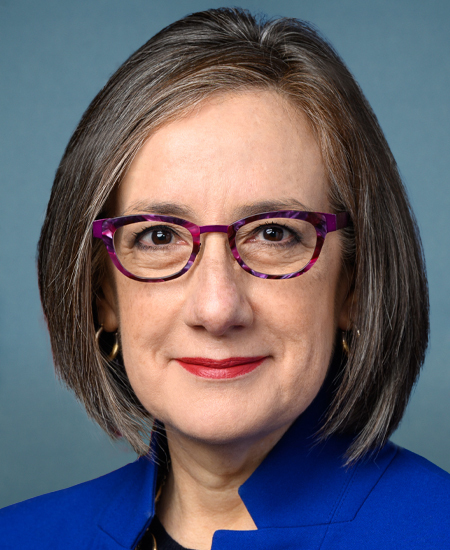
Rep. Andrea Salinas
Sponsored bills
Maddy summaryHR 4889, the Raise the Wage Act of 2023, would gradually increase the federal minimum wage for most workers to $15.50 per hour by 2027, with specific annual targets: $9.50 starting in 2023, rising to $11.00 after one year, $12.50 after two years, and $15.50 after four years. It would also phase out the separate lower minimum wage for tipped employees (starting at $6.00/hour) by aligning their pay with the regular minimum wage by 2028, while requiring employers to let workers keep all tips. The bill includes similar phased increases for workers under 20 and transitions toward fairer wages for workers with disabilities under special certificates, which would sunset after 2028. Future annual increases after 2028 would tie the minimum wage to the median hourly wage of all workers.
Maddy summaryHR 4157, the "Not Just a Number Act," requires the Department of Veterans Affairs (VA) to produce annual reports on veteran suicide rates and their connection to VA healthcare and benefits. The reports must break down suicide rates by age, gender, and race, and examine how engagement with VA services (like Vet Centers, healthcare enrollment, benefits claims, and housing loans) correlates with suicide trends. The bill also mandates a VA toolkit for state/local coroners to improve veteran suicide death reporting, and a study on creating a dedicated VA suicide prevention office. These measures aim to standardize data collection and identify effective prevention strategies, directly affecting VA operations, congressional oversight, and veteran care systems.
Maddy summaryHR 4769, the PFAS Alternatives Act, funds research and training to develop PFAS-free turnout gear for firefighters. It authorizes $25 million annually (2024-2028) for grants to eligible organizations to research, develop, and test next-generation gear without per- and polyfluoroalkyl substances (PFAS), which are linked to firefighter cancer risks. The bill requires partnerships with firefighting organizations to ensure research translates into practical training and gear care guidance, including decontamination protocols. It also allocates $2 million yearly for training programs on proper gear use and maintenance, aiming to reduce exposure to hazardous chemicals during fire operations.
This resolution (1) recognizes the Latino community’s commitment to conservation and the importance of getting outdoors, and (2) supports the designation of Latino Conservation Week.
Maddy summaryThis bill creates two tax credits to support local media and small businesses. It provides a credit for small businesses (under 50 full-time employees) that advertise in qualifying local newspapers or broadcast stations, covering 80% of first-year ad costs up to $5,000 and 50% of subsequent-year costs up to $2,500. It also establishes a payroll tax credit for employers hiring local news journalists, covering 50% of wages for the first four quarters (capped at $12,500 per journalist) and 30% thereafter, with a maximum of 1,500 journalists per employer. Both credits expire after five years and require strict definitions of "local media" (e.g., publishers with local journalists and community focus) to prevent misuse.
Maddy summaryH.J.Res. 25 would remove the 1979 deadline for states to ratify the Equal Rights Amendment (ERA), which was originally proposed in 1972. This bill directly affects states that ratified the ERA after the deadline (such as Nevada, Illinois, and Virginia in 2017-2018) by making their ratifications legally valid. The key provision states that the ERA is valid as part of the Constitution if ratified by three-fourths of states, regardless of the original deadline. The bill does not create new rights but aims to finalize the constitutional amendment process by eliminating the time limit.
Maddy summaryHR 2768, the PFC Joseph P. Dwyer Peer Support Program Act, establishes a VA grant program to fund peer-to-peer mental health support for veterans. It provides up to $250,000 per grant to eligible nonprofits, veteran service organizations, or state/local Tribal agencies to create programs where veterans serve as peer specialists offering 24/7 nonclinical support. The program requires adherence to VA-developed standards for volunteer training and service delivery, while prohibiting the collection of veterans' personally identifying information. The bill authorizes $25 million over three years to implement this initiative, directly benefiting veterans seeking accessible mental health assistance through peer networks.
Maddy summaryHR 1639 establishes a 5-year pilot program at five VA medical centers to implement the Zero Suicide Institute's curriculum, aiming to improve suicide care for veterans. The program requires participating sites to train staff on standardized suicide screening, assessment, treatment protocols, and safety planning over ten weeks, with one site specifically serving rural veterans. It mandates annual reporting to Congress on staff training completion, policy alignment with the Institute's standards, and comparisons of suicide-related outcomes (like screening rates and hospitalizations) between pilot sites and other VA facilities. This directly affects veterans receiving care at the selected VA medical centers by changing how suicide risk is managed within their treatment.
Maddy summaryThis bill requires the Department of Veterans Affairs (VA) to reimburse veterans for travel expenses at the same rate used for government employees traveling on official business. It directly affects veterans receiving VA medical care who travel using personal vehicles, ensuring their mileage reimbursement matches the federal standard set by the General Services Administration. The key change aligns the VA's reimbursement rate with the existing federal government rate (currently 41.5 cents per mile), eliminating the previous fixed rate and requiring annual updates to reflect current government standards.