

Protecting Military Installations from Foreign Espionage Act This bill places restrictions on the purchase of certain property by a foreign person who is owned or controlled by, is acting for or on behalf of, or receives subsidies from Russia, China, Iran, or North Korea. Specifically, the Committee on Foreign Investment in the United States must review a purchase or lease by, or a concession to, any such foreign person of private or public real estate in the United States that is within (1) 100 miles of a military installation; or (2) 50 miles of a military training route, special use airspace, a controlled firing area, or a military operations area. Further, the Department of Defense and the Department of Transportation may not issue final determinations regarding specified projects (e.g., energy projects) that involve a transaction under review by the committee until the committee concludes its action.
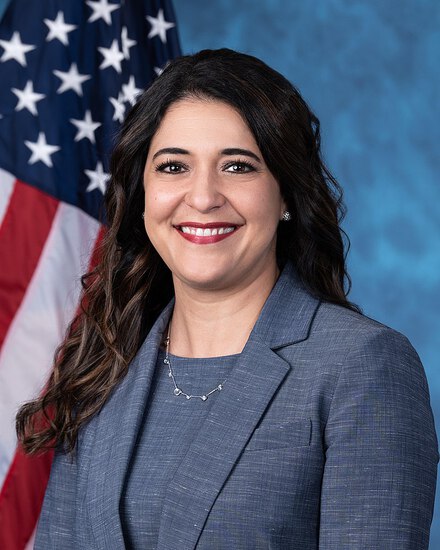
Rep. Stephanie I. Bice
Sponsored bills
Finish the Wall Act This bill requires the Department of Homeland Security (DHS) to resume activities related to the construction of a barrier system along the U.S.-Mexico border and addresses other border-related issues. DHS must resume all such construction activities that were planned or underway prior to January 20, 2021. DHS must also expend all funds appropriated or explicitly obligated since October 1, 2016, for construction of this barrier system. DHS may not cancel contracts for activities related to such construction entered into on or before January 20, 2021. Furthermore, within 14 days of this bill's enactment, DHS must certify to Congress that U.S. Customs and Border Protection facilities that process adults taken into custody at the border are fully compliant with certain laws related to the collection of DNA. (Among other things, these laws allow for the collection of DNA samples from non-U.S. persons detained under U.S. authority.)
Natural Gas Export Expansion Act This bill revises requirements regarding natural gas imports or exports to expand the expedited application and approval process to any nation, even if not a party to a free trade agreement with the United States, that is not specifically excluded by this bill. The bill excludes any nation subject to sanctions or trade restrictions imposed by the United States or excluded by the President or Congress for national security reasons.
Secure and Fair Enforcement Banking Act of 2021 or the SAFE Banking Act of 2021 This bill generally prohibits a federal banking regulator from penalizing a depository institution for providing banking services to a legitimate cannabis-related business. Prohibited penalties include terminating or limiting the deposit insurance or share insurance of a depository institution solely because the institution provides financial services to a legitimate cannabis-related business and prohibiting or otherwise discouraging a depository institution from offering financial services to such a business. Additionally, proceeds from a transaction involving activities of a legitimate cannabis-related business are not considered proceeds from unlawful activity. Proceeds from unlawful activity are subject to anti-money laundering laws. Furthermore, a depository institution is not, under federal law, liable or subject to asset forfeiture for providing a loan or other financial services to a legitimate cannabis-related business. The bill also provides that a federal banking agency may not request or order a depository institution to terminate a customer account unless (1) the agency has a valid reason for doing so, and (2) that reason is not based solely on reputation risk. Valid reasons for terminating an account include threats to national security and involvement in terrorist financing, including state sponsorship of terrorism. Finally, the bill decreases the cap on the surplus funds of the Federal Reserve banks. (Amounts exceeding this cap are deposited in the general fund of the Treasury.)
This resolution expresses the sense of the House of Representatives that (1) clean water is a national priority, and (2) the 2020 final rule titled The Navigable Waters Protection Rule: Definition of "Waters of the United States" should not be withdrawn or vacated.
Accelerate Long-term Investment Growth Now Act or the ALIGN Act This bill makes permanent the expensing of certain new business equipment. Expensing allows the deduction of the full amount of an expense item in the same taxable year.
Equal Pay for Servicewomen Act This bill requires the Department of Defense (DOD) to address out-of-pocket cost inequities for military service uniforms. Specifically, the bill requires DOD to implement the four recommendations made by the Government Accountability Office in its report titled Military Service Uniforms DOD Could Better Identify and Address Out-of-Pocket Cost Inequities (GAO-21-120). The recommendations made in the report are related to reducing differences in out-of-pocket costs incurred by enlisted service members across the services and by gender. The bill requires DOD to prescribe regulations to ensure that out-of-pocket uniform costs to officers or enlisted members may not exceed costs to other officers or members in their branch solely based on gender; and if a change to a uniform affects only officers or enlisted members of one gender, the officers or members must be entitled to an allowance equal to the out-of-pocket cost related to the change. DOD must provide a one-time allowance to female officers and enlisted members in an amount based on gender disparities in out-of-pocket uniform costs during the past 10 years and proportional to the length of service of the officer or member.
BUILDER Act of 2021 or the Building United States Infrastructure through Limited Delays and Efficient Reviews Act of 2021 This bill places limits on the environmental review of proposed major federal actions under the National Environmental Policy Act of 1969 (NEPA) and establishes deadlines and other requirements to expedite the environmental review of such actions. Specifically, the bill limits the scope of the environmental review of major federal actions significantly affecting the quality of the human environment as specified by the bill. The bill also specifies the thresholds that trigger when agencies must issue environmental assessments and environmental impact statements for proposed agency actions, outlines when agencies are not required to prepare environmental documents for such actions, and establishes deadlines to complete such documents. The bill also establishes a process for designating a lead federal agency as well as a joint lead agency, such as a state government, to supervise the environmental review under NEPA. A lead agency may allow a project sponsor to prepare environmental documents under specified circumstances. Additionally, the bill revises requirements concerning the judicial review of NEPA cases, including by establishing deadlines to file lawsuits under NEPA.
Wage Equity Act of 2021 This bill addresses workplace wage discrimination based on sex. Specifically, it limits the acceptable reasons for wage disparities based on sex to legitimate business-related factors unrelated to sex. Italso protects from liability for such discrimination those employers who conduct a job and wage analysis audit to identify wage disparities and take reasonable steps to remedy any such disparities. Further, the bill prohibits employers from relying on, or requesting, the wage history of a prospective employee for hiring and wage determination purposes unless it is voluntarily provided by the prospective employee. Employers generally may not prohibit employees from inquiring about, or discussing, wage information concerning another employee or from requesting information from an employer about wage differentials. Finally, the bill permits the Department of Labor to establish a grant program for negotiation skills education for women and girls. It also requires the Government Accountability Office to study and report on the causes and effects of sex-based wage disparities.
Veterans 2nd Amendment Protection Act This bill prohibits the Department of Veterans Affairs (VA) from transmitting certain information to the National Instant Criminal Background Check System (NICS) utilized by licensed importers or dealers of firearms. Specifically, the bill prohibits the VA from transmitting personally identifying information of a veteran or a beneficiary to the NICS solely on the basis that such veteran or beneficiary has an appointed fiduciary to manage their benefits, unless there is an order or finding of a judicial authority that such veteran or beneficiary is a danger to themselves or others.