

Maddy summaryHR 5144, the GOT Act, prohibits all federal employees, elected officials, and judges from maintaining official government accounts on TikTok or any account operated by TikTok's parent company, ByteDance. It directly affects every member of the executive, legislative, and judicial branches of the U.S. government who uses TikTok for work-related purposes. The bill bans creating, establishing, or keeping such accounts on TikTok or equivalent platforms owned by ByteDance. This is a direct policy change to prevent federal personnel from using the platform for official business, citing national security concerns.
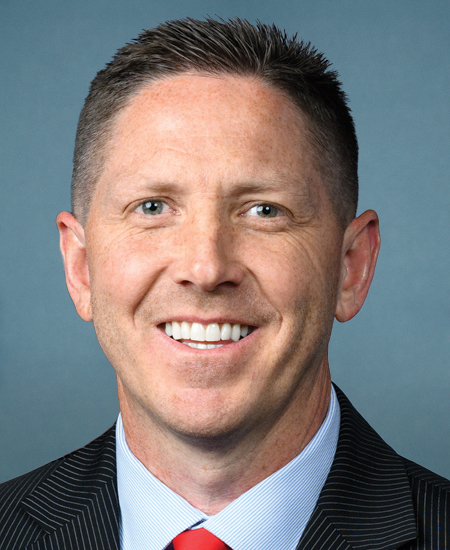
Rep. Josh Brecheen
Sponsored bills
Maddy summaryThis bill amends federal funding rules for Title X family planning services. It prohibits the Secretary of Health and Human Services from requiring any State, clinic, or organization receiving Title X funds to provide abortion counseling or referrals as a condition of receiving that funding. The law directly affects all Title X grantees - clinics and providers that receive federal funds for preventive reproductive health services. The key provision ensures that funding eligibility cannot be tied to abortion-related services or referrals.
Maddy summaryHR 5130, the "Finish It Act," requires the Department of Defense to use stored border wall construction materials (valued at approximately $300 million) for building permanent barriers along the U.S.-Mexico border within 30 days of the bill's enactment. It mandates that states receiving materials certify they will use them exclusively for border barriers, with penalties for unused materials (requiring repayment of the original cost) and imposes a 1% budget cut for every two days of delay in implementation. The bill also demands a detailed report from the Department of Defense within 90 days, including internal communications about storage costs and contracts with private landowners. This legislation directly affects the Department of Defense and border states, focusing on redirecting existing resources rather than creating new funding or construction.
Maddy summaryThe Healthy SNAP Act of 2023 changes what foods SNAP recipients can buy by updating the program's definition of eligible "food." It explicitly excludes soft drinks, candy, ice cream, and prepared desserts like cakes or cookies, while requiring the USDA Secretary to designate specific nutrient-rich foods that address dietary gaps and promote health. The bill mandates the Secretary to review and update these designated foods every five years based on nutrition science and public health needs, and allows states to substitute culturally appropriate, nutritionally equivalent foods with approval. This directly affects the 40 million SNAP participants nationwide by altering their purchasing options under the program.
Maddy summaryHRES 628 would terminate the Office of Diversity and Inclusion within the U.S. House of Representatives. The bill specifically eliminates the office and amends House Rules (including Rule II and Rule X) to remove all references to it. This resolution would end the office's existence and its role in overseeing diversity and inclusion initiatives for House staff and operations. The change applies solely to the House's internal structure and does not affect other legislative functions or external policies.
Maddy summaryThis bill directs the U.S. Treasury to mint commemorative coins marking the Marine Corps' 250th anniversary in 2025. It authorizes three coin types: $5 gold coins (max 50,000), $1 silver coins (max 400,000), and half-dollar coins (max 750,000), with surcharges of $35, $10, and $5 respectively. The surcharge proceeds will fund the Marine Corps Heritage Center's educational programs, with no net cost to taxpayers as the Treasury must recover all minting costs through the surcharges. The coins can only be issued during 2025, and the Treasury must ensure all costs are covered before distributing funds to the Heritage Foundation.
Maddy summaryHR 4157, the "Not Just a Number Act," requires the Department of Veterans Affairs (VA) to produce annual reports on veteran suicide rates and their connection to VA healthcare and benefits. The reports must break down suicide rates by age, gender, and race, and examine how engagement with VA services (like Vet Centers, healthcare enrollment, benefits claims, and housing loans) correlates with suicide trends. The bill also mandates a VA toolkit for state/local coroners to improve veteran suicide death reporting, and a study on creating a dedicated VA suicide prevention office. These measures aim to standardize data collection and identify effective prevention strategies, directly affecting VA operations, congressional oversight, and veteran care systems.
Maddy summaryHR 4726 terminates the requirement that aliens (non-citizens) must be vaccinated against COVID-19 to obtain visas, adjust to permanent residency, or naturalize as U.S. citizens. The bill immediately ends this mandate upon enactment and prohibits federal funding for any administration or enforcement of the vaccination rule. It specifically targets requirements set by the CDC and DHS under existing public health laws. This change directly affects non-citizens applying for visas, green cards, or U.S. citizenship who previously faced this vaccination condition. The policy shift removes a specific health-related barrier from three key immigration processes.
Publish Overdose and Suicide Tracking For American Safety Today Act of 2023 or the POST FAST Act of 2023 This bill requires the Centers for Disease Control and Prevention to publish data about suicides and drug overdoses in the United States for a given month within 60 days of the end of that month.
Maddy summaryHR 4776, the Protecting Free Speech Act, ends a specific Department of Homeland Security (DHS) program called the Disinformation Governance Board and prevents federal funding for any similar entity. The bill directly affects DHS by terminating the board's operations and prohibiting the use of federal funds to create or support any replacement program with comparable functions. It does not create new free speech protections but formally removes this particular DHS initiative and blocks future funding for equivalent efforts. The bill focuses on eliminating an existing program rather than changing broader speech policies.