

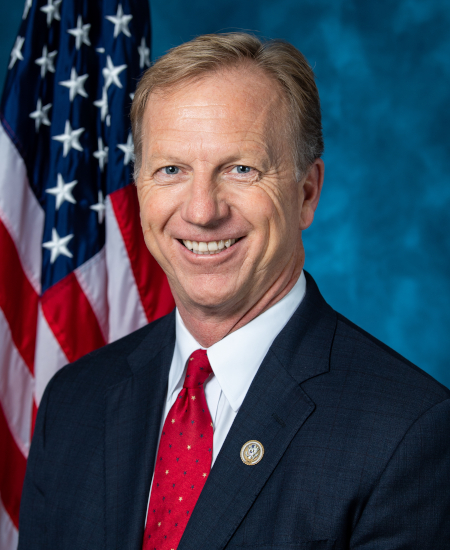
Photo of Kevin Hern
R United States House · District 1 · Oklahoma

Rep. Kevin Hern

Compare
Total votes
2,837
all sessions
Attendance
98%
48 missed
Near the chamber average
With party
92%
of cast votes
Near the chamber average
Bipartisan score
4%
crosses aisle rarely
Near the chamber average
Sponsored
531
bills & resolutions
Lower than 91% of chamber peers
Committees
3
assignments
531 bills and resolutions

Sponsored bills

Total
531
Primary
55
Co-sponsor
476
This page
531
matching current filters
Co-sponsor HR 5482
In committee · Indiana House · Co-sponsor
Energy Poverty Prevention and Accountability Act of 2024

Maddy summaryThis bill requires federal agencies to assess whether energy policies and rules disproportionately affect at-risk communities, including low-income, minority, rural, elderly, and Native American communities. Agencies must conduct studies before actions like leasing federal land or issuing new energy rules, and include an "energy poverty statement" certifying the policy won't cause energy poverty. Within one year, the Comptroller General and OMB must jointly report to Congress on how current policies impact these communities and recommend solutions to reduce energy poverty. The law aims to prevent energy poverty by mandating concrete evaluations of policy impacts on vulnerable groups.

In committee Dec 18, 2024 1 co-sponsor
Co-sponsor HR 3269
In committee · Indiana House · Co-sponsor
Law Enforcement Innovate to De-Escalate Act

Maddy summaryHR 3269, the Law Enforcement Innovate to De-Escalate Act, exempts specific less-than-lethal projectile devices from federal firearm taxes and National Firearms Act restrictions. The bill defines these devices as those firing projectiles at under 500 feet per second and designed not to cause death or serious injury. This directly affects law enforcement agencies using such devices and manufacturers producing them, by removing tax burdens and registration requirements. The key change is creating a clear legal exemption for these devices under federal law, streamlining their use for de-escalation purposes.

In committee Dec 18, 2024 1 co-sponsor
Co-sponsor HR 1209
In committee · Indiana House · Co-sponsor
FOCA Act of 2023

Maddy summaryThe FOCA Act of 2023 requires federal agencies to stop mandating or banning contractor agreements with labor organizations (like union contracts) in construction project bids and contracts. It directly affects federal contractors, subcontractors, and agencies managing construction projects funded by the government. The bill prohibits favoring or penalizing contractors based on their labor affiliation status, aiming to promote fair competition and reduce costs. It also mandates updates to federal contracting rules within 60 days of enactment to implement these changes.

In committee Dec 18, 2024 1 co-sponsor
Co-sponsor HR 9001
In committee · Indiana House · Co-sponsor
Physician Led and Rural Access to Quality Care Act

Maddy summaryThis bill creates an exemption from certain physician self-referral rules for specific rural hospitals. It defines a "covered rural hospital" as one located more than 35 miles (or 15 miles in mountainous terrain) from another hospital or critical access hospital, primarily affecting rural facilities in remote areas. The bill also removes restrictions preventing physician-owned hospitals from expanding their services. These changes directly impact rural hospitals meeting the new distance criteria and physicians owning hospitals in those areas, while leaving most existing Medicare self-referral rules unchanged.

In committee Dec 17, 2024 1 co-sponsor
Primary HR 8921
In committee · Indiana House · Lead sponsor
Tribal Child Welfare Support Act

Maddy summaryHR 8921, the Tribal Child Welfare Support Act, directly affects Indian tribes and tribal consortia by changing how federal child welfare funds are distributed. The bill requires the Secretary of Health and Human Services to pay funds directly to tribal organizations (instead of through states) for child welfare services under Section 428 of the Social Security Act. It also reserves 3% of funds from Section 425 specifically for these tribal payments each fiscal year. This change only applies if total funding meets or exceeds 103% of the 2024 level, ensuring state allotments aren't reduced when the tribal funds are allocated.

In committee Dec 17, 2024 0 co-sponsors
Co-sponsor HR 8832
In committee · Indiana House · Co-sponsor
Maintaining Innovation and Safe Technologies Act

Maddy summaryHR 8832 requires the Health and Human Services Secretary to issue Medicare payment guidance by January 1, 2026, for specific AI-powered remote monitoring devices. It directly affects Medicare beneficiaries using devices like continuous glucose monitors that employ AI for automatic adjustments and transmit health data to providers. The bill mandates guidance on payment under Medicare Part B for these devices, focusing on their AI components and data transmission features. This policy change aims to clarify how Medicare will cover these technologies, impacting both patients and healthcare providers. The summary is based solely on the bill's text, with no additional interpretation.

In committee Dec 17, 2024 1 co-sponsor
Primary HR 8576
In committee · Indiana House · Lead sponsor
Securing Access to Care for Seniors in Critical Condition Act of 2024

Maddy summaryThis bill changes Medicare payment rules for long-term care hospitals treating critically ill seniors. It adds a new "high acuity criterion" requiring that a patient's discharge must be assigned to a Medicare payment category with a severity score of at least 0.8 (measured by the MS-LTC-DRG system) and occur on or after October 1, 2025, to qualify for certain payment adjustments. This directly affects long-term care hospitals that serve seniors in critical condition, ensuring Medicare payments better reflect the complexity of care for these patients. The change modifies how site-neutral payments apply, aiming to support facilities providing high-acuity care to vulnerable seniors.

In committee Dec 17, 2024 0 co-sponsors
Co-sponsor HR 8398
In committee · Indiana House · Co-sponsor
Miscellaneous Tariff Bill Reform Act

Maddy summary# Summary of Tariff Suspensions and Reductions Document This document is a section of U.S. tariff legislation that adds new duty suspensions and reductions to the Harmonized Tariff Schedule of the United States. It contains 120 new tariff items (numbered 9902.19.01 through 9902.20.24) that provide temporary duty-free or reduced-duty status for various goods. Key features of the document: 1. **Content**: The list includes chemical compounds, food ingredients, and specialty materials (such as shelled pine nuts, licorice extract, refined carrageenan, various chemicals like neodymium metal, tungsten concentrate, and numerous organic compounds). 2. **Tariff Treatment**: Most entries are listed as "Free" (meaning duty-free), with a few having small duty rates (e.g., 0.7%, 1.8%, 2.3%, 2.9%, 4.3%). 3. **Effective Period**: All listed suspensions and reductions are effective "On or before 12/31/2025." 4. **Purpose**: These tariff suspensions are intended to support specific industries, reduce costs for manufacturers, or provide temporary relief for certain imported goods. 5. **Technical Details**: Each entry includes the chemical name, CAS number, Harmonized Tariff Schedule code, duty rate, and a brief description of the product. This document represents a legislative amendment to the Harmonized Tariff Schedule, specifically adding new subchapter II of chapter 99 to provide temporary duty relief for these specific items.

In committee Dec 17, 2024 1 co-sponsor
Primary HR 8227
In committee · Indiana House · Lead sponsor
To amend title XVIII of the Social Security Act to remove in-person requirements under Medicare for mental health services furnished through telehealth and telecommunications technology.

Maddy summaryHR 8227 removes Medicare's requirement for an initial in-person visit before covering mental health services delivered via telehealth. It directly affects Medicare beneficiaries seeking mental health care, allowing them to receive these services remotely without first needing an in-person appointment. The bill amends Medicare rules to eliminate geographic restrictions for telehealth mental health visits, effective July 1, 2019, or after the end of the public health emergency period. This change applies to services provided through rural health clinics and federally qualified health centers as well, streamlining access to mental health care via technology.

In committee Dec 17, 2024 0 co-sponsors
Primary HR 7693
In committee · Indiana House · Lead sponsor
To amend the Internal Revenue Code of 1986 to treat distributions from health savings accounts for funeral expenses of the account beneficiary as qualified distributions.

Maddy summaryThis bill amends the tax code to allow health savings account (HSA) funds to be used tax-free for funeral expenses of the account holder or beneficiary. It directly affects HSA account holders who may need to cover costs like burial, cremation, caskets, or funeral services for themselves or a deceased beneficiary. Key provisions define "funeral expenses" broadly to include related costs (e.g., embalming, transportation, grave plots) but limit tax-free withdrawals to $5,000 per person. The bill also permits expenses incurred within 90 days before death to be treated as if paid before death, aligning with existing HSA rules for death-related distributions.

In committee Dec 17, 2024 0 co-sponsors
Showing 131 to 140 of 531 bills
Previous 1 … 13 14 15 … 54 Next