

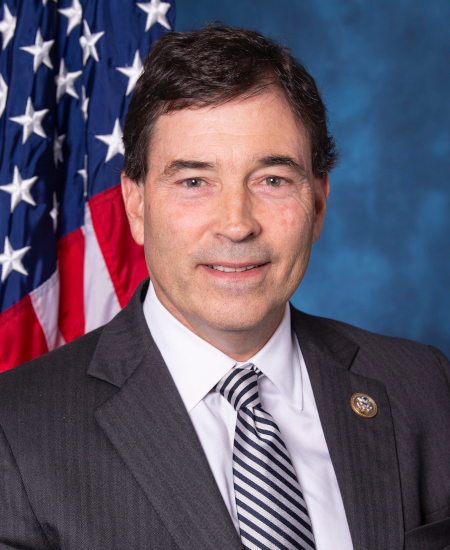
Photo of Troy Balderson
R United States House · District 12 · Ohio On the 2026 ballot

Rep. Troy Balderson

Compare
Total votes
2,837
all sessions
Attendance
99%
20 missed
Near the chamber average
With party
97%
of cast votes
Higher than 75% of chamber peers
Bipartisan score
2%
crosses aisle rarely
Lower than 76% of chamber peers
Sponsored
800
bills & resolutions
Lower than 76% of chamber peers
Committees
4
assignments
800 bills and resolutions

Sponsored bills

Total
800
Primary
52
Co-sponsor
748
This page
800
matching current filters
Co-sponsor HR 7176
Passed · Indiana House · Co-sponsor
Unlocking our Domestic LNG Potential Act of 2024

Maddy summaryHR 7176, the "Unlocking our Domestic LNG Potential Act of 2024," streamlines approval processes for U.S. liquefied natural gas (LNG) export terminals. It grants the Federal Energy Regulatory Commission (FERC) exclusive authority to approve or deny LNG export facility projects, requiring FERC to deem such exports "consistent with the public interest" unless specific legal exceptions apply. The bill explicitly preserves the President’s authority to block LNG exports under sanctions laws targeting countries designated as state sponsors of terrorism. This directly affects LNG companies seeking export permits and FERC’s regulatory role, without altering existing environmental or safety regulations.

Passed Feb 15, 2024 1 co-sponsor
Co-sponsor HRES 966
Passed · Indiana House · Co-sponsor
Condemning rape and sexual violence committed by Hamas in its war against Israel.

Maddy summaryHRES 966 is a symbolic resolution condemning alleged sexual violence committed by Hamas during its October 7, 2023, attack on Israel. It specifically references eyewitness accounts, forensic evidence, and Hamas fighters' admissions of ordering gang rape, sexual mutilation, and assault against Israeli civilians. The resolution calls for international condemnation of such acts as weapons of war, urges nations to criminalize sexual violence, and supports investigations into Hamas' actions. As a non-binding resolution, it does not create new laws or directly affect any individuals but formally expresses the House's position on the issue.

Passed Feb 14, 2024 1 co-sponsor
Co-sponsor HJRES 114
In committee · Indiana House · Co-sponsor
Providing for congressional disapproval under chapter 8 of title 5, United States Code, of the rule submitted by the Federal Highway Administration relating to "National Performance Management Measures; Assessing Performance of the National Highway System, Greenhouse Gas Emissions Measure".

Maddy summaryHJRES 114 is a joint resolution seeking congressional disapproval of a Federal Highway Administration (FHWA) rule that would have required tracking greenhouse gas emissions as part of assessing performance for the National Highway System. The rule, published in the Federal Register in December 2023, aimed to establish specific metrics for evaluating highway system performance, including emissions data. If approved, this resolution would nullify the rule, preventing the FHWA from implementing the emissions tracking requirement. This action directly affects how the FHWA measures highway system performance, specifically regarding environmental metrics.

In committee Feb 8, 2024 1 co-sponsor
Co-sponsor HR 7217
Failed · Indiana House · Co-sponsor
Israel Security Supplemental Appropriations Act, 2024

Maddy summaryThis bill appropriates over $15 billion in supplemental funding for U.S. security assistance to Israel following attacks in Israel. It includes specific allocations such as $5.2 billion for Israel's Iron Dome, David's Sling, and Iron Beam defense systems, as well as funds for military personnel, operations, and equipment across all branches of the military. The bill requires the Secretary of Defense and Secretary of State to submit regular reports to Congress detailing security assistance provided to Israel and designates all funding as "emergency requirements" under federal law. This funding directly supports U.S. security assistance programs with Israel to respond to regional security threats.

Failed Feb 6, 2024 1 co-sponsor
Co-sponsor HR 793
In committee · Indiana House · Co-sponsor
JOBS Act of 2023

Maddy summaryThe JOBS Act of 2023 would expand Federal Pell Grant eligibility to cover certain short-term job training programs that prepare students for high-demand careers. It defines "eligible job training programs" as those offering 150-600 hours of instruction over 8-15 weeks, aligned with in-demand industry sectors, and leading to recognized credentials that help students meet hiring requirements and take licensure exams. The bill would allow students in these programs to receive Pell Grants under standard terms, with the minimum Pell Grant amount reduced from 10% to 5% of the maximum. It also requires accrediting agencies to evaluate these programs and creates data-sharing between Education and Labor departments to track program effectiveness.

In committee Feb 6, 2024 1 co-sponsor
Co-sponsor HJRES 107
In committee · Indiana House · Co-sponsor
Providing for congressional disapproval under chapter 8 of title 5, United States Code, of the rule submitted by the Federal Communications Commission relating to "The Infrastructure Investment and Jobs Act: Prevention and Elimination of Digital Discrimination".

Maddy summaryHJRES 107 is a congressional resolution seeking to block a Federal Communications Commission (FCC) rule published on January 22, 2024 (89 Fed. Reg. 4128). The resolution aims to disapprove the FCC's rule implementing digital discrimination protections under the Infrastructure Investment and Jobs Act, which would have required internet providers to prevent discriminatory practices. If passed, this resolution would nullify the FCC rule, preventing it from taking effect under the Congressional Review Act (Chapter 8 of Title 5, U.S. Code). The bill directly affects the FCC's regulatory authority over digital discrimination enforcement in broadband services.

In committee Feb 2, 2024 1 co-sponsor
Co-sponsor HR 7101
In committee · Indiana House · Co-sponsor
FTC REDO Act

Maddy summaryHR 7101, the FTC REDO Act, rescinds the Federal Trade Commission's (FTC) January 2024 rule targeting auto retail scams and prohibits the FTC from finalizing future auto retail rules without meeting specific requirements. Before proposing new rules, the FTC must conduct a quantitative study on deceptive practices, consumer testing on new mandates, and an economic analysis of costs/benefits - each subject to 30 days of public comment and independent peer review. These studies must demonstrate evidence of unfair practices, show new rules enhance consumer protection without unduly burdening businesses, and compare the proposed rule to less burdensome alternatives. The bill directly affects the FTC's rulemaking process for auto retail, impacting how regulations on dealerships, disclosures, and consumer protections are developed.

In committee Feb 2, 2024 1 co-sponsor
Primary HJRES 110
In committee · Indiana House · Lead sponsor
Providing for congressional disapproval under chapter 8 of title 5, United States Code, of the rule submitted by the Department of the Treasury relating to "Coronavirus State and Local Fiscal Recovery Funds".

Maddy summaryThis resolution seeks congressional disapproval of a Treasury Department rule (88 Fed. Reg. 80584, November 2023) that established spending guidelines for $350 billion in federal Coronavirus State and Local Fiscal Recovery Funds. If passed, it would nullify the rule, preventing the Treasury from enforcing its specific restrictions on how states and localities could use these pandemic recovery funds. The bill does not alter the underlying funding program but targets the implementation rules through a procedural disapproval process under Title 5 of the U.S. Code. It directly affects the Treasury Department's authority to administer the fund distribution rules.

In committee Feb 1, 2024 0 co-sponsors
Co-sponsor HR 1633
In committee · Indiana House · Co-sponsor
RAIL Act

Reducing Accidents In Locomotives Act or the RAIL Act This bill addresses safety requirements for rail carriers and trains transporting hazardous materials. Specifically, the Department of Transportation (DOT) must issue safety regulations for trains carrying hazardous materials to require that rail carriers (1) provide state emergency response commissioners with advance notice and information about the hazardous materials; (2) reduce blocked rail crossings; and (3) comply with certain requirements regarding train length and weight specifications, track standards, speed restrictions, and response plans. DOT must also establish requirements for wayside defect detectors. These are used by railway systems alongside the tracks to detect defects and failures (e.g., wheel bearing failures). Current federal regulations do not require their use, but federal guidance does address their placement and use. Under the bill, DOT must issue regulations establishing requirements for the installation, repair, testing, maintenance, and operation of wayside defect detectors for each rail carrier operating a train carrying hazardous materials. Further, these regulations must establish requirements that safety placards be able to withstand heat in excess of 180 degrees. The bill also increases the maximum fines DOT may impose on rail carriers for violating safety regulations, requires DOT to update rail car inspection regulations and audit the federal inspection program, phases out certain railroad tank cars by May 1, 2028 (one year sooner than required under current law), expands training for local first responders, and imposes a new fee on certain rail carriers.

In committee Jan 29, 2024 1 co-sponsor
Co-sponsor HR 7079
In committee · Indiana House · Co-sponsor
Banning EPA’s Encroachment on Facilities Act

Maddy summaryThis bill prohibits the EPA from finalizing, implementing, or enforcing the December 13, 2023, proposed rule on water pollution standards for meat and poultry processing facilities under the Clean Water Act. It directly affects meat and poultry processing plants by blocking a specific EPA regulation that would have set new wastewater discharge limits. The key provision explicitly bans the EPA from moving forward with this rule or any "substantially similar" rule. The bill does not create new regulations but stops a specific EPA action from taking effect.

In committee Jan 25, 2024 1 co-sponsor
Showing 351 to 360 of 800 bills
Previous 1 … 35 36 37 … 80 Next