

Cosmetic Safety for Communities of Color and Professional Salon Workers Act of 2021 This bill imposes labeling requirements on cosmetics intended for professional use, requires research on health issues relating to cosmetics, and addresses related issues. The Food and Drug Administration (FDA) must require (1) the labeling for cosmetics intended for professional use to include the name of each ingredient in descending order of predominance; and (2) the manufacturer, distributor, or seller of such a cosmetic to provide this information on its website. The Occupational Safety and Health Administration must issue a standard requiring each manufacturer or importer selling a cosmetic intended for professional use to (1) obtain or develop a safety data sheet for the cosmetic in various languages; and (2) make the data sheet available to relevant distributors and employers, such as hair salon owners. The standard must also require employers to make the data sheet available to employees exposed to the product and provide to employees versions of the sheet in languages other than English upon request. The FDA must conduct (or award grants for) research into chemicals linked to adverse health effects and most commonly found in cosmetics that are (1) marketed to women and girls of color; or (2) used by professional nail, hair, and beauty salon workers. The FDA must also award grants to support research focused on designing safer cosmetic chemicals, such as those with no inherent toxicity. The FDA must take actions to ensure that cosmetics marketed to women and girls of color are in full compliance with FDA requirements.
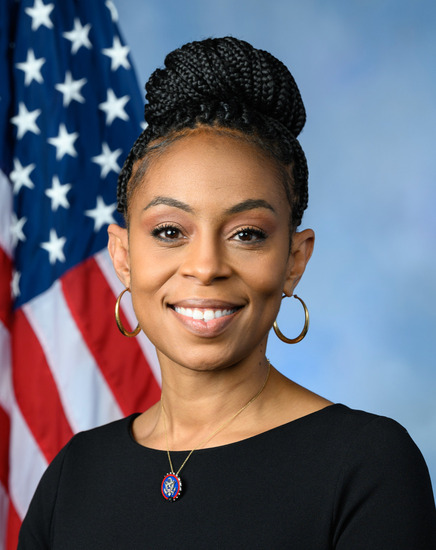
Rep. Shontel M. Brown
Sponsored bills
Animal Freedom from Testing, Experiments, and Research Act of 2021 or the AFTER Act of 2021 This bill requires federal research facilities to facilitate the adoption or nonlaboratory placement of certain warm-blooded animals (e.g., dogs, cats, monkeys, guinea pigs, hamsters, and rabbits) with animal rescue organizations, animal sanctuaries, animal shelters, or individuals. In order to be adopted or placed, the animals must (1) no longer be needed for research; (2) be suitable for release; (3) not be birds, rats, or mice.
Maddy summaryThis bill (HR 5430) would add wigs to Medicare's list of covered durable medical equipment. It directly affects Medicare beneficiaries who require wigs due to medical conditions like hair loss from cancer treatment, as certified by their doctor. The key provision requires a dermatologist, oncologist, or attending physician to provide written certification of medical necessity before Medicare covers the wig as part of rehabilitative treatment. This change expands existing coverage for cranial prostheses under Medicare's rules without altering the program's overall structure.
Indigenous Peoples' Day Act This bill designates Indigenous Peoples' Day as a legal public holiday in lieu of Columbus Day.
Israel Relations Normalization Act of 2021 This bill requires the Department of State to take certain actions promoting the normalization of relations between Israel, Arab states, and other relevant countries and regions. Specifically, the State Department must develop a strategy on expanding and strengthening the Abraham Accords (the term used to refer collectively to agreements between Israel and the United Arab Emirates and between Israel and Bahrain marking the public normalization of relations between the two Arab countries and Israel). The strategy must include a description of how the U.S. government will encourage further normalization of relations with Israel. In addition, the State Department must report on options for U.S. international efforts to promote the strengthening of ties between Israel, Arab states, and other relevant countries and regions. The State Department must also report on the status of the normalization of relations with Israel, including information on (1) laws that punish individuals for people-to-people relations with Israelis (i.e., anti-normalization laws), and (2) evidence of steps taken by Arab governments toward permitting or encouraging normalized relations between their citizens or residents and Israeli citizens.
This resolution expresses the sense of the House of Representatives that the United States shall recognize kind actions in our country, encourage kindness, spread love, and foster a culture of being kind to one another.
Closing the College Hunger Gap Act of 2021 This bill requires the Department of Education (ED) to collect data on the food and housing insecurity of college students. Specifically, ED must add questions that measure rates of food and housing insecurity to the National Postsecondary Student Aid Study. In addition, ED must collect data on student eligibility under the Supplemental Nutrition Assistance Program (SNAP). ED must also provide students with contact information for the state agency that administers SNAP in their state.
Medicare Negotiation and Competitive Licensing Act of 2021 This bill establishes several requirements relating to the prices of prescription drugs. Specifically, the bill requires the Centers for Medicare & Medicaid Services (CMS) to negotiate with pharmaceutical companies regarding prices for drugs covered under Medicare. (Current law prohibits the CMS from doing so.) If the CMS is unable to negotiate the price of a drug, such drug is subject to competitive licensing in order to further its sale under health insurance programs, notwithstanding existing government-granted exclusivities. The negotiated prices also apply to other federal health care programs, private health insurance, and the uninsured; pharmacies that charge more than the negotiated price for uninsured individuals are subject to civil penalties. Manufacturers must also comply with specified reporting requirements relating to prices and licensing, subject to civil penalties. The bill also institutes an excise tax on drugs for which the price spikes beyond a certain limit, subject to specified exemptions, as well as on drugs for which the price exceeds the negotiated price.
Equal Pay for Equal Work Act This bill establishes the National Equal Pay Enforcement Task Force to improve enforcement of equal pay laws.
Domestic Workers Bill of Rights Act This bill provides rights and protections for domestic workers (e.g., housekeepers, nannies, caretakers, personal assistants, and chauffeurs), including pay and leave rights, and health and safety protections. Specifically, the bill repeals the exemption of domestic live-in employees from certain minimum wage and maximum hour requirements. Employers must provide written notice of termination and provide at least 30 days of lodging and two weeks of severance pay to terminated live-in employees. Live-in employees also must be provided with reasonable access to telephone and internet service during their employment. The bill requires employers to provide domestic workers with a written agreement covering wages, sick leave, benefits, and other matters. Further, domestic workers may request and be granted changes to work schedules due to personal events. The bill also provides domestic workers with certain privacy rights, extends to domestic workers protections against discrimination in employment, and increases the federal medical assistance percentage (FMAP) for certain Medicaid-funded medical services provided by domestic workers. The Department of Labor must (1) award grants for a domestic worker national hotline for reporting emergencies, training on hazards facing domestic workers, and workforce investment activities for domestic workers; and (2) establish a Domestic Worker Wage and Standards Board to investigate standards in the domestic workers industry. Labor must publish online a document that describes the rights and protections for domestic workers under this bill.