

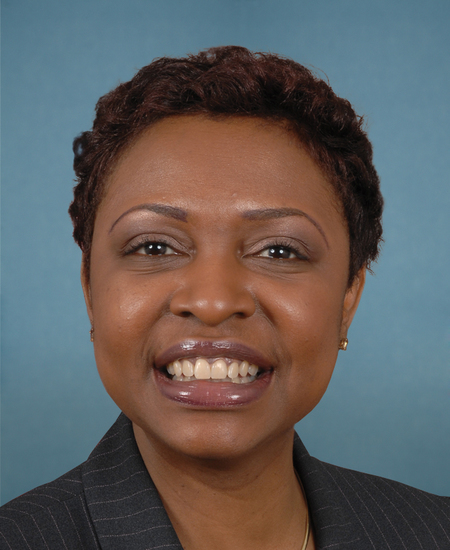
Photo of Yvette D. Clarke
D United States House · District 9 · New York On the 2026 ballot

Rep. Yvette D. Clarke

Compare
Total votes
2,837
all sessions
Attendance
99%
40 missed
Near the chamber average
With party
97%
of cast votes
Near the chamber average
Bipartisan score
2%
crosses aisle rarely
Near the chamber average
Sponsored
2,018
bills & resolutions
Higher than 91% of chamber peers
Committees
4
assignments
2,018 bills and resolutions

Sponsored bills

Total
2,018
Primary
83
Co-sponsor
1,935
This page
2,018
matching current filters
Co-sponsor HRES 1039
In committee · Indiana House · Co-sponsor
Supporting the goals and ideals of "National Black HIV/AIDS Awareness Day".

Maddy summaryHRES 1039 is a symbolic resolution supporting National Black HIV/AIDS Awareness Day observed annually on February 7. It highlights that Black Americans account for disproportionate HIV impacts (e.g., 39% of new diagnoses despite representing 12% of the U.S. population) and urges state/local health agencies to promote HIV testing, reduce stigma, and prioritize minority-led HIV services. The resolution encourages alignment with the National HIV/AIDS Strategy and emphasizes culturally competent care, but does not create new funding or enforceable requirements. It serves as a non-binding endorsement of existing efforts to address racial disparities in HIV prevention and treatment.

In committee Feb 4, 2026 1 co-sponsor
Co-sponsor HRES 1035
In committee · Indiana House · Co-sponsor
Condemning Federal workforce reductions that undermine preparedness, response, and recovery, and expressing concern regarding proposed future staffing cuts to the Federal Emergency Management Agency.

Maddy summaryHRES 1035 is a non-binding House resolution condemning recent and proposed workforce reductions at FEMA, which the resolution states endanger the agency's ability to prepare for, respond to, and recover from disasters. It specifically cites a 35% staffing shortage at FEMA (per GAO) and notes that over 2,000 permanent staff left FEMA in 2025, weakening disaster response during events like Hurricanes Helene and California wildfires. The resolution expresses concern that staffing cuts would delay aid, reduce assistance to vulnerable communities (including rural, coastal, and wildfire-prone areas), and undermine counterterrorism programs supporting first responders. It calls for a stable, adequately resourced FEMA workforce to ensure effective disaster management, without proposing new legislation or policy changes.

In committee Feb 4, 2026 1 co-sponsor
Co-sponsor HR 7341
In committee · Indiana House · Co-sponsor
GRAD Act

Maddy summaryThis bill creates new funding eligibility for Historically Black Colleges and Universities (HBCUs) and Predominantly Black Institutions (PBIs) that offer approved master's degree programs. It amends existing law to add specific categories (subsections S for HBCUs and F for PBIs) allowing these institutions to access federal funds previously restricted to certain program types. The key mechanism expands funding access by adjusting how remaining funds are allocated after initial disbursements. Directly affects qualifying HBCUs and PBIs meeting both the institution type and master's program criteria.

In committee Feb 4, 2026 1 co-sponsor
Co-sponsor HR 7345
In committee · Indiana House · Co-sponsor
Studying Disastrous Impacts of Mass Deportation Act

Maddy summaryHR 7345 directs the Congressional Budget Office (CBO) to study the long-term economic effects of immigration policies implemented beginning January 20, 2025. The CBO must assess impacts across specific sectors (like healthcare, agriculture, STEM fields), public safety concerns, demographic shifts, small business effects, and tax revenue at federal, state, and local levels. Federal agencies - including Homeland Security, the Bureau of Labor Statistics, and the IRS - must provide requested data to support this study. The report must be completed within 180 days of the bill’s enactment or by the end of the current congressional session, whichever comes first. This is a procedural study bill, not a policy change.

In committee Feb 4, 2026 1 co-sponsor
Co-sponsor HR 7352
In committee · Indiana House · Co-sponsor
PASTEUR Act of 2026

Maddy summaryThe PASTEUR Act of 2026 creates a new government contracting program to incentivize development of new antimicrobial drugs for treating drug-resistant infections. The Health and Human Services Secretary would award contracts to pharmaceutical sponsors meeting specific criteria on clinical benefits, innovation, and public health impact, with annual payments ranging from $75 million to $300 million (adjusted for inflation). Contract requirements include ensuring drug availability, tracking resistance data, promoting appropriate use, and maintaining supply chains. The bill also establishes antimicrobial stewardship programs for hospitals and outpatient facilities and improves surveillance of antimicrobial use and resistance. This legislation aims to address antibiotic resistance by creating financial incentives for new treatments and improving how antimicrobials are used and monitored.

In committee Feb 4, 2026 1 co-sponsor
Co-sponsor HR 7346
In committee · Indiana House · Co-sponsor
Drain ICE Act of 2026

Maddy summaryHR 7346, the Drain ICE Act of 2026, repeals specific funding provisions (sections 90003 and 100052) from the "One Big Beautiful Bill Act" and cancels all unspent funds allocated under those sections. This bill directly affects ICE’s detention budget by removing existing financial authority for detention operations. It does not change immigration enforcement practices or directly impact individuals; it solely modifies budgetary allocations. The bill focuses on eliminating funding mechanisms, not on policy changes for migrants or enforcement. (Procedural bill; summary limited to 2 sentences as specified.)

In committee Feb 4, 2026 1 co-sponsor
Co-sponsor HR 7335
In committee · Indiana House · Co-sponsor
Humanitarian Standards for Individuals in ICE and CBP Custody Act

Maddy summaryHR 7335 establishes comprehensive humanitarian standards for individuals held in U.S. Immigration and Customs Enforcement (ICE) and U.S. Customs and Border Protection (CBP) custody. The bill requires facilities to provide immediate health screenings within 12 hours (6 hours for high-risk individuals like children, pregnant people, or those with medical conditions), ensure access to adequate water, sanitation, food (with 2,000+ calories daily for adults), and age-appropriate shelter. It mandates specific facility standards including separate housing for males and females, accessible accommodations for people with disabilities, daily outdoor access for those detained over 48 hours, and proper medical equipment and personnel on-site. The bill also requires regular inspections, staff training on humanitarian protocols, and public reporting of sexual abuse complaints. These standards directly affect all individuals detained by ICE or CBP, with special protections for vulnerable groups like children, pregnant people, and those with medical needs.

In committee Feb 4, 2026 1 co-sponsor
Co-sponsor HR 7265
In committee · Indiana House · Co-sponsor
Vote by Mail Tracking Act

Maddy summaryHR 7265, the Vote by Mail Tracking Act, requires all government entities sending mail-in ballots for federal elections to use a standardized Postal Service barcode on ballot envelopes. This barcode enables tracking of each individual ballot, while also mandating specific envelope designs and machineability standards set by the Postal Service. The bill applies to all mail-in ballots for federal office elections starting in 2026, but excludes Federal write-in absentee ballots under the Uniformed and Overseas Citizens Absentee Voting Act. The Postmaster General must provide compliance guidance to government entities by June each year to implement the tracking system.

In committee Feb 4, 2026 1 co-sponsor
Co-sponsor HR 5658
In committee · Indiana House · Co-sponsor
Child Care for Every Community Act

Maddy summaryHR 5658, the Child Care for Every Community Act, establishes a federal framework to create universal, high-quality child care and early learning programs available to all young children not yet required to attend school. The bill requires that covered children (children below compulsory school age) be entitled to participate in these programs, with no fees for low-income families and sliding-scale fees for others based on family income. Key provisions include requiring full-working-day, full-calendar-year care; setting national quality standards for staff qualifications and facilities; mandating comprehensive services including health, nutrition, and family support; and requiring coordination with schools to support children's transitions to kindergarten. The bill directly affects families seeking child care, child care providers, and local communities that would administer these programs through designated "prime sponsors."

In committee Feb 4, 2026 1 co-sponsor
Co-sponsor HR 4242
In committee · Indiana House · Co-sponsor
Innovate Less Lethal to De-Escalate Tax Modernization Act

Maddy summaryThis bill exempts certain less-than-lethal projectile devices from federal sales taxes and National Firearms Act restrictions. It directly affects manufacturers, importers, and producers of these devices, which are defined as non-lethal tools (like rubber bullets or beanbag rounds) designed not to cause serious injury and unable to be easily converted to use standard firearm ammunition. Key mechanisms include a 90-day classification process for manufacturers seeking exemption, an annual public list of approved devices, and annual congressional reports on devices excluded from the exemption. The policy change applies to devices meeting specific safety criteria, such as projectile velocity limits and design features preventing misuse as conventional weapons.

In committee Feb 2, 2026 1 co-sponsor
Showing 191 to 200 of 2,018 bills
Previous 1 … 19 20 21 … 202 Next