

This resolution recognizes the significant impact and legacy of Cecil Corbin-Mark in the environmental justice community and further recognizes that climate change most severely impacts vulnerable and disadvantaged communities. In addition, the resolution urges the U.S. government to work with its global partners to pursue policies that prioritize climate adaptation among vulnerable and disadvantaged communities.
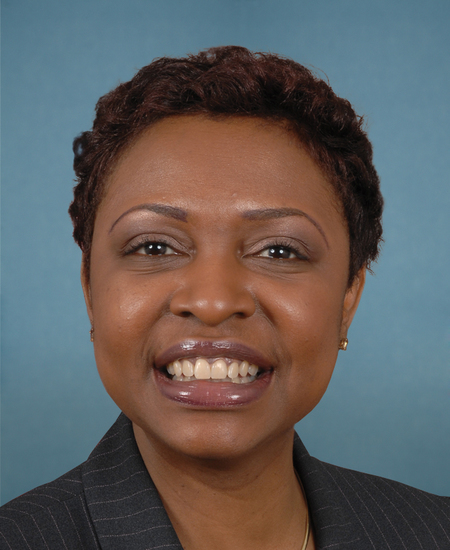
Rep. Yvette D. Clarke
Sponsored bills
This concurrent resolution recognizes the disparity in wages paid to Black women and its impact on women, families, and the nation, and reaffirms Congress' support for ensuring equal pay and closing the gender wage gap.
Equal Pay for Equal Work Act This bill establishes the National Equal Pay Enforcement Task Force to improve enforcement of equal pay laws.
Emergency Child and Adult Nutrition Assistance Act of 2021 This bill provides funding for and extends through June 2021 programs that, during the COVID-19 emergency, reimburse certain operational costs of child and adult care food programs and school meals programs. Under the bill, funding allocated to states remains available through FY2022.
Anti Digital Redlining Act of 2021 This bill prohibits an internet service provider (ISP) from discriminating in decisions about deploying or upgrading broadband service in a particular geographic area based on residents' race, income, or other factors (i.e., digital redlining). It also prevents some restrictions on the choice of telecommunications service providers in multi-dwelling units. The Federal Communications Commission (FCC) must solicit public comments on criteria to determine whether an ISP is discriminating in deployment or upgrading decisions and related matters. Based on the comments, the FCC must issue rules to prevent such discrimination. An individual may file a complaint of discriminatory conduct that violates the bill's provisions or applicable rules with the FCC. The bill authorizes the FCC to remedy violations, including by requiring (subject to limitations) an ISP to provide services in a geographic area. Additionally, the bill prohibits ISPs and multichannel video programming distributors (e.g., cable operators) from engaging in certain conduct that restricts a multi-dwelling unit resident's choice of internet, cable, and related services. Units must also allow ISPs and distributors reasonable access to their premises. The bill permits residents to sue for violations and otherwise provides for enforcement through FCC administrative processes. The FCC must also analyze the use of franchise agreements between telecommunications service providers and municipal governments on the price of, quality of, and competition among telecommunications services in the local market. These agreements set out the terms under which a telecommunications service provider is authorized by a regulator to operate.
Expanding Broadcast Ownership Opportunities Act of 2021 This bill requires the Federal Communications Commission (FCC) to take certain actions to increase diversity of ownership in the broadcasting industry and establishes a related tax incentive. Specifically, the bill requires the FCC to report to Congress regarding (1) recommendations for increasing the total number of broadcast stations that are owned or controlled by members of minority groups or women, (2) the total number of broadcast stations that are owned or controlled by members of minority groups or women, and (3) whether there is a nexus between diversity of ownership or control of broadcast stations and the diversity of the viewpoints expressed on the stations. In addition, the bill allows companies engaged in the qualifying sale of a broadcast station to receive favorable tax treatment by electing nonrecognition of the gain or loss resulting from the sale. To qualify for this treatment, the sale must result in or preserve ownership and control of a broadcast station by socially disadvantaged individuals.
Quiet Communities Act of 2021 This bill requires the Environmental Protection Agency to reestablish an Office of Noise Abatement and Control to promote the development of local noise control programs, carry out research, and develop and disseminate educational materials, among other duties.
Safe School Drinking Water Act This bill requires the Environmental Protection Agency to establish a program to award grants to assist local educational agencies in installing and maintaining filtration stations (e.g., drinking fountains) at schools and child care programs.
Rescinding DHS' Waiver Authority for Border Wall Act This bill rescinds the authority of the Department of Homeland Security to waive legal requirements in order to ensure the expeditious construction of barriers and roads in the vicinity of the U.S. border.
Domestic Workers Bill of Rights Act This bill provides rights and protections for domestic workers (e.g., housekeepers, nannies, caretakers, personal assistants, and chauffeurs), including pay and leave rights, and health and safety protections. Specifically, the bill repeals the exemption of domestic live-in employees from certain minimum wage and maximum hour requirements. Employers must provide written notice of termination and provide at least 30 days of lodging and two weeks of severance pay to terminated live-in employees. Live-in employees also must be provided with reasonable access to telephone and internet service during their employment. The bill requires employers to provide domestic workers with a written agreement covering wages, sick leave, benefits, and other matters. Further, domestic workers may request and be granted changes to work schedules due to personal events. The bill also provides domestic workers with certain privacy rights, extends to domestic workers protections against discrimination in employment, and increases the federal medical assistance percentage (FMAP) for certain Medicaid-funded medical services provided by domestic workers. The Department of Labor must (1) award grants for a domestic worker national hotline for reporting emergencies, training on hazards facing domestic workers, and workforce investment activities for domestic workers; and (2) establish a Domestic Worker Wage and Standards Board to investigate standards in the domestic workers industry. Labor must publish online a document that describes the rights and protections for domestic workers under this bill.