

Maddy summaryHR 4474, the Equal Shot Act of 2025, prohibits the Small Business Administration (SBA) from denying financial assistance - such as loans or guarantees - to firearm businesses solely because of their industry. It directly affects firearm manufacturers, distributors, trade associations, and affiliated entities like shooting ranges or training providers. The bill requires the SBA to treat these applicants equally under existing law, removing any policy that would block them based on their connection to firearms. This is a concrete policy change ensuring firearm-related businesses have the same access to SBA programs as other eligible applicants.
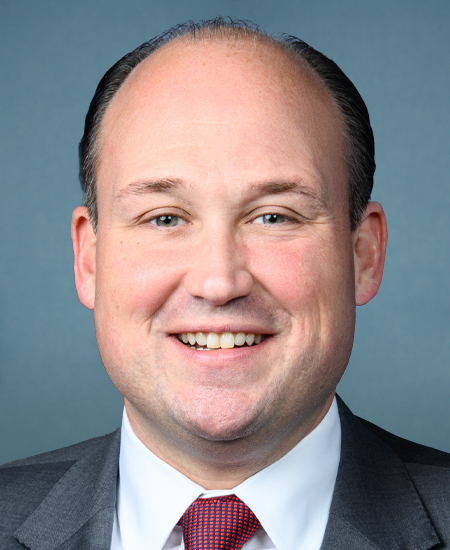
Rep. Nicholas A. Langworthy
Sponsored bills
Maddy summaryHR 4382 authorizes the U.S. Mint to produce commemorative coins for the 2028 Los Angeles Olympics/Paralympics and 2034 Salt Lake City Winter Olympics/Paralympics. It specifies gold, silver, and half-dollar coin designs with defined mintage limits (e.g., up to 100,000 $5 gold coins for each event), all bearing inscriptions like "2028" or "2034" and standard coin features. A surcharge ($5-$50 per coin) is added to sales, with all funds directed to the respective Olympic committees to support event hosting and legacy programs like youth sports. The bill ensures no net cost to the government by requiring surcharge revenues to cover all design, production, and marketing expenses before funds are disbursed.
Maddy summaryHRES 570 is a House resolution commending Petty Officer 3rd Class Scott Ruskan for rescuing 165 people during catastrophic July 2025 flooding in central Texas. The resolution honors Ruskan, a Coast Guard Aviation Survival Technician from Air Station Corpus Christi, for his role as the sole triage coordinator during the disaster. It recognizes his "exceptional courage" and "selflessness" in saving lives during the Guadalupe River flooding that caused extensive damage and loss of life. As a ceremonial resolution, it does not create new laws or policies but formally expresses the House's gratitude for Ruskan's service.
Maddy summaryHRES 571 is a symbolic resolution passed by the U.S. House of Representatives to commemorate the one-year anniversary of the July 13, 2024, attempted assassination of President Donald J. Trump in Butler, Pennsylvania. It condemns two assassination attempts against the President (in Butler and West Palm Beach), honors victims Corey D. Comperatore (who died shielding his family), David Dutch, and James Copenhaver (who were critically injured), and expresses gratitude to first responders. The resolution also condemns incitement of violence against political officials and calls for unity against political violence. As a non-binding resolution, it does not create new laws or policies but formally states the House’s position on these events.
Maddy summaryThe PBM Reform Act of 2025 aims to increase transparency and fairness in pharmacy benefit manager (PBM) operations within Medicare Part D and Medicaid programs. The bill requires Medicare Part D plans to allow any pharmacy meeting standard terms to join their networks, establishes "essential retail pharmacies" in underserved areas (with limited pharmacy access), and mandates detailed reporting on drug pricing, rebates, and reimbursement rates. It creates a process for pharmacies to report PBM violations of reasonable contract terms and prohibits "spread pricing" in Medicaid, where PBMs retain the difference between what they pay pharmacies and what they charge plans. These provisions aim to improve pharmacy access for Medicare beneficiaries and ensure fairer reimbursement practices for pharmacies.
Maddy summaryThis bill requires drug manufacturers to pay rebates to Medicare when their "selected drugs" (cancer and complex therapies subject to negotiated maximum fair prices) are used. Manufacturers must calculate rebates based on the difference between current Medicare payment rates (ASP+6) and new negotiated rates (MFP+6), covering the gap for beneficiaries. This lowers patient coinsurance from the current 20% of ASP+6 to 20% of MFP+6 for these specific drugs during the negotiated price period. The rebates are paid to the Medicare trust fund and apply to Medicare Part B beneficiaries using these drugs, directly affecting drug manufacturers and patients covered under Medicare Part B.
Maddy summaryHR 4234 prohibits U.S. officials from temporarily allowing certain individuals to enter the country at the border. It specifically bans parole (temporary entry) for refugees and individuals identified as having terrorism links, being on terror watchlists, or posing a national security risk due to potential ties to terrorism. The bill defines "known terrorist" (arrested/convicted for terrorism), "special interest alien" (with potential terrorism nexus), and "suspected terrorist" to establish these restrictions. These provisions apply to people seeking entry at the border who meet these criteria, replacing existing parole authority for such cases.
Maddy summaryThe CONNECT for Health Act of 2025 expands Medicare telehealth coverage by removing geographic restrictions that limited where patients could receive care, expanding the types of health care providers who can offer telehealth services, and eliminating the requirement for an in-person visit before receiving telemental health services. The bill includes specific provisions to support telehealth use for Native American health facilities, rural health clinics, and Federally Qualified Health Centers. It requires the Centers for Medicare & Medicaid Services to collect and publish data on telehealth usage and impacts, and to develop resources to improve accessibility for people with disabilities and limited English proficiency. Program integrity measures are added to monitor telehealth billing practices and prevent fraud while maintaining coverage for telehealth services during public health emergencies.
Maddy summaryHR 4110, the Organic Dairy Data Collection Act, requires the U.S. Department of Agriculture (USDA) to establish new data collection systems for organic dairy producers. Specifically, it mandates the Secretary of Agriculture to support programs gathering cost-of-production data for organic milk (including feed costs like corn and soybeans), create a monthly Organic All Milk Prices Survey analogous to existing conventional milk surveys, and publish periodic reports with organic-specific data such as state-level costs, regional production volumes, mailbox prices for top dairy regions, and organic feed prices. These reports must be published using existing USDA data services (National Agricultural Statistics Service, Economic Research Service, Agricultural Marketing Service) and include the top 6 organic dairy-producing regions. The bill directly affects organic dairy farmers by creating standardized, publicly available data on their production costs and market prices, which was previously not systematically reported.
Maddy summaryHR 4072, the Pro Codes Act, requires standards development organizations (like ASTM or IEEE) to make technical standards publicly accessible online at no cost when those standards are incorporated by reference into federal, state, or local laws or regulations. This applies to over 23,000 standards currently referenced in the Code of Federal Regulations, ensuring the public can read them freely while allowing organizations to maintain revenue through paid subscriptions. The bill amends copyright law to mandate this free online access - including searchable features - within a reasonable timeframe after an organization learns a standard is referenced, without disrupting their business model. It balances public access with copyright protection, placing the burden of proof on anyone claiming an organization failed to comply. The law directly affects standards organizations, government agencies, and the public who rely on these referenced standards for safety, innovation, and compliance.