

Maddy summaryThe HEAR Act of 2026 makes it illegal for most people to import, sell, manufacture, transfer, or possess firearm silencers and mufflers. The law allows exceptions for law enforcement officers, campus security personnel, nuclear facility employees, and licensed manufacturers conducting authorized testing. To help individuals comply with the new restrictions, the bill requires the Attorney General to create a nationwide buy-back program that pays people who surrender their silencers. These changes would take effect 90 days after the bill is signed into law.
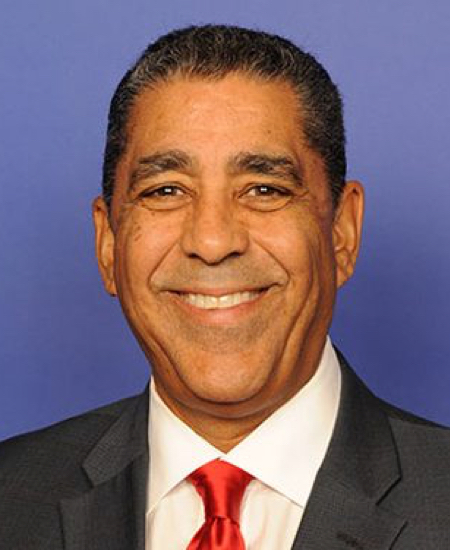
Rep. Adriano Espaillat
Sponsored bills
Maddy summaryThe Artificial Intelligence Environmental Impacts Act of 2026 directs the Environmental Protection Agency to study and report on the environmental effects of artificial intelligence, including energy and water use, pollution, and electronic waste. This bill requires large data centers to annually submit detailed public reports on their resource consumption and environmental footprint, with penalties for non-compliance. Additionally, it establishes a stakeholder consortium to develop standardized methods for measuring these impacts and to identify ways to promote beneficial uses of AI while reducing negative effects. The legislation aims to increase transparency and accountability regarding the growing environmental costs associated with AI infrastructure and operations.
Maddy summaryThis resolution expresses support for designating June 5, 2026, as National Gun Violence Awareness Day and June 2026 as National Gun Violence Awareness Month. The bill calls on the public to wear orange on the designated day to honor victims and promote awareness of gun safety. It highlights statistics on gun-related deaths and injuries to underscore the need for community discussions on making neighborhoods safer.
Maddy summaryThis resolution expresses support for designating May 2026 as Mental Health Awareness Month to highlight the importance of mental well-being and reduce stigma. It does not create new laws or allocate funding but serves as a formal statement acknowledging the rising rates of mental illness, suicide, and disparities in care across the United States. The text cites various statistics regarding anxiety, depression, and access to treatment to underscore the need for public awareness and continued efforts by medical and community organizations. Ultimately, the bill encourages citizens and institutions to use this month to promote mental health resources and support for individuals and families affected by mental illness.
Maddy summaryThe Earned Benefits Equality and Family Reunification Act establishes a 10-year demonstration program allowing Medicare beneficiaries to voluntarily use their benefits for health care services in selected foreign countries. This initiative targets individuals who are relocating abroad or living overseas to help them reunify with family while ensuring that the quality and cost of care in these nations meet specific American standards. The program covers premiums, deductibles, and out-of-pocket costs for services in at least 11 initial countries, including Canada, Germany, India, and Israel, with payments capped at the equivalent cost of similar services in the United States. To manage the program, the Secretary of Health and Human Services will consult with various stakeholders, require participating physicians to undergo fraud training, and conduct annual evaluations to assess improvements in care quality and cost savings before considering any expansion.
Maddy summaryThis joint resolution seeks to officially reject a final rule issued by the Department of Education regarding federal student loan programs. If passed, the measure would prevent the new regulations from taking effect, leaving the previous rules in place. The bill directly impacts borrowers, lenders, and the Department of Education by nullifying the specific changes outlined in the "Reimagining and Improving Student Education" proposal. It is a procedural action that uses the Congressional Review Act to disapprove the agency's policy without altering the underlying law.
Maddy summaryThe Subpoena Abuse Prevention Act restricts how federal agencies can use administrative subpoenas to obtain phone and app records from service providers. It requires agencies to identify a specific person or account before requesting data, bans subpoenas aimed at investigating or retaliating against constitutionally protected activities like free speech, and mandates that agencies certify the subpoena's legitimate purpose. The law also allows service providers to notify customers about the subpoena and consult with lawyers, unless a court order specifically prevents such notification. Additionally, federal agencies must publicly report annually on the number of subpoenas issued and the total accounts affected.
Maddy summaryThis bill authorizes the U.S. Mint to produce commemorative $5 gold and $1 silver coins marking the 25th anniversary of the September 11, 2001, terrorist attacks. The coins must feature designs honoring victims and first responders (including the inscription "Never Forget") and will be sold only during 2027-2028. All surcharges ($35 per gold coin, $10 per silver coin) collected from sales will fund the National September 11 Memorial and Museum at the World Trade Center, with no net cost to the federal government. The coins are legal tender but primarily intended for collectors, not circulation.
Maddy summaryThe Smithsonian American Women’s History Museum Act authorizes the creation of a new Smithsonian museum dedicated to women’s history, to be located within the National Mall Reserve in Washington, D.C. If the site is managed by another federal agency, the bill requires that agency to transfer the land after notifying Congress and relevant committees. The museum must ensure exhibits and programs accurately represent diverse women’s experiences by consulting a broad range of experts and community voices. The Smithsonian will submit biennial reports to Congress detailing how the museum meets these representation standards.
Maddy summaryThe No Taxpayer-Funded Settlement Slush Funds Act of 2026 prohibits the use of federal money to pay specific settlements involving high-ranking government officials and their close associates. It bars payments to the President, Vice President, their immediate families, cabinet members, senior executive staff, political appointees, and individuals connected to these roles, as well as any entity owned by the President or Vice President. Additionally, the bill restricts settlements related to claims about the January 6 Capitol attack, foreign election interference, or previously dismissed lawsuits, while requiring Treasury reports for large settlements and allowing the government to seek repayment if rules are broken.