

Maddy summaryHRES 166 is a non-binding House resolution expressing U.S. support for the Iranian people's desire for a democratic, secular, and nonnuclear republic. It condemns the Iranian regime's terrorism, regional proxy wars, internal suppression of ethnic and religious minorities, and human rights abuses - including executions and repression of women-led protests. The resolution calls for holding the regime accountable through sanctions, supports the Ten-Point Plan for Iran’s democratic transition, and urges protection for Iranian political refugees in Albania. It does not create new laws but affirms U.S. policy alignment with Iranian protesters' demands.
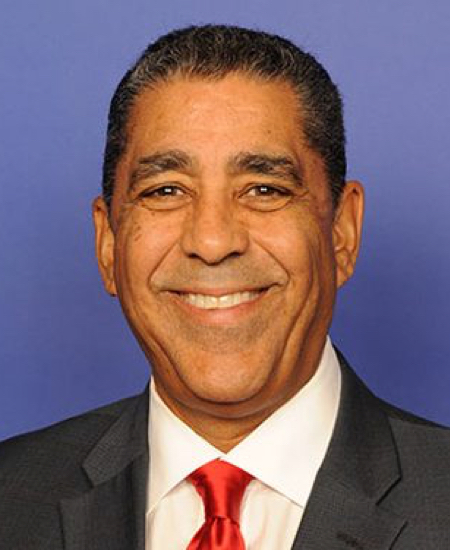
Rep. Adriano Espaillat
Sponsored bills
Maddy summaryHR 1638, the CROWN Act of 2025, prohibits discrimination based on hair texture or hairstyle that is commonly associated with race or national origin, particularly affecting Black individuals who wear natural or protective styles like braids, locs, cornrows, twists, or Afros. The bill explicitly expands protections under existing federal civil rights laws (including the Civil Rights Act of 1964 and the Fair Housing Act) to cover hair-based discrimination in federally funded programs, housing, public accommodations, employment, and equal rights. It requires schools, employers, and other entities receiving federal funds to eliminate grooming policies that disproportionately target these hairstyles. The law clarifies that such discrimination violates federal law and provides enforcement through existing civil rights mechanisms.
Maddy summaryHR 1567 requires the Secretary of the Interior to conduct a study assessing the feasibility of establishing the African Burial Ground International Memorial Museum and Educational Center at New York City's African Burial Ground National Monument. The study will examine factors like available collections (including DNA samples from remains), potential locations (such as 22 Reade Street), community involvement, financial planning, and collaboration opportunities with institutions like the National Museum of African American History and Culture. The Secretary must submit a report to Congress within three years, detailing findings on costs, location options, and recommendations for the museum's potential development. This bill does not create the museum but sets the process for evaluating its future establishment.
Maddy summaryEthan's Law requires gun owners to store firearms securely in homes where minors live or where residents are legally prohibited from owning guns. It makes it unlawful to leave firearms unsecured if a minor or ineligible person could access them, with fines of $500 per violation and harsher penalties if injury or death occurs. The bill creates a federal grant program to help states implement similar secure storage laws and treats unsafe storage as negligence in legal cases. It directly affects households with children or residents who cannot legally possess firearms, aiming to reduce accidental shootings and unauthorized access.
Maddy summaryHR 1568 would establish the African Burial Ground International Memorial Museum and Educational Center at the National Historic Landmark site in Lower Manhattan, New York City, honoring the approximately 20,000 enslaved Africans buried there. The museum would examine African cultural traditions brought to the U.S. by enslaved people, explore the institution of slavery through exhibits and educational programs, and be associated with the National Museum of African American History and Culture. The National Park Service would operate the museum, with the Secretary of the Interior managing the facility in consultation with an advisory council composed of federal, state, and local officials. The bill authorizes $15 million for fiscal year 2025 and additional funding for subsequent years to support the museum's construction, operation, and educational programs. The museum would be located on property adjacent to the National Monument established at the burial ground site.
Maddy summaryHRES 159 is a symbolic resolution expressing the U.S. House of Representatives' support for designating February 24-28, 2025, as "Public Schools Week." It does not create new laws or allocate funds but aims to highlight the importance of public schools in communities. The resolution cites reasons such as public schools serving 90% of U.S. students, fostering critical thinking, and requiring equitable funding - though these are context, not policy changes. It directly affects public schools and their communities by raising awareness of their role in education. As a non-binding resolution, it has no direct impact on school operations or funding.
Maddy summaryThis resolution (HRES 146) is a formal, non-binding statement of recognition by the U.S. House of Representatives honoring the Harlem Renaissance - a pivotal cultural, social, and political movement in American history. It commemorates the movement's role in reshaping African American identity, advancing civil rights, and fostering artistic expression from the 1910s through the mid-1930s, highlighting contributions in literature, music, visual arts, and social thought. The resolution specifically recognizes figures like Langston Hughes, Duke Ellington, and organizations such as the NAACP, while supporting efforts to preserve Harlem's cultural legacy. It has no policy impact or direct effect on individuals or communities, serving solely as a symbolic tribute to historical significance.
Maddy summaryHR 1488 repeals two laws that authorized U.S. military force against Iraq: the 1991 Gulf War authorization and the 2002 Iraq War authorization. This bill removes the legal basis for military operations under these specific resolutions, directly affecting how future U.S. military actions in Iraq could be justified. The key provision is the direct repeal of both resolutions from federal law, eliminating their continued legal effect. As a result, any new military action in Iraq would require fresh congressional authorization rather than relying on these repealed laws.
Maddy summaryHR 1410 expands access to mental health care for 9/11 responders and survivors by allowing licensed mental health providers (not just physicians) to conduct initial health evaluations and certifications under the World Trade Center Health Program. It adjusts the program’s funding formula to account for changing enrollment numbers by linking annual funding to the previous year’s enrollment ratio, and clarifies that deceased individuals are excluded from enrollment counts. The bill also extends the timeframe for adding new health conditions to the program’s list and requires a 2028 report assessing long-term funding needs through 2090. These changes aim to streamline eligibility, improve care access, and ensure sustainable funding for the program.
Maddy summaryThis bill updates federal vehicle safety standards to permit pulsating light systems on high-mounted stop lamps, directly affecting vehicle manufacturers and safety regulators. It requires the Transportation Secretary to issue new regulations within 180 days establishing performance rules for these systems. The key provision defines a "pulsating light system" as one that emits rapid pulses (max 4 pulses within 1.2 seconds) when brakes are applied, then switches to steady light, with a mandatory 5-second lockout period before pulses can repeat after brake release. The bill amends Federal Motor Vehicle Safety Standard 108 to formally allow this technology under specific technical parameters.