

Maddy summaryHR 7322, the True Shutdown Fairness Act, requires federal agencies to pay regular wages to most employees and contractor workers during government shutdowns in fiscal year 2026, instead of furloughing them. It applies to all standard federal employees (excluding those on emergency duty) and contractor workers whose jobs would normally halt during a funding gap. Agencies must pay covered employees within 7 days of the bill's enactment for ongoing shutdowns, and contractors receive reimbursement for costs incurred keeping workers paid. The bill also prohibits agencies from implementing layoffs or placing employees on administrative leave for more than 10 days during a shutdown.
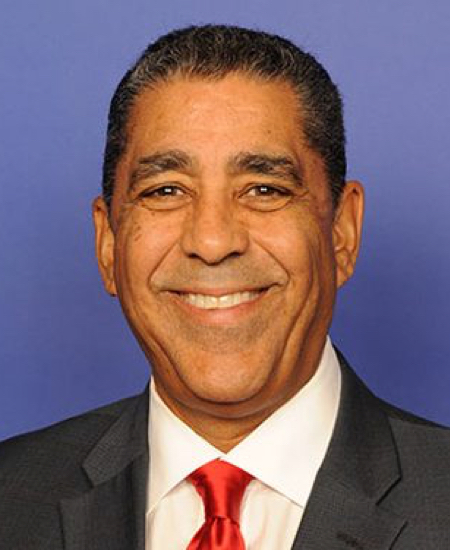
Rep. Adriano Espaillat
Sponsored bills
Maddy summaryHJRES 144 is a congressional disapproval resolution targeting a specific rule issued by the Department of Veterans Affairs (VA) on December 31, 2025, which addressed "Reproductive Health Services" (90 Fed. Reg. 61310). This resolution directs Congress to disapprove the VA rule under Chapter 8 of Title 5, U.S. Code, meaning the rule would have no legal effect if passed. The bill directly affects the VA's implementation of reproductive health services for veterans, as it seeks to nullify the agency's existing policy. This is a procedural measure, not a substantive policy change, aimed solely at blocking the VA's rule through congressional action.
Maddy summaryHR 7252, the Restoring Community Trust Act of 2026, repeals Section 642 of the 1996 Illegal Immigration Reform and Immigrant Responsibility Act (8 U.S.C. 1373). This provision currently requires state and local government agencies to share information about individuals with federal immigration authorities. The bill removes this mandate, allowing states and localities to decide independently whether to share such information with federal immigration officials, consistent with their own laws. It does not prohibit voluntary cooperation but aims to restore state authority over internal operations and reduce legal uncertainty for local governments.
Maddy summaryHCONRES 68 would require the President to remove U.S. military forces from Venezuela unless Congress has explicitly authorized their use through a declaration of war or a specific law. This applies to any U.S. Armed Forces currently stationed in Venezuela without such authorization. The resolution is based on the War Powers Resolution, which mandates congressional oversight of military deployments. It directs the immediate withdrawal of unapproved forces without adding new time limits or conditions.
Maddy summaryThis bill creates a tax credit for businesses selling products made with U.S.-grown cotton. The credit equals 24% of the cotton's market value if processed only in the U.S. or in countries with U.S. trade deals, or 18% for other processing locations. To qualify, cotton must be digitally traced from U.S. farms to finished products and certified by the USDA as meeting origin requirements. It directly affects clothing and textile manufacturers selling qualifying products in the U.S. market.
Maddy summaryThe Language Access for All Act of 2026 requires federal agencies to ensure meaningful access to government services for people with limited English proficiency (LEP). Agencies must translate vital documents into languages commonly spoken in the U.S. (based on Census data), provide multilingual digital tools, interpretation services, and use bilingual staff as an alternative to professional interpreters. Each agency must create a language access plan within one year, detailing how it will serve LEP populations - including during emergencies - and annually certify compliance with technical standards. Noncompliance is treated as discrimination under civil rights law, with enforcement by the Department of Justice.
Maddy summaryHR 4368 authorizes U.S. security assistance to 13 Caribbean nations (including Jamaica, Dominican Republic, and Barbados) to strengthen local law enforcement, combat gangs and trafficking, and improve community safety. It provides $88 million annually (2025-2029) for programs like border security cooperation, anti-corruption training for courts and police, youth crime prevention, and disaster response coordination. The initiative targets government and civil society partners in these countries to address transnational crime, corruption, and security vulnerabilities. It requires annual progress reports to Congress on funding use and outcomes.
Maddy summaryThis bill establishes two new programs under the National Affordable Housing Act to increase affordable rental housing on property owned by faith-based organizations and institutions of higher education. It provides $25 million annually (2026-2031) for technical assistance to help these groups remove barriers to developing housing for low-income households, including those at risk of homelessness, veterans, and people with disabilities. Additionally, it creates $50 million annually in competitive challenge grants for local governments and states to adopt policies removing barriers and produce housing for households earning below 60% of area median income, with priority for well-resourced neighborhoods. The programs require public planning and reporting to ensure funds directly support affordable housing development on eligible properties.
Maddy summaryHR 7124 prohibits the use of specific mobile biometric apps (Mobile Fortify and Mobile Identify) outside U.S. ports of entry, restricting them solely for border identification. It requires Homeland Security to remove these apps from all non-Department devices, ban sharing with other agencies, and destroy U.S. citizens' captured biometric data (photos/fingerprints) within 12 hours of collection at ports of entry. The bill directly affects U.S. citizens whose biometric data is collected during border processing. Key mechanisms include mandatory app removal, remote deactivation of unauthorized installations, and strict data destruction timelines.
Maddy summaryHRES 1004 is a symbolic House resolution honoring Dr. Martin Luther King, Jr.'s legacy by celebrating diversity and condemning hate. It specifically calls for the House to celebrate his 97th birthday on January 19, 2026, and to condemn harassment, discrimination, or prejudice targeting Black Americans, Indigenous people, Jewish, Asian-American/Pacific Islander, Muslim, Hispanic/Latino communities, and LGBTQ+ individuals. The resolution affirms Dr. King’s teachings on unity and equality but does not create new laws or impose obligations on any entity. As a ceremonial resolution, it has no legal effect and directly affects no individuals or groups.